In November, a year after ChatGPT’s release, a relatively unknown Chinese start-up leaped to the top of a leaderboard that judged the abilities of open-source artificial intelligence systems. The Chinese firm, 01.AI, was only eight months old but had deep-pocketed backers and a $1 billion valuation and was founded by a well-known investor and technologist, Kai-Fu Lee. In interviews, Mr. Lee presented his A.I. system as an alternative to options like Meta’s generative A.I. model, called LLaMA. There was just one twist: Some of the technology in 01.AI’s system came…
Tag: Foreign Investments
Silicon Valley Venture Capitalists Are Breaking Up With China
DCM Ventures, a Silicon Valley venture capital firm, began investing in China’s start-ups in 1999. The move reaped such blockbuster returns that in 2021, DCM said it planned to “double down” on its strategy of investing in China, the United States and Japan. Yet when DCM set out to raise money last fall for a new fund focused on very young companies and promoted its “cross-Pacific” expertise, the firm described plans to invest in the United States, Japan and South Korea, according to a fund-raising memo that was viewed by…
China’s Investors Are Losing Faith in Its Markets and Economy
Like many Chinese people, Jacky hoped that he could make enough money investing in China’s stock markets to help pay for an apartment in a big city. But in 2015 he lost $30,000, and in 2021 he lost $80,000. After that, he shut down his trading account and started investing in Chinese funds that track stocks in the United States. It’s a perilous time for investors in China. Their main vehicle, so-called A shares of Chinese companies, fell more than 11 percent in 2023 and have continued their losses this…
American Firms Invested $1 Billion in Chinese Chips, Lawmakers Find
A congressional investigation has determined that five American venture capital firms invested more than $1 billion in China’s semiconductor industry since 2001, fueling the growth of a sector that the United States government now regards as a national security threat. Funds supplied by the five firms — GGV Capital, GSR Ventures, Qualcomm Ventures, Sequoia Capital and Walden International — went to more than 150 Chinese companies, according to the report, which was released Thursday by both Republicans and Democrats on the House Select Committee on the Chinese Communist Party. The…
How China Censors Critics of the Economy
China’s top intelligence agency issued an ominous warning last month about an emerging threat to the country’s national security: Chinese people who criticize the economy. In a series of posts on its official WeChat account, the Ministry of State Security implored citizens to grasp President Xi Jinping’s economic vision and not be swayed by those who sought to “denigrate China’s economy” through “false narratives.” To combat this risk, the ministry said, security agencies will focus on “strengthening economic propaganda and public opinion guidance.” China is intensifying its crackdown while struggling…
After China Evergrande, Real Estate Crisis ‘Has Not Touched Bottom’
The unwavering belief of Chinese home buyers that real estate was a can’t-lose investment propelled the country’s property sector to become the backbone of its economy. But over the last two years, as firms crumbled under the weight of massive debts and sales of new homes plunged, Chinese consumers have demonstrated an equally unshakable belief: Real estate has become a losing investment. This sharp loss of faith in property, the main store of wealth for many Chinese families, is a growing problem for Chinese policymakers who are pulling out all…
China Evergrande Must Be Liquidated, a Judge Said. What Happens Next?
After nearly two years of false starts, last-ditch proposals and pleas for more time, China Evergrande, a massive property company, has been ordered to dismantle itself. It’s a big moment. Evergrande’s collapse in 2021 sent China’s housing market into a tailspin. The worries in real estate, where most households put their savings, helped tip the economy into a downturn. The scale of Evergrande’s empire is enormous: Its developments cover hundreds of cities. It controls dozens of business and is more than $300 billion in debt — a sum far greater…
Real Estate Giant China Evergrande Will Be Liquidated
Months after China Evergrande ran out of cash and defaulted in 2021, investors around the world scooped up the property developer’s discounted I.O.U.’s, betting that the Chinese government would eventually step in to bail it out. On Monday it became clear just how misguided that bet was. After two years in limbo, Evergrande was ordered by a court in Hong Kong to liquidate, a move that will set off a race by lawyers to find and grab anything belonging to Evergrande that can be sold. The order is also likely…
What Hefei, China’s EV City, Says About the State of the Economy
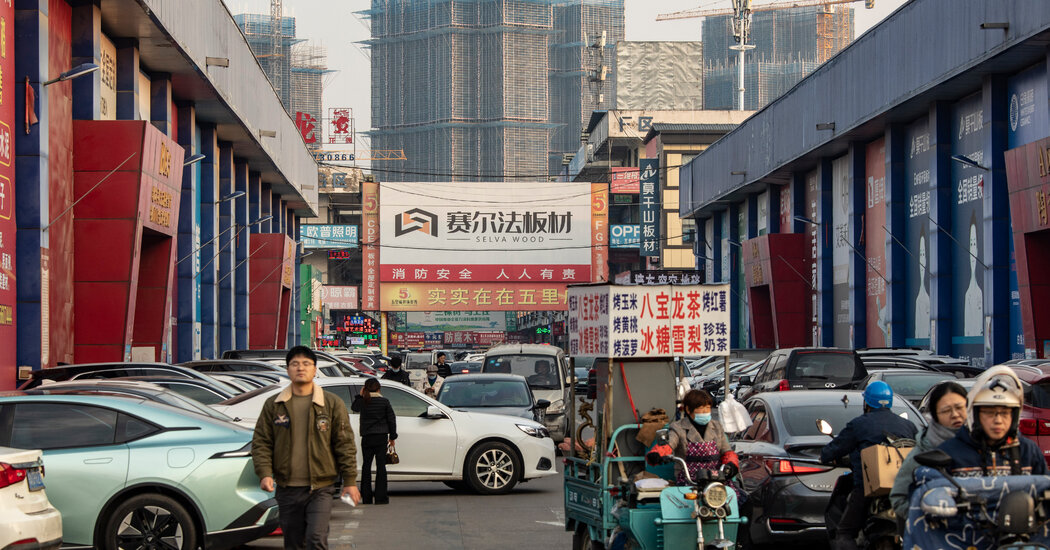
Ultramodern factories churn out electric cars and solar panels in Hefei, an industrial center in the heart of central China. Broad avenues link office towers and landscaped parks. Subway lines open at a brisk pace. Yet at Hefei’s market for construction materials, which fills 10 city blocks, local merchants are gloomy. Wu Junlin, a vendor of doors, has closed two of his three stores and laid off all but one of his dozen employees. “I have been doing this for 20 years — after all these years, this year is…
As China’s Markets Stumble, Japan Rises Toward Record
There’s a shift underway in Asia that’s reverberating through global financial markets. Japan’s stock market, overlooked by investors for decades, is making a furious comeback. The benchmark Nikkei 225 index is edging closer to the record it set on Dec. 29, 1989, which effectively marked the peak of Japan’s economic ascendancy before a collapse that led to decades of low growth. China, long an impossible-to-ignore market, has been spiraling downward. Stocks in China recently touched lows not seen since a rout in 2015, and Hong Kong’s Hang Seng Index was…