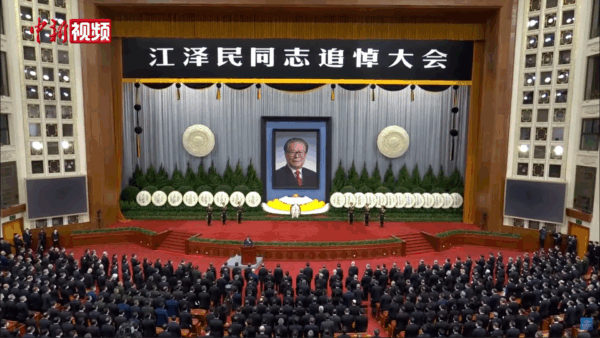
On August 17, Xi Jinping delivered a speech commemorating the 100th anniversary of the birth of former Chinese Communist Party (CCP) General Secretary and Chinese President Jiang Zemin, who passed away in 2022. The speech unsurprisingly was laudatory. Jiang, Xi stated, was “a great Marxist,” “a great proletarian revolutionary, politician, military strategist, diplomat,” and “the core of the party’s third generation central leadership collective.”
Yet the speech was more than a mere commemoration. Rather, it exhibited a long-noted tendency of the CCP to “make the past serve the present” through the instrumentalization of historical narratives about itself and its leaders. In the speech Xi constructed a version of Jiang’s legacy that effectively sought to incorporate it as the antecedent to his “new era for socialism with Chinese characteristics,” which was proclaimed at the 19th Party Congress in October 2017.
Xi’s Jiang, then, in contrast to most assessments of the Jiang era, emerges as neither representative of an alternative path to the “new era” nor as a vestige of a bygone period of “liberalization” but as providing the historical foundations for Xi’s “new era.”
The speech constructed this version of Jiang’s legacy in four major ways.
First, it established that Jiang’s tenure was an indispensable link in the development of “socialism with Chinese characteristics” from Mao to the present. This is reflected in the narration of Jiang’s political life from joining the CCP in 1946 to becoming general secretary in June 1989 and his subsequent direction of “a new situation of comprehensive reform and opening up.” In this narrative, Jiang’s capacity to lead is firmly connected to his commitment to remaining “true to our original aspiration” and upholding of the “party’s basic theory, basic line, and basic strategy.” Jiang is thus portrayed as a loyal servant and protector of the CCP’s political and ideological patrimony.
Second, and arguably the fundamental lesson of Jiang’s career that the speech sought to convey, is that Jiang was a staunch defender and believer in the supremacy of the party. Not only does Xi describe Jiang as having “unwavering political faith” in Marxism, communism, and “socialism with Chinese characteristics” but also a firm belief in the necessity of the CCP’s leadership. This is illustrated by Jiang’s handling of the “major tests” in both domestic and international politics of the “late 1980s and early 1990s” (i.e. June 1989 and the Taiwan Straits Crisis of 1995-96). Jiang in facing these challenges “unwaveringly” upheld the “Four Cardinal Principles,” “carried out governance and rectification,” “engaged in diplomatic struggles,” and “resolutely safeguarded the country’s independence, dignity, security, and stability.”
Crucially, in Xi’s telling, the lesson Jiang drew from this experience was that to govern the country one “must first govern the party, and that governance must be strict” and the “more reform, opening up, and economic development there is, the more we must strengthen party leadership.” In this way, Xi construes Jiang as a precedent for his own insistence that economic modernization requires greater concentration on CCP unity, discipline, and political control.
Third, the speech strongly affirmed the legacy of “reform and opening” of the Jiang era. Xi praised Jiang for “keeping pace with the times” and adapting a “new pattern” of “opening up” for the “socialist market economy” characterized by multiple forms of ownership, encouragement of both foreign investment in the economy and the “going out” of Chinese firms, and China’s accession to the World Trade Organization (WTO). This, the speech contended, was not deviation from Marxism-Leninism but rather evidence of Jiang’s “innovative spirit” of “adapting to the demands of the times and practical development.” As such, it was entirely consistent with Mao Zedong’s “Sinification of Marxism” in which the “universal truths of Marxism” are integrated with and adapted to “the realities of Chinese society.”
The point of this somewhat arcane ideological excursion is potentially twofold: to underline that innovation is necessary to preserve Marxism’s relevance under changing historical conditions; and to establish Jiang as a precedent for Xi’s own claim to have adapted Marxism in the form of “Xi Jinping Thought on socialism with Chinese characteristics.”
Fourth, the speech contrasted Jiang’s relatively optimistic assessment of a period of “strategic opportunity” for China during the latter stages of his tenure with Xi’s own more stark recent rhetorical formulations. Under Jiang’s “far-sighted” assessment of China’s position, the CCP was able to establish the “basic guidelines of seizing opportunities, deepening reform, expanding openness, promoting development” for “rejuvenating the country.” However, under the conditions of “great changes unseen in a century,” Xi asserted, the party “must strengthen our sense of crisis, establish bottom-line thinking, better coordinate development and security… and actively face major tests of turbulent winds and even stormy seas, resolutely defend national sovereignty, security, and development interests.”
This distinction reinforces the trajectory of the CCP’s altered view of the relationship between development and security, which has been evident since at least the 20th Party Congress in October 2022. As Sheena Greitens noted, “Party leaders now speak of security and development as equally important, referring to security as the ‘prerequisite’ for development.”
Xi’s commemoration of Jiang was ultimately less an exercise in historical remembrance than an attempt to impose continuity on the CCP’s post-Mao history.
By presenting this version of Jiang Zemin’s legacy, Xi absorbed him into the prevailing ideological discourse, in which Jiang’s era becomes a necessary stepping-stone to the “new era.” Here, the innovations of the “reform era” are not ruptures but evidence of the CCP’s ability to adapt the universal truths of Marxism to Chinese reality. Viewed in this way, then, Xi’s emphasis on control, ideological discipline, and security over development is not retrogression but his own “far-sighted” attempt at “keeping pace with the times.”

