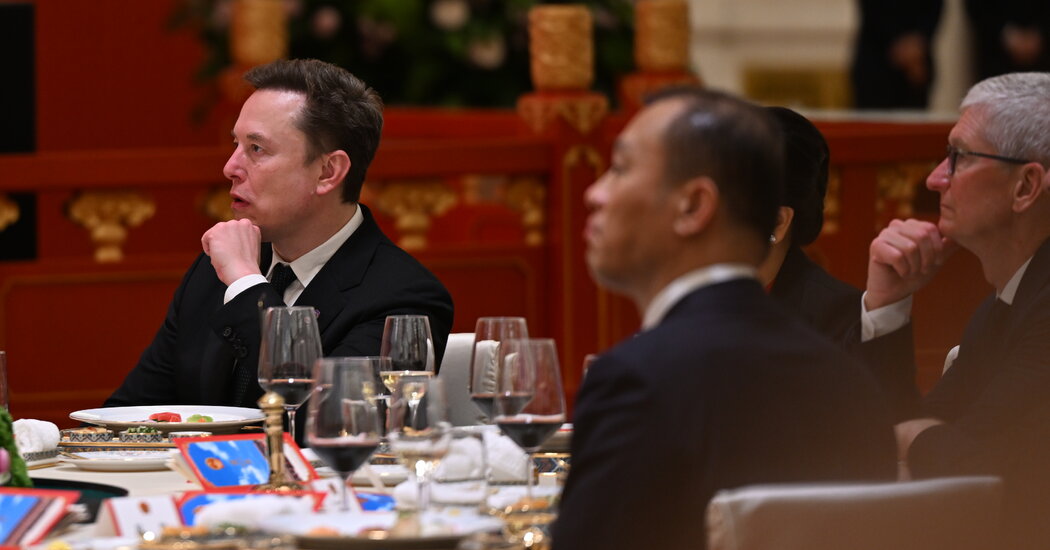
The chief executives who accompanied President Trump to a meeting and grand banquet in China last week were seeking to curry favor with both the Trump administration and the Chinese government, keenly aware that the support of either could make or break their businesses.
But the delegation — which included executives from Boeing, Apple, Nvidia, Cargill and other firms — arrived in Beijing with a variety of commercial complaints about doing business in China, some of which are public, some of which have not been previously reported.
In recent weeks, the Chinese government has blocked exports of high-end solar manufacturing equipment from a Chinese supplier, Suzhou Maxwell Technologies, to Tesla, the Elon Musk-led automaker, according to a person familiar with the matter who was not authorized to speak publicly. As part of its solar and energy storage business, Tesla had been looking to buy nearly $3 billion worth of manufacturing equipment from Suzhou Maxwell to build products that would further enable the transition to sustainable energy and bring about 100 gigawatts of solar capacity to the United States.
Tesla also has major business interests in China — its Shanghai factory is its largest — but Mr. Musk visited China with the hope of unblocking those solar manufacturing exports, the person said. There’s no indication yet that his efforts were successful. Mr. Musk and Tesla did not respond to requests for comment.
A spokesperson for the Chinese embassy in Washington said they weren’t familiar with the situation, but that China welcomed foreign companies to do business in China as long as they complied with laws and regulations.
Other companies in attendance had their own complaints. Coherent, a Pennsylvania semiconductor firm that was included in the delegation, has been struggling to obtain indium phosphide, a material exported by China that is necessary to make photonic chips for data centers, other people said. China has also not yet approved purchases of Nvidia’s H200 chips, though earlier this year, the U.S. government approved the company to sell them to major Chinese tech firms including Alibaba, Tencent and ByteDance.