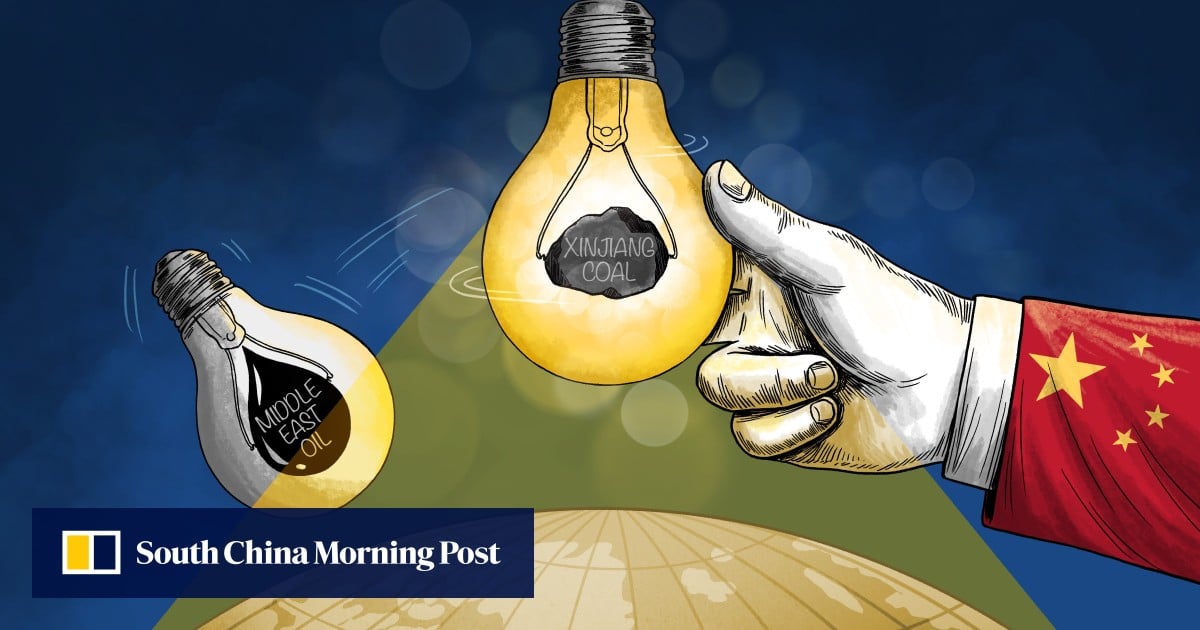
As the war in Iran disrupts global oil and chemical supplies, China’s coal-heavy energy sector is seizing an unprecedented opportunity. Dannie Peng visited the Changji Hui Autonomous Prefecture in northern Xinjiang – one of China’s four major bases for large-scale, modern coal-chemical production. In the second of a two-part series, she discovers how China is leveraging coal chemicals to offset oil shocks. It is late April, and northern Xinjiang is already gripped by scorching heat. Salt flats stretch to the horizon, barren and lifeless, until the monotony breaks at Wucaiwan – a boomtown in Changji Hui autonomous prefecture that has risen swiftly on the back of energy development.
Here, the rhythmic roar of machinery shatters the long-standing silence of the Gobi Desert. Dozens of industrial giants cluster tightly in this landscape, including open-pit mines with annual outputs in the tens of millions of tonnes,
massive thermal power plants and sprawling chemical enterprises.
This industrial forest of towering chimneys and intricate pipelines forms the heart of the Zhundong National Economic and Technological Development Zone, which sits atop estimated coal reserves of 390 billion tonnes – eclipsing the oil riches of the Persian Gulf in terms of weight.
The zone is also one of China’s four primary bases for modern, large-scale coal-chemical production.
In the country’s far west, a “new Middle East” centred on energy extraction, power generation and chemical processing is undergoing rapid development – only with
coal instead of oil. Here, some of the world’s largest and most advanced facilities are converting coal into liquid fuel, clean gas, plastics, chemical fertilisers and more.
For the better part of the past century, oil – nearly 60 per cent of which is concentrated in the Persian Gulf – has been the undisputed backbone of global industrial and economic development, particularly in the transport and petrochemical sectors.
South China Morning Post