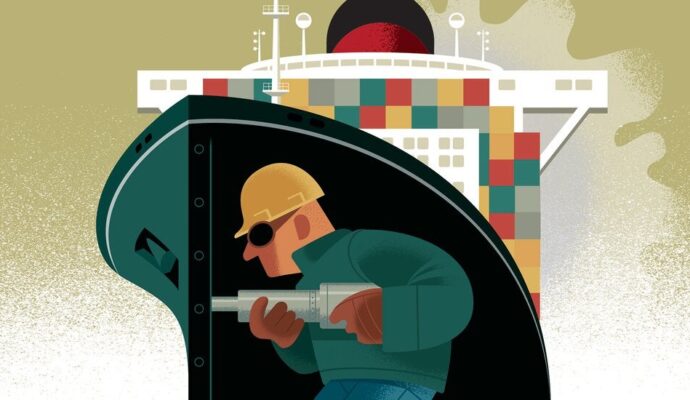
A globally recognizable tech executive, high-spirited from preparing for a public offering, offers imprudent remarks criticizing the government. The state strikes back harder than anyone expects. Overnight, the bargain between a skyrocketing sector of the economy and the government is shattered.
If you think this story could be about Anthropic, you’re only half right. In 2020, the Alibaba co-founder Jack Ma found himself in the doghouse after he publicly rebuked Chinese regulators. Citing regulatory concerns, the authorities canceled the public offering of Ant Group, another company Mr. Ma helped found, and subsequently unleashed a regulatory storm that left few Chinese tech companies untouched.
The U.S. government is skating close to its own Jack Ma moment, when a government wounds a tech leader seemingly out of spite. Self-destructive American actions, not Chinese competition, may be the most significant threat to the evolution of A.I. for years to come, long after the government and Anthropic resolve their current dispute.
On June 9, Anthropic released its model Fable 5, an adapted version of its powerful Mythos model, which has incredible capacity to find vulnerabilities in software. Anthropic’s chief executive, Dario Amodei, even said that companies that used Mythos had called it a “superweapon.” Three days later, the U.S. government issued an export control directive blocking use of Fable 5 by foreigners and noncitizens — including some of Anthropic’s own employees — which prompted Anthropic to disable all access to the model. A tangle of explanations behind this directive have been reported, including the risk of “jailbreak” (when a model bypasses built-in safety guardrails) and the risk of access by foreign adversaries. On Friday, the government permitted Anthropic to restore some users’ access to a version of Mythos, though negotiations are still underway about Fable 5.
Over the past decade, the U.S. government has used export controls to deal sometimes crippling blows to Chinese technology champions. The action against Anthropic upended this logic by turning this policy instrument against American companies, purportedly to exert the U.S. government’s grip over increasingly slippery A.I. models. The challenges of regulating A.I. at the frontier have now reportedly moved the government to ask Anthropic’s chief competitor, OpenAI, to limit the users for its own next model.
We often think of A.I. as a race between the United States and China. Instead we are seeing the emergence of an even more acute form of competition, between the public power of governments and the private power of ambitious companies. Both countries are struggling to determine whether their frontier A.I. companies are national champions or national security threats. A.I. labs in both countries are also starting to realize how much their operations depend on the state’s sufferance. The U.S. government needs to strike a better balance between ambition and control, lest it irrevocably damage its relationship with these companies and America’s long-term technological edge.