NYT
How Asia Has Survived the Energy Crisis
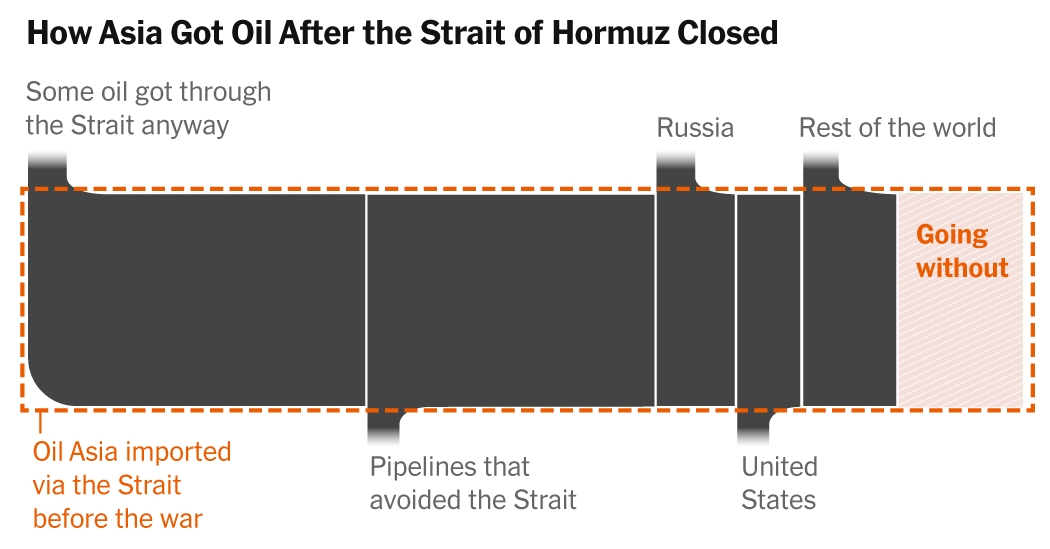
NYT
China’s carbon dioxide emissions fell by 1% after the outbreak of the US-Israeli war on Iran, thanks to a sharp reduction in oil consumption and a steady rise in the use of electric vehicles and public transport, analysis shows. The report reveals the role of clean energy in cushioning the price shocks caused by the strait of Hormuz crisis to the world’s biggest oil importer. It also reinforces hopes that China, which is the world’s biggest greenhouse gas emitter, may be nearing a turning point in decarbonising its economy. China…
Donald Trump has found a new way to promise victory over Iran. After months of war have failed to force Iran’s capitulation or collapse, his administration has unveiled what the US Treasury secretary, Scott Bessent, calls Operation Economic Outcast: an effort to cut it off from what remains of the global economy and threaten foreign governments, banks and companies with sanctions if they continue doing business with Tehran. There is no question that Iran is vulnerable. Its economy has been battered by years of sanctions, war and a months-long US…
The White House has threatened sanctions on any country that trades with Iran in another bid to economically isolate the country, as US military efforts falter. Launching what he called Operation Economic Outcast, the US Treasury secretary, Scott Bessent, compared it with D-day. China, Iran’s biggest trading partner, has already signalled that it will not cooperate with Trump’s attack on the Iranian economy. Lucy Hough speaks to Julian Borger, senior international correspondent – watch on YouTube The Guardian
When Marco Rubio suggested that the world should look to new shipping lanes to bypass the logjammed strait of Hormuz, it’s unlikely he had the Arctic’s northern sea route in mind. And yet in recent months the promise of this 5,500km channel – cleaved through frozen seas by nuclear-powered icebreakers and illuminated by a sun that never dips below the Arctic horizon – has grown. Japan, Korea and India have all expressed interest in sending cargoes through the northern sea route (NSR), but it’s China that has established the first…
The US military campaign to protect merchant shipping from Iranian attacks by asserting direct maritime control in the strait of Hormuz is not an idea unique to Donald Trump’s administration. Almost exactly 200 years ago, in the period 1825-27, a powerful US naval squadron led by Commodore John Rodgers was sent to the Mediterranean to defend American ships from the depredations of Greek corsairs and pirates. For all the new-minted republic’s brave talk of liberty, the US squadron did not assist Greece’s ongoing “regime change” struggle for independence from the…

China is one of the biggest stories in the world — and one of the most complex. That’s why The New York Times has always tried to have correspondents on the ground who can get under the surface and report out the nuances. But the Chinese authorities have long been wary of foreign journalists. They restrict their access, surveil their movements and sometimes expel them outright. My colleague Vivian Wang, our brilliant China correspondent, recently had her visa revoked. During her time in the country, she talked to a cross-section…

The passage of oil tankers through the Strait of Hormuz has been slowed significantly by the persistent cycle of hostility between the United States and Iran. But whether prices at the gas pump rise or fall will depend not only on how much oil flows out of the Persian Gulf but also on decisions made by China. Typically the world’s largest oil importer, China slashed purchases this spring, reducing demand so much that it prevented oil prices from soaring even higher earlier in the war. Now, one of the biggest…

The United States and Iran have a deal: For 60 days, Tehran will allow ships to sail through the Strait of Hormuz without charging tolls; in return, Washington will lift its naval blockade, waive sanctions on Iranian oil and help Iran get access to its frozen assets. Negotiations on the future of Iran’s nuclear program are also set to begin. Even if the deal holds, Iran is poised to emerge from the war battered militarily and economically but strengthened strategically, the newly empowered gatekeeper of the world’s most important energy…

While the United States and Iran haggle over reopening the Strait of Hormuz and restoring oil exports from the Persian Gulf, China, the world’s largest oil importer, is not expected to quickly ramp up purchases from the region. If normal traffic through the strait fully resumes in the coming weeks, numerous tankers carrying oil bound for China that have been stranded in the Persian Gulf during the war would be on the move again. Their eventual arrival at Chinese ports is likely to produce a temporary surge in deliveries. China…