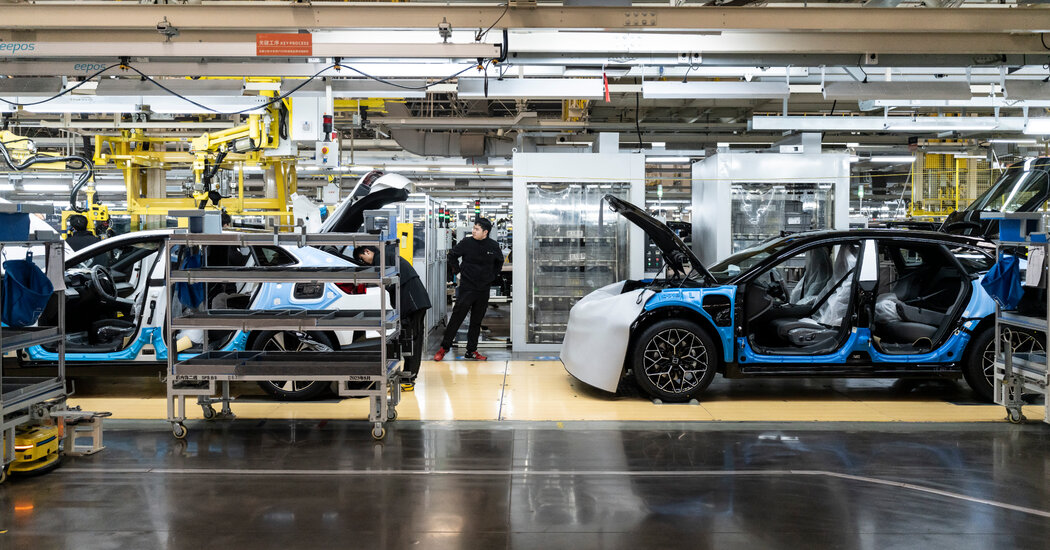
America’s Naval Power Is Waning. That Could Change.

The United States might be losing another war — one that could define the country’s security into the next century. Military and commercial power are intertwined. Maritime power, in particular, has always played a crucial part in establishing and maintaining commercial power. America is learning this lesson the hard way. For hundreds of years, the countries that have ruled the waves have ruled the world, as the 19th-century American naval strategist Alfred Thayer Mahan put it. In an age of drones, we can be forgiven for thinking this time has…

Oil Is Flowing From the Persian Gulf, but Prices Remain High. Why?

More oil is flowing from the Middle East than at any point since the start of the war with Iran, yet crude still costs almost $100 a barrel, much more than at other times when supplies were more constrained. That seeming conundrum can partly be explained by a change in traders’ views about how long the conflict is going to last. Optimism that an enduring peace deal might be around the corner has given way to concern that hostilities could restart. In the meantime, the United States and other countries…

Shippers Face Deepening Dilemma as U.S. and Iran Vie for Control of the Strait

Harry Vafias, a chief executive of a shipping company, recently got one of his vessels out of the Persian Gulf on a route protected by the U.S. military. But after Iran and the United States attacked each other this week, all but ending the truce the countries agreed to last month, Mr. Vafias, the head of StealthGas, based in Athens, said he was holding off on moving another ship through the Strait of Hormuz. “Things are becoming uglier by the minute,” he said in an email, “so we are not…

China Raises Pressure on Taiwan With Expanded Coast Guard Patrols

China is opening a new front in its pressure campaign against Taiwan, sending ships to its east to drive home a political point: Beijing claims not only the island itself but also the seas around it. The China Coast Guard announced on Saturday that its ships would conduct “law-enforcement patrols” in the Western Pacific waters east of Taiwan, a self-ruled island of 23 million people that Beijing claims as its territory. The Western Pacific is crowded with commercial traffic and would be a vital arena if Beijing ever tried to…

China Emerges as a Relative Winner From Strait of Hormuz Crisis

The war in Iran and the effective closure of the Strait of Hormuz have inflicted deep economic pain on many countries and sent some industries into a tailspin as they struggled with higher prices for energy, fertilizer and chemicals. It may also have given China a competitive edge. While the energy shocks and supply chain challenges stemming from the war have posed some challenges for China, the country has largely managed to avoid the kind of inflation spike and cascading economic and political effects that have afflicted many other nations.…

Iran Just Taught the World a Dangerous Lesson

The United States and Iran have a deal: For 60 days, Tehran will allow ships to sail through the Strait of Hormuz without charging tolls; in return, Washington will lift its naval blockade, waive sanctions on Iranian oil and help Iran get access to its frozen assets. Negotiations on the future of Iran’s nuclear program are also set to begin. Even if the deal holds, Iran is poised to emerge from the war battered militarily and economically but strengthened strategically, the newly empowered gatekeeper of the world’s most important energy…

The Iran War Permanently Altered the Global Economy

The framework deal between the United States and Iran sets the stage for an end to the bursts of violence and debilitating disruption of energy deliveries and trade in the Persian Gulf. But don’t expect economies around the globe to simply pick up where they left off before the United States and Israel began bombing Iran on Feb. 28. The war has set in motion changes that will be hard to reverse. The global energy order is being reshaped. The near shutdown in oil and gas deliveries from the Middle…

China Moves the Price of Oil, Even When It Buys Less

After the war in Iran cut off a fifth of the world’s oil supply, oil prices jumped, at one point reaching nearly $120 a barrel. But they didn’t spike higher, even though some analysts warned ominously of $200 oil, and prices have since come down. At more than $80 a barrel, oil is expensive. But it could be a lot higher. One major reason was China. The biggest oil buyer in the world, China has kept a lid on prices by rapidly reducing the amount of oil it imports. Before…

Shady Shipping

The peace talks between the United States and Iran have been stuck for a month. On Sunday, President Trump dismissed Iran’s most recent demands as “TOTALLY UNACCEPTABLE!” According to Iran’s state broadcaster, the country’s leaders wanted the U.S. to pay war reparations, end sanctions and — crucially — recognize Iran’s sovereignty over the Strait of Hormuz. Iran’s chokehold on the strait and the U.S. blockade are a source of global economic pain. But the ships occasionally making it out — a Russian oligarch’s yacht, two German cruise ships and the…