This November, Taiwanese voters go to the polls to elect mayors, city councilors, and village chiefs. Many foreign policy observers will read the results as a verdict on Taiwanese attitudes toward China, President Lai Ching-te, Trump, or a potential war. That would be an analytical mistake. The outcomes cannot be explained by how voters feel about independence, unification, China, the United States, or any other national issue. As the saying goes, local elections are about local issues.
Decades of data show that Taiwanese voters prioritize China, sovereignty, and Taiwan’s future in national elections, but we have little longitudinal data on how they decide in local ones. What we do know is that voters often cast ballots for mayor or city council differently than they do for president. For example, Taichung and New Taipei have elected a Kuomintang (KMT) mayor in each of the last two local elections, yet a majority of their voters still supported Lai and the Democratic Progressive Party (DPP) in 2024. Electing a mayor from one party hardly means a city will back that party’s presidential candidate.
Candidates across Taiwan are campaigning on local issues that vary by city, such as housing, public transportation, and urban renewal. Some touch on national issues, but most mayoral and city council candidates avoid them, since talking about national issues or polarizing figures could cost them votes.
One telling example is the absence of both the DPP and KMT party leaders from most mayoral and city council election campaign advertisements. Lai, who is also the DPP chair, and KMT chair Cheng Li-wun are both deeply polarizing figures, specifically for their positions on national issues including China and Taiwan’s relationship with the United States. Featuring Lai or Cheng in a local campaign invites voters to see local candidates as extensions of their party’s divisive leadership rather than a local candidate. In Taichung, for example, former president Tsai Ing-wen can be found far more frequently in DPP campaign ads than Lai.
Regardless of which party does well, both will likely frame the results as a sign that Taiwanese civil society broadly supports their policies, including on cross-strait politics. It would again be a mistake to buy that message. Local election results are not a referendum on party support or on attitudes toward the party chairs. During Tsai’s presidency, for instance, the DPP performed dismally in both sets of local elections, yet won clear victories in the national elections that followed. In Taiwan, national and local elections are neither tied to nor predictive of each other.
So what can we learn from these elections? Most importantly, they will set the chess pieces for 2028. A few key races will show which parties gain confidence and may shift factional politics.
One key example is New Taipei City, traditionally a KMT stronghold, and arguably the most important race this cycle. Outgoing mayor Hou Yu-ih is leaving office with high approval ratings despite his failed 2024 presidential campaign. His replacement should have an easy race, but the KMT candidate, Lee Shu-chuan, is struggling. Although he has a history of being a strong bureaucrat, Lee has run a lackluster campaign and lacks charisma. So far, his campaign has been bland.
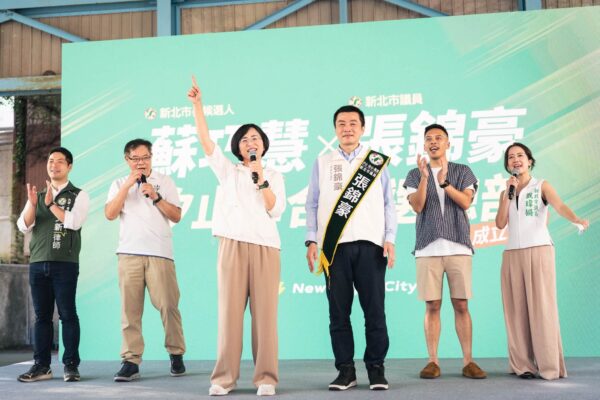
His DPP opponent, Su Chiao-hui, is performing strongly for a DPP candidate in New Taipei. As the daughter of DPP heavyweight and former New Taipei mayor Su Tseng-chang, she is both a family legacy and a demonstration of long commitment to the city. She has cleverly avoided national discourse, emphasizing instead her record of delivering for her community.
Su’s campaign is leaving a far stronger impression among New Taipei voters than many suspected she would. The race is very close, and a DPP victory would dent KMT confidence heading into 2028 because New Taipei was supposed to be an easy KMT victory.
Importantly, a Su victory would not necessarily be a victory for Lai. Su is not a member of Lai’s faction, and although her win would be a major boost for the party, it would not raise Lai’s standing within it. Her victory would, however, help the DPP campaign with strong leadership in 2028. It would also send a message to the KMT that their traditional voter strongholds need more from their candidates than just a strong bureaucratic record.
Another example is the increasingly contentious Taipei race between the DPP’s Puma Shen and the KMT’s Chiang Wan-an. Chiang, the incumbent mayor and a 2028 presidential hopeful, was expected to win re-election easily, but Shen is running a strong campaign. Though best known as the founder of the disinformation research organization Doublethink Lab and the civil defense organization Kuma Academy, Shen has focused not on national topics like civil defense, but on improving Taipei’s livability. Chiang, meanwhile, has faced more scandals this campaign than in the rest of his tenure, and has so far run a particularly lackluster campaign. He is still expected to win, but Shen’s showing is unexpectedly competitive.
To a degree, the Taipei race is less about who wins, and more about whether Chiang can build momentum for a 2028 presidential run. If Chiang wins by only a few percentage points, it would be a big victory for the DPP and would hurt Chiang’s momentum if he hopes to become the KMT’s 2028 nominee. Even if Shen loses, his performance has been strong enough that he likely has a political future in the DPP.
Though unlikely, if the DPP were unexpectedly successful in taking both Taipei and New Taipei, this would probably lead to a political narrative about the KMT losing its traditional territory in northern Taiwan – not dissimilar to the narrative that emerged in 2018 after Han Kuo-yu of the KMT unexpectedly captured the mayorship of Kaohsiung, a long-time DPP stronghold. It should not, however, be over-interpreted to infer a permanent change in Taiwan civil society or a reflection of national attitudes. If Taipei and New Taipei elect DPP mayors, it will be due to the KMT mismanaging their candidates and campaigns, combined with smart, effective campaigning from Su and Shen.
Even if Chiang wins, the KMT faces a difficult presidential primary season. The field is already crowded: outgoing Taichung mayor Lu Shiow-yen, Legislative Yuan president Han Kuo-yu, and KMT chair Cheng Li-wun are all contending for the nomination. Cheng herself faces a difficult future if the KMT does poorly. Though she is not on the ballot, her opponents within the party are likely to push her to resign, which would leave the KMT’s 2028 presidential leadership up in the air.
Finally, the elections have exposed a breakdown in cooperation between the KMT and TPP. While the “Blue-White Alliance” has been a steadfast partnership thus far during Lai’s first term, the outward show of friendship has buckled this cycle. TPP chair Huang Kuo-chang withdrew in favor of Li Shu-chuan in New Taipei, but in Zhubei, the administrative capital of Hsinchu County, neither party would withdraw for the other, and the two suspended election cooperation in the county. This suggests that the parties may split again over a joint ticket in 2028, as they did in 2024, dividing the pan-Blue camp among its many potential candidates.
The 2026 local elections matter because they set the stage for 2028, but they do not predict who will win it. Once the national cycle begins, discussion will shift from local issues back to the dominant topic in Taiwan’s national elections: cross-strait relations. The 2026 results are not about China, Lai Ching-te, or the United States, but those topics will soon become salient again. For now, they are on the back burner.