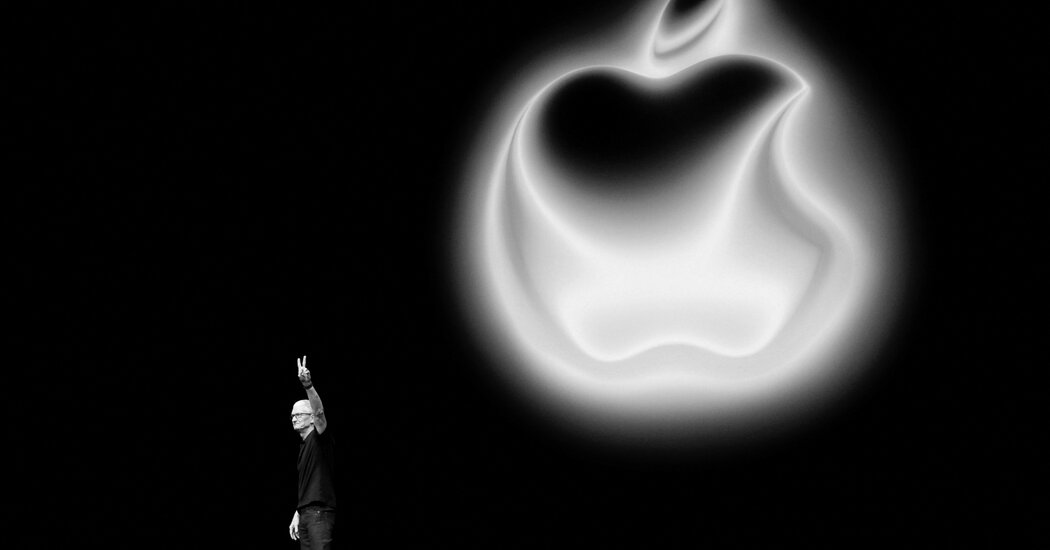
Tim Cook is ending his illustrious stint as chief executive of Apple. The soft-spoken operator accomplished the near impossible, filling the shoes of the visionary co-founder Steve Jobs, turning the iPhone from a cultural phenomenon into a financial juggernaut and transforming his company into a $4 trillion goliath — growing its market value by $682 million per day, on average, for 15 years. By the metrics investors care about, Mr. Cook is nothing short of a rock star.
But when one considers his role in the sweep of American history, his legacy grows more complicated, for much of Apple’s success is due to his move to consolidate virtually all of his company’s manufacturing in China.
The results have been profound. Apple under Mr. Cook played a significant role in the rise of China’s middle class, and produced the iPhone in enormous quantities at a low enough cost that roughly half of all Americans own one. His choices also dramatically escalated China’s economic standing and technological prowess to the point that its increasingly authoritarian leaders now see themselves as powerful rivals to the U.S.
If President Xi Jinping’s imperialist instincts fade, Mr. Cook will be remembered for helping bring capitalism and liberalism to one of the most populous countries in the world. If the tensions between China and the United States continue to escalate, especially if Beijing makes good on its threats to attack the island of Taiwan — a democracy that happens to produce the vast majority of the world’s semiconductor chips — Mr. Cook will be remembered differently. He will be the man who not only squandered his company’s future (as it is still highly dependent on China), but also handed the West’s technological prowess to its biggest threat.
History can be a brutal editor. Consider Jack Welch, the long-lionized chief executive of General Electric. In his two-decade reign, which ended in 2001, Mr. Welch earned shareholders an astonishing 21 percent annual return — just a nudge less than Mr. Cook’s — and was anointed “manager of the century” by Fortune magazine. His moves into financial engineering were the stuff of Wall Street legend — until the financial crisis exposed the company as hollowed out and recklessly overleveraged. By 2009, G.E. was begging for government-backed infusions of cash; its stock price had plummeted 85 percent. In 2022, author David Gelles recast Mr. Welch as “the man who broke capitalism.”
Mr. Cook started at Apple as a senior vice president of operations in 1998 and quickly overhauled Apple’s manufacturing strategy to rely on inexpensive labor overseas. By owning the process rather than owning the factories, Apple could retain control over production while offloading the manufacturing risks to suppliers. Mr. Cook also wrested royalties from app makers and moved into media streaming and advertising, all part of a “services” push that was twice as profitable as the hardware Apple sold.