At the height of the Cold War, a top official in China’s intelligence agency said that his country would never use seduction to entrap a person.
Such tactics might be for the C.I.A. or the K.G.B., the official named Kong Yuan, of the Central Investigation Department, told a group of agents in training in April 1960, but China was guided by principles. He looked at the few female comrades in the audience. “Rest assured, we will not be asking you to go run beauty traps.”
Despite that pledge, captured in a 2010 memoir by a former Chinese diplomat, China’s intelligence services have for decades used romantic entanglements to compromise or extract information from prominent people.
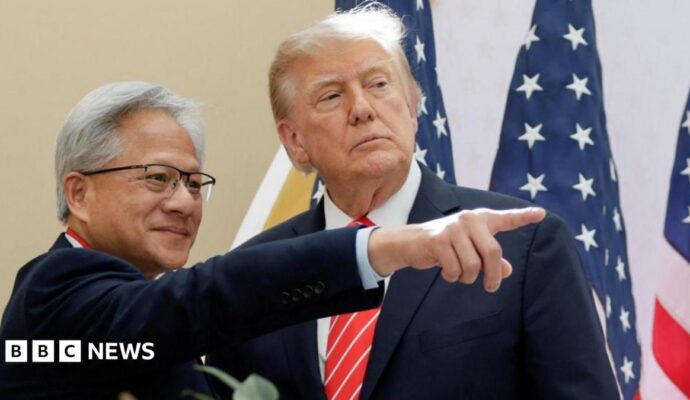
American officials say that China’s Ministry of State Security, which runs intelligence operations today, recruited a Chinese businesswoman to collect intelligence on Jensen Huang, the chief executive of Nvidia and one of the most powerful figures in the artificial intelligence boom.
It was not clear what role the woman, Alice Huang, or Huang Le, might have had with the Chinese spy agency. Ms. Huang was a top executive of a Singapore company that operates data centers in Southeast Asia using Nvidia chips and that rents their computing power to Chinese firms.
Mr. Huang has acknowledged that he had an affair with Ms. Huang. President Trump has said that Mr. Huang told him that he was not aware that the woman was a spy. China has rejected the espionage allegations against Ms. Huang, calling them smears against the country. U.S. officials have not provided evidence for their claims. Ms. Huang has not responded to requests for comment.