China’s growing pressure on LGBTQ communities is increasingly transnational. Chinese nationals who attend Pride events overseas can attract police attention after returning home; overseas Chinese LGBTQ groups remain vulnerable to censorship on Chinese platforms; cultural spaces in Europe can lose access to Chinese social media for promoting transgender films; and mainland writers publishing gay fiction on overseas platforms have faced prosecution at home. Hong Kong offers a particularly revealing entry point because similar pressures are visible there even though same-sex relationships are legal (though not legally recognized as marriages).
In October, the organizing committee of Hong Kong Pride canceled its annual Rainbow Market at Central Market after being told that an administrative error had resulted in double-booking. Organizers had already received confirmation, paid a deposit, and announced the venue.
The cancellation followed a wider pattern. Earlier in 2026, Pink Dot HK, the city’s largest annual LGBTQ carnival, canceled its event after the operator of Stanley Plaza and Murray House withdrew the venues, citing unresolved licensing issues. It was the second consecutive year in which Pink Dot failed to proceed. In 2025, negotiations to hold the event at West Kowloon Cultural District’s Art Park had also collapsed.
Hong Kong Pride itself lost a planned venue at Kwun Tong Promenade in 2025 after organizers had already paid rent and announced the event.
These cases illustrate how LGBTQ public life in Hong Kong is being narrowed through administrative and institutional means rather than formal criminal prohibition. Consensual same-sex conduct remains legal, and LGBTQ organizations continue to exist. But these groups find it harder and harder to organize publicly, retain venues, sustain institutions, and remain visible in civic life.
This is striking because Hong Kong once had one of the most visible LGBTQ communities in East Asia. The city decriminalized consensual homosexual conduct between adult men in 1991, while its courts later expanded legal protections for same-sex couples in areas including immigration, taxation, and public housing. Social acceptance also rose significantly. Survey research published in 2023 found that 69 percent of respondents were “moderately” or “very accepting” of gay men and lesbians, while 60 percent supported same-sex marriage and 71 percent supported anti-discrimination legislation based on sexual orientation.
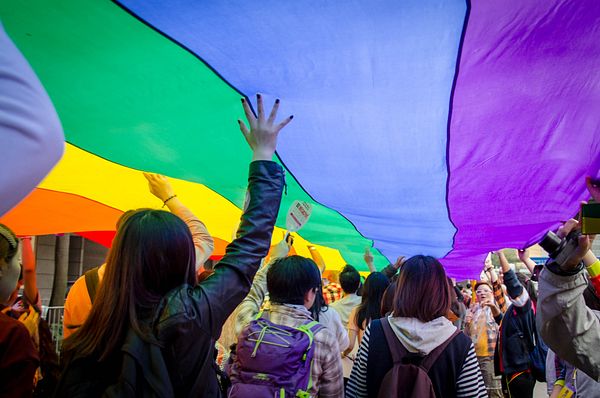
Hong Kong Pride once drew thousands into the streets, but its last full Pride march took place in 2018. In 2019, police declined permission for a march amid the citywide protests and permitted only a static rally. Pandemic restrictions later pushed Pride activities online, after which organizers shifted toward indoor markets and smaller events. The large public march never returned.
Most LGBTQ organizations in Hong Kong were never primarily political in the conventional sense. Their work focused on discrimination, health, family acceptance, culture, community support, and legal equality. Their shrinking space therefore shows how Hong Kong’s post-2020 transformation has moved beyond suppressing explicit political opposition and into regulating autonomous social life.
The same pattern is visible in mainland China. China decriminalized homosexuality in 1997 and removed homosexuality from its official classification of mental disorders in 2001 (in practice, if not in actual fact). During the 2000s and early 2010s, LGBTQ organizations, university groups, online communities, and cultural events expanded in major cities. Under Xi Jinping, that space has contracted sharply. Shanghai Pride ceased operations in 2020, the Beijing LGBT Center closed in 2023, university LGBTQ groups have faced mounting restrictions, and social media accounts associated with sexual minority organizations have been deleted or suspended.
Foreign connections have become increasingly important to this repression. Chinese authorities often treat independent organizations with international ties as possible channels of foreign influence. LGBTQ groups are especially exposed because contemporary sexual minority advocacy is highly transnational, involving foreign NGOs, embassies, academic institutions, cultural organizations, and legal networks. This allows questions of private identity and social equality to be reframed as questions of sovereignty and political security.
The reach of this logic now extends beyond China’s borders. In 2026, France’s Le Monde reported that Chinese nationals who had participated in Bangkok Pride later received police attention after returning to China. How the authorities identified them remains unclear, but participation in a lawful LGBTQ event in Thailand had become a matter of interest to Chinese police.
This fits within the broader discussion of transnational repression, but LGBTQ communities also reveal a related form of cross-border control that operates through information systems. Chinese platforms and censorship practices increasingly project domestic restrictions into overseas Chinese-speaking communities.
The Chinese Rainbow Network illustrates this problem. The organization operates overseas, yet material on its WeChat public account became inaccessible. Citizen Lab had already shown the structural basis for such control when it found that content exchanged between non-China-registered WeChat accounts could still be subjected to analysis for politically sensitive material. Overseas users can therefore remain inside an information environment shaped by the political requirements of the Chinese party-state.
Recent cases involving the LGBTQ community show how this extends to cultural expression. The Paris-based Chinese-language cultural space 8lithèque reportedly had its Xiaohongshu (RedNote) account banned after promoting a screening of a transgender-themed film. The event was taking place in France, but the organizers remained vulnerable to the content rules of a Chinese platform.
The Haitang Literature City prosecutions show another dimension of this expanding reach. Haitang, a Taiwan-based platform, became popular among mainland Chinese writers of danmei and boys’ love fiction, including sexually explicit material. Chinese authorities later summoned, detained, and prosecuted mainland writers who had published on the platform, citing China’s obscenity laws. The platform was outside mainland China, but the writers were not beyond the reach of Chinese law enforcement.
Taken together, these cases show how China’s control increasingly travels through people, platforms, and language communities. Whether joining a cultural space in Paris, a platform in Taiwan, a Pride parade in Bangkok, or a community organization in North America, Chinese citizens and Chinese-language communities remain exposed to censorship, surveillance, or coercive pressure originating from inside China.
Why should LGBTQ communities matter so much to the party-state?
One reason is autonomous organization. Community centers, university societies, legal aid groups, online networks, cultural organizations, and Pride events create horizontal ties among citizens outside structures supervised by the Communist Party. Chinese authorities have become increasingly suspicious of such organization across many fields, including labor rights, feminism, religion, public health, and environmental activism.
Sexual minority rights also raise broader questions about pluralism. The principle that individuals should retain dignity and rights even when they depart from majority social norms places limits on the authority of the state, family, and society over private identity.
Family structure adds another dimension. Under Xi Jinping, official discourse has placed growing emphasis on marriage, reproduction, family responsibility, and demographic duty. These themes have become more prominent as China confronts low fertility, population decline, delayed marriage, and rapid aging. Women are increasingly encouraged to marry and have children, while official rhetoric emphasizes “good family traditions” and reproductive responsibility.
LGBTQ identities sit uneasily within this model because they challenge the assumption that adult life should culminate in heterosexual marriage and biological reproduction. They also complicate fixed gender roles within the family.
These tensions acquire greater political significance because Xi has tied social order to the broader project of the “great rejuvenation of the Chinese nation.” The Communist Party increasingly presents itself as a guardian of Chinese civilizational continuity and social morality.
This emphasis on tradition also represents a shift in the party’s own ideological history. The early People’s Republic was explicitly revolutionary in its approach to family hierarchy. The 1950 Marriage Law attacked arranged marriage, concubinage, male superiority, and other practices described as remnants of the feudal family system. Maoist discourse framed women’s emancipation as part of the destruction of inherited social hierarchy.
Mao-era China was never sexually liberal, but the contrast shows that the Communist Party’s current appeal to traditional family values is selective rather than timeless. During the revolutionary period, dismantling inherited hierarchies served the party’s claim to be creating a new society. Under Xi, family hierarchy, reproductive responsibility, and civilizational continuity serve a different political purpose by reinforcing social order and distinguishing Chinese values from supposedly foreign liberal influence.
LGBTQ communities therefore sit at the intersection of several Xi-era concerns: autonomous organization, minority rights, gender hierarchy, demographic policy, foreign influence, and individual autonomy.
Repression can be effective at weakening the organizational capacity of such groups. Authorities can close community centers, prevent events, delete accounts, restrict fundraising, discourage international partnerships, and make public participation more risky. But these measures cannot remove the identities and experiences that produced these communities.
That creates a long-term political problem. Concepts such as constitutionalism or representative government can remain abstract for citizens who encounter them mainly through rhetoric. Sexuality and gender are experienced through everyday life. Government policy reaches LGBTQ people through relationships, family formation, public expression, employment, access to community, and the ability to describe oneself openly. Feminists encounter a similar dynamic when state-defined expectations concerning marriage, reproduction, and gender roles collide with their own lives.
Repeated discrimination turns political authority into a personal experience. Not every LGBTQ person or feminist will become politically oppositional, but a state that continually restricts people at the level of identity, family, and bodily autonomy risks creating durable alienation that cannot easily be displaced by nationalism or civilizational rhetoric.
The contraction of LGBTQ space in Hong Kong therefore matters beyond sexual minority rights. It shows how the logic of political control can expand into social life and how Chinese digital platforms, information systems, and law enforcement practices can extend that control across borders.
For LGBTQ communities, the immediate result is the erosion of public and organizational space. For Beijing, the longer-term consequence may be a widening gap between its civilizational narrative and the everyday experience of those whose identities increasingly fall outside the social order it seeks to define.