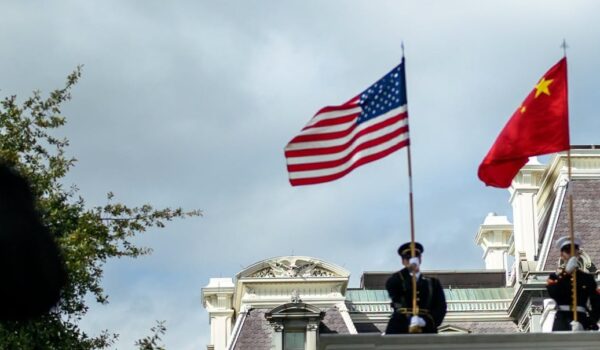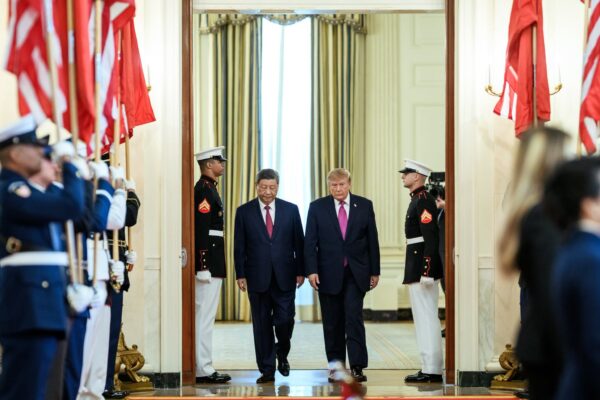
U.S. President Donald Trump rolled out the red carpet for President Xi Jinping’s state visit to Washington and greeted him in person at Joint Base Andrews on the evening of September 23, a rare gesture for an American president. Critics in both parties warned that the pageantry would reward a rival.
However, the red carpet, the state dinner with its exquisite menu, the cannon salute and the bald eagle sculpture gifted to Xi are just the surface. Beneath them, the bilateral relationship has begun to take a new direction.
At their Beijing summit in May, the two leaders agreed to build a “constructive China-U.S. relationship of strategic stability.” It’s a lengthy phrase, but each word is there for a reason. “Constructive” commits both sides to a positive agenda, not just damage control. “Strategic” places the relationship at the level of leaders and long horizons. “Stability” sets a direction and boundary for the relationship.
This new formula is sharply different from the language used to describe China-U.S. relations since 2018.
Recall Trump’s first term. Washington launched a trade war, imposed tariffs on Chinese goods, and placed Huawei and other Chinese firms under technology sanctions. Washington urged multinational companies to quickly adopt “China Plus One” strategies, moving out of China and building a second supply base in Vietnam, India, or Mexico. It trumpeted decoupling as the goal.
Since 2018, Beijing has gradually diversified its trade across Southeast Asia, Latin America, and Africa. China-U.S. trade fell by around 30 percent in 2025 alone, according to the McKinsey Global Institute’s 2026 update on the geometry of global trade. Meanwhile, China built a complete and strategically critical supply chain, from basic materials to advanced equipment. China now is the only country to make goods in all 41 industrial categories and 666 sub-categories in the United Nations classification.
Today, China sells advanced machinery, components and critical materials to other countries’ factories. McKinsey called it the factory to the world factories, and the Wall Street Journal described the same shift. In many ways, China Plus One did not remove China from the global supply chain. Instead, it has helped China move up the value chain, as India, Vietnam, and Mexico become assembly lines for Chinese products.
These economic shifts have resulted in a telling change in Washington’s vocabulary. In August 2023, then-U.S. Commerce Secretary Gina Raimondo said that China was “uninvestable.” This became the preferred talking point of politicians and China hawks across Washington. For years, terms like “de-risking,” “de-coupling,” “friend-shoring” and “China+ Plus One” filled congressional hearings, cable interviews, and opinion pages.
However, references to China Plus One have nearly vanished in Washington. No one among the Trump administration’s senior officials and business executives uses the term anymore.
The change was also symbolized by the guests at the head table during the state dinner for Xi. Beside the two presidents were Tim Cook of Apple, Jensen Huang of Nvidia, Lisa Su of Advanced Micro Devices (AMD) and Elon Musk of Tesla and SpaceX. All of them understand how critical China is to their businesses, both as a market and as the base of their supply chains.
Apple’s first foldable phone, the iPhone Duo, was developed, trial-produced and assembled exclusively in China, according to Apple’s vice president for Asia procurement and operations, not built in India or Vietnam. Tesla previously announced plants to phase Chinese suppliers out of its American-built cars. Now it is seeking multiple suppliers in China for its Optimus humanoid robot, and orders have already been placed. Huang has argued for months that export controls are backfiring on American competitiveness. Su has pledged to deepen AMD’s engagement in China. These executives know China Plus One and decoupling with China are not working.
Smaller firms follow the same logic. EnerVenue, a California battery startup, announced last week that it began mass production in Changzhou after abandoning plans for a $264 million factory in Kentucky. Its chief executive cited China’s skilled workforce and supply chain strength, and called China the “factory of factories.” Chinese business media have also reported cases of American manufacturers that moved orders to India or Southeast Asia to avoid tariffs, struggled with quality and delivery, and returned the work to their original Chinese suppliers.
The toasts at the state dinner on September 24 affirmed the new direction, especially in the people-to-people and business-to-business ties. Both leaders reached back into history. Trump spoke of the foundation of commerce and mutual respect, and of ties between the two peoples that endure.
Xi recalled the trade that began soon after American independence and the Hump airlift over the Himalayas during the war against Japan. He recalled “ping-pong diplomacy,” and the redwoods Richard Nixon gave China that now grow in Zhejiang. He praised Ronald Sakolsky, an American teacher who donated $5,000 to fund a Chinese woman’s desert tree-planting two decades ago and recently returned to China to see a forest in the desert.
Xi’s most strategic move was his remark that Trump’s Make America Great Again and China’s pursuit of national rejuvenation “can surely be mutually reinforcing.” This is a strategic discourse specifically aimed at the idea that dominates Washington’s thinking about the China-U.S. relationship: the Thucydides Trap, which holds that a rising power and an established one are headed for war. Xi’s remark rejected that premise and offered an alternative frame. Two great projects of national renewal need not collide. He called for “a new approach for major countries to get along.”
None of this means rivalry and competition between the two great powers have slowed down. In July the Federal Communications Commission added foreign-made humanoid and industrial robots to its covered list, a move Beijing condemned. Chip export controls remain unchanged. China’s rare earth magnet shipments to the United States fell 21 percent in August to 512 tons, heading toward their lowest level since 2021. Taiwan, Iran, and AI safety will test the newly coined “constructive relationship of strategic stability.” But both leaders have endorsed its guardrails.
While Trump 1.0 started decoupling and China Plus One, Trump 2.0 now regards China as an equal partner in deals, a critical supplier the American economy cannot easily replace, and the other half of a G2.
The festivities at Joint Base Andrews and in the East Room of the White House will soon fade from the headlines. But Washington has stopped talking about leaving China, and corporate America never really left.