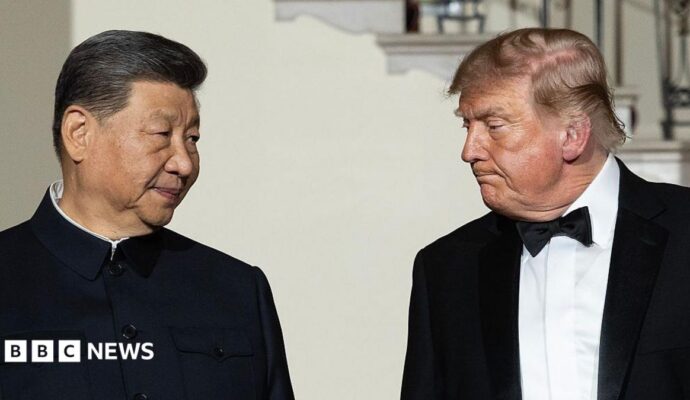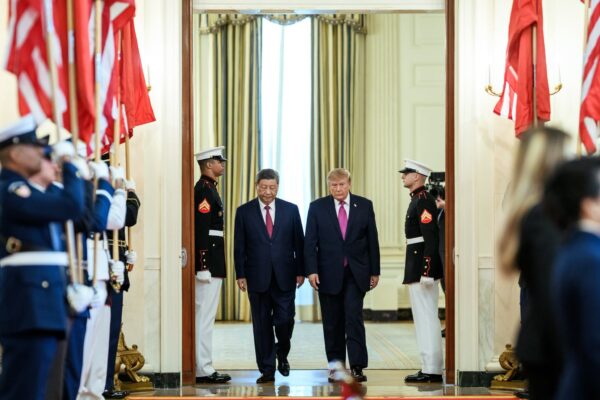
The latest meeting between U.S. President Donald Trump and Chinese President Xi Jinping led to much anxiety in Taiwan, with fears that Trump could potentially throw Taiwan under the bus in the course of negotiations with Xi. The two leaders agreed to dialogue on AI, as well as tariff reductions on $30 billion in “non-sensitive goods” going both ways. Even so, readouts between the two sides differed as to what was agreed to be purchased, and any discussion of semiconductors, chips, and export controls was not mentioned.
Besides trade deals, there have been few concrete outcomes from the meeting to date, and the two leaders initially remained silent when asked by reporters if Taiwan featured in their summit. Trump later denied that Taiwan was discussed at length, then stated that he and Xi “didn’t spend a lot of time talking about Taiwan.”
Other reports suggest that Xi tried press Trump to curtail support for Taiwan, and accept Beijing’s framing on Taiwan. Chinese state-run media quoted Xi as stating during the meeting: “I hope that the United States adheres to the correct position of opposing ‘Taiwan independence’ and handles the Taiwan issue prudently.”
In particular, ahead of the Trump-Xi meeting, international media reporting suggested that Xi would try to convince Trump to cut weapons sales to Taiwan. Although the Trump administration approved $11 billion in arms sales to Taiwan last December, the Trump administration has yet to approve a further $14 billion package.
It was generally understood that Trump would not approve the arms sale ahead of his meeting with Xi, in order to ensure that the talks went smoothly. For its part, the Taiwanese government has attempted to reassure the public that ties with the United States are stable, and reiterated that U.S. policy on Taiwan has not changed after the summit. Nevertheless, the real question will be whether Trump reveals any unexpected curveballs for Taiwan after the meeting itself.
If so, this would follow the precedent set by Trump after his meeting with Xi in May 2026 in Beijing. Little happened during the meeting itself, which was mostly a non-event. In May, as with this latest summit, Trump initially declined to answer questions on Taiwan from reporters. The readouts of the May 2026 meeting differed between the United States and China, with the U.S. denying that Taiwan had come up at all, while China claimed that it had been discussed. As if to forestall a potential shift in position by Trump, U.S. Secretary of State Marco Rubio emphasized during the May trip that U.S. policy on Taiwan was unchanged in an interview with NBC.
During an interview with Fox News shortly after his return from China, however, Trump seemed to hit out at Taiwan, stating that he was “not looking to have somebody go independent,” and that Taiwan needed “cool down a bit.” Trump then moved on to attack Taiwan with accusations that it had stolen the U.S. semiconductor industry, while calling on semiconductor companies to move back to the United States.
Most alarming of all, Trump cast doubt on U.S. commitment to Taiwan as a whole, while suggesting that the Taiwan-U.S. relationship was mostly transactional. In particular, Trump suggested that arms sales to Taiwan were up for negotiation, and that this made for a “good bargaining chip” in talks with China.
Such comments provoked alarm in Taiwan, seeing as this contravenes U.S. commitments to provide weapons to Taiwan dating back to the Reagan-era Three Assurances. Trump also raised questions about whether the United States would intervene in the event of a conflict with China, stating that he did not think it was logical for American troops to “travel 9,500 miles to fight a war.”
Given that recent history, Taiwanese may have been more nervous after the latest Trump-Xi summit ended.
Indeed, indications have since emerged that Trump offered to sell arms to China during his September meeting with Xi. David Perdue, the U.S. ambassador to China, stated that Trump made such comments to Xi in an interview with Fox News on September 27. Although Perdue also stated that U.S. policy remained unchanged on Taiwan, this was an unusual comment by Trump. The offer came only a few days after controversy erupted about F-35 parts that were mistakenly diverted to Hong Kong, raising concerns about sensitive U.S. military technology ending up in Chinese hands.
As such, while Taiwan may have breathed a sigh of relief that the September summit has not resulted in any overt shift in U.S. policy on Taiwan, what remains is to see whether Trump shifts later on. As some analysts have noted, Trump has already echoed Chinese language on Taiwan on numerous occasions in the past. And while some elements of his administration, such as Rubio, may emphasize that policy remains unchanged, this is not reassuring when Trump himself contradicts those statements.
It is still uncertain when further U.S. arms sales to Taiwan will be approved. Trump and Xi are set to meet two more times this year, in November at the Asia-Pacific Economic Cooperation summit in Shenzhen, China, as well as at the G20 summit in December at the Trump National Doral Miami Golf Club in Florida. It is possible that Trump will hold off on arms sales until after these meetings, or until 2027. Trump’s decision whether to approve arms sales or not could also be impacted by the U.S. midterm elections in November.
With the Trump administration holding off on approving arms sales to Taiwan, this may complicate the domestic debate on defense spending. In past years, the United States has sought to pressure Taiwan to increase defense spending to 5 percent or even 10 percent of GDP, with Trump himself suggesting that the U.S. should not defend Taiwan if Taiwan is not serious about its own defense.
But at a time of stark partisanship, the Kuomintang (KMT) delayed for over 200 days on reviewing the central government budget, while enacting widespread cuts to government ministries it views as antagonistic. The delays impacted defense spending, as well as spending on Taiwan’s domestic drone program. Even so, the KMT suddenly reversed course in August to finally approve the budget, though it limited drone spending by passing it as part of the central government budget rather than as a special expenditure.
Efforts by the United States to push Taiwan to increase defense spending are likely to ring hollow in Taiwan if Washington refuses to sell Taiwan arms. Likewise, comments by Trump will increase doubts about U.S. reliability as an ally in wartime – indeed, survey polling shows that skepticism about the U.S. is up across the board in Taiwan. (Such polling also shows an increase in the Taiwanese public’s willingness to fight – even without U.S. intervention.) Certainly, with the United States holding off on arms sales to Taiwan for so long, Trump suddenly offering to sell arms to China is not likely to reaffirm faith in the U.S. in Taiwan.
Increased skepticism about U.S. reliability is likely to lead to efforts to shore up Taiwan’s domestic defense programs, which are not reliant on the mercurial nature of arms sales. Taiwan is especially likely to seek cooperation from non-U.S. partners on drone development, while positioning itself as an alternative to drone supply chains highly reliant on China.
It can be expected that summits between Trump and Xi will fall into this familiar script going forward – even when the meetings themselves may result in little substance, the point is to see what occurs afterward, and how left-field comments or actions by Trump are perceived.