A SHADOW OVER THE WORLD: Franklin D. Roosevelt, the Rise of Fascism, and the Making of America’s World War II, by William I. Hitchcock
In “For Whom the Bell Tolls,” Ernest Hemingway’s classic novel of the Spanish Civil War in the 1930s, the protagonist, Robert Jordan, proclaims his uncompromising worldview early in the story. Beside a campfire in a cave amid the pine-covered hills, Jordan is asked whether he is a communist.
“No,” he replies. “I am an antifascist.”
“For a long time?”
“Since I have understood fascism.”
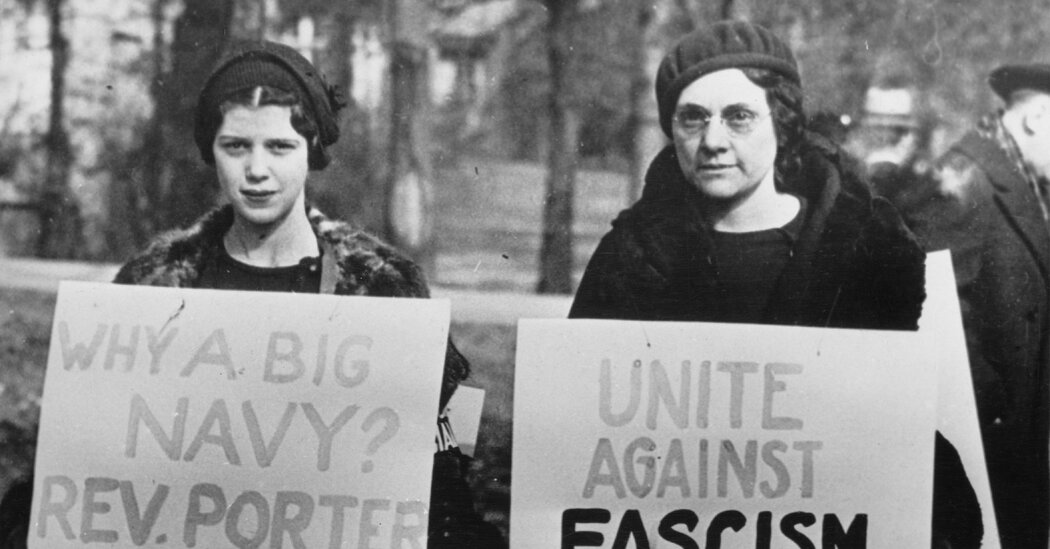
Nearly a century later, tragically, we all understand fascism and its evils. But how much do we truly know about the origins of its concomitant, antifascism? This is the question that propels William I. Hitchcock’s sly, corpulent new book, “A Shadow Over the World.”
A historian at the University of Virginia, Hitchcock was a Pulitzer finalist for “The Bitter Road to Freedom,” his chronicle of the human toll of the liberation of Europe in the Second World War. In “A Shadow Over the World,” he seeks to remedy another neglected feature of the conflict: antifascism’s legacy in global affairs. Its ideologies, he asserts, are ultimately tied up with everything from domestic politics to race relations to our modern-day crusades for democratic reforms abroad — “like a genie let out of its glowing lantern.”
“A Shadow Over the World” is packaged like a standard-issue, tub-thumping popular history, complete with cover portrait of Franklin Delano Roosevelt looking stern and prepared to battle his fascistic-minded foes. It is structured around Roosevelt’s decisions to confront the Axis powers and his efforts to build a coalition around the defense of democracy abroad. “Was he ready at last to cast aside irresolution and unequivocally join the struggle against the fascist threat?” Hitchcock asks, melodramatically, at one point.
Ultimately, however, the book is full of nuanced analyses of some of the most contentious debates in modern diplomatic history. There are endnotes in this book — on the uses and abuses of the word “isolationism,” for instance — that are nearly as long as this review.


