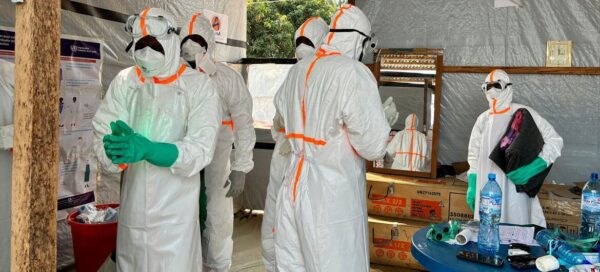
The Ebola epidemic spreading through the Democratic Republic of the Congo (DRC) could become the largest Ebola outbreak on record if infections continue at their current pace. More than 6,700 people had been infected and more than 3,200 had died by September 2026. The outbreak is caused by Bundibugyo virus, a form of Ebola for which there is currently no licensed vaccine or approved treatment.
The crisis is unfolding at a remarkable moment for global health. The United States is retreating from the global health system it once led. Beijing is the world’s second-largest economy and holds substantial interests in the DRC’s copper and cobalt industries. That matters not because Beijing has an obligation to replace Washington. Rather, the outbreak offers a test of whether, as the United States pulls back from global institutions, China will step forward.
During the 2014-2016 West African Ebola outbreak, which caused approximately 11,325 deaths and more than 28,600 cases, China emerged as an unexpectedly prominent donor. By late 2014, Beijing had provided assistance valued at 750 million yuan, including laboratories, food aid, and health personnel. What was particularly striking, however, was the speed with which China’s aid arrived. Ebola was first detected in Guinea in March 2014, and by April, China had sent 4 million yuan worth of assistance. This was quickly followed by several firsts for Beijing, including the use of chartered flights to deliver humanitarian relief and the deployment of its first overseas infectious-disease field hospital.
Western countries, on the other hand, were slower to react. It was not until the outbreak had expanded dramatically during the summer of 2014 that the United States, Britain, and other major donors mounted large-scale responses. By then, China had already been providing assistance for months. Although Western countries would ultimately contribute more money, the significance of China’s early response went beyond its dollar value. It demonstrated Beijing’s growing willingness to assume a visible role in international affairs, foreshadowing a decade of intensifying geopolitical competition.
Humanitarian concerns were not the only interests at stake. Officially, Chinese authorities talked about South-South cooperation, multilateralism and subtle criticism of Western indecisiveness. Western analysts, however, saw additional strategic interests, such as reducing the risk that Ebola would reach China and testing Beijing’s capacity for overseas power projection.
The response offered scientific benefits as well. The crisis gave Chinese scientists rare access to outbreak data and field specimens. Chinese teams gained valuable experience establishing and operating mobile biosafety laboratories, capabilities that would later become increasingly important as China expanded its role in infectious-disease preparedness.
China today is wealthier, more diplomatically influential, and far more technically capable than it was a decade ago. Yet as of late August 2026, Beijing had provided $4.5 million – around 30.2 million yuan – in direct support to the Africa Centers for Disease Control and Prevention and sent a few teams of medical experts. All assistance is valuable. But the level of support from China remains far smaller than many would have expected.
On the American side, despite the Trump administration’s broader retreat from foreign aid and its “America First” approach to global health, the United States has committed more than $512 million directly to Ebola response. Furthermore, the administration has requested more than $1.4 billion in additional funding from Congress. This suggests something more complicated than a simple transfer of global health leadership from Washington to Beijing.
One explanation is that China simply faces less pressure to prove itself. In 2014, China was still establishing its identity as a major global actor. Ebola offered an unusually visible opportunity to demonstrate that Beijing could provide international aid at a moment when Western governments appeared hesitant. Today, China’s global status is no longer in question. It finances infrastructure across much of the developing world, sits at the center of global manufacturing, and has built deep diplomatic relationships throughout Africa.
A second explanation is that the scientific incentives have changed. During the 2014-2016 outbreak, China could pair humanitarian assistance with an expanding research agenda, such as developing a vaccine against the Zaire Ebolavirus that was ravaging Western Africa. The current scientific landscape is different. Many of the vaccine and therapeutic candidates prioritized by the WHO are being developed outside China. With less obvious scientific ownership, Beijing may have fewer incentives to pair humanitarian assistance with a high-profile research agenda.
A third explanation may be the differing geopolitical environment. China in 2026 is operating amid slower economic growth and a more difficult geopolitical environment. Chinese citizens may want to see resources focused on issues at home. Further, an expansive intervention in eastern DRC would also carry operational and security risks. Lastly, Ebola competes for attention with wars, economic instability, and other international crises that are defining 2026.
China’s own rhetoric creates an important test. Its June 2026 white paper on global governance argued that major countries should assume greater responsibility and that international cooperation should produce concrete results. Ebola provides an opportunity to put those principles into practice.
The current Ebola crisis also presents areas where China could make distinctive contributions. Its strong manufacturing and logistical capacities could make it an important surge supplier of diagnostics, protective equipment, and other medical goods. On the diplomatic front, China can mobilize its strong relationships with African partner countries to become a multiplier of African and WHO capacities, assisting with the continent-wide response.
Greater transparency could help. More detailed public reporting on the scale, timing, and purpose of Chinese assistance would make Beijing’s contribution easier to assess. Western governments, for their part, should avoid treating Chinese participation reflexively as a geopolitical threat. Both sides should look for areas where cooperation is possible.
The larger lesson extends beyond Ebola. The decline of American leadership does not necessarily mean that another power will automatically fill the void. China may have the resources to do so, but whether – and where – it chooses to deploy them is a different question.
For the people confronting Ebola on the frontlines, however, geopolitics is secondary. The immediate objective is simpler: preventing as much suffering as possible. The test for Washington and Beijing is not which country replaces the other, but whether both can use their considerable capabilities to bring the outbreak under control.