In early 2024, a grandmotherly figure known as “Wang Po”(王婆)became a national sensation in China for her folksy matchmaking performances in Kaifeng. Less than two years later, the country’s online matchmaking scene has undergone an unexpected gender reversal. A new generation of male matchmaking influencers, including Aoye(鳌烨), Wukong(悟空), Dachao(大超), and Tianshu(天书), has taken over the spotlight.
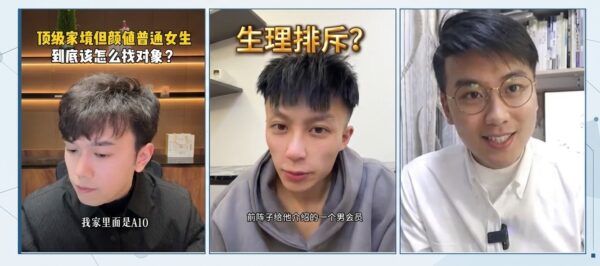
These men have little in common with the traditional image of the matchmaker. Often dressed in business attire and speaking in the language of markets, they assess participants’ appearance, education, family background, income, and assets before telling them what kind of partner they can realistically expect.
The male matchmakers’ appeal may partly come from the authority they claim through a language of competition, income, and hierarchy that has traditionally been coded as masculine. But their rise reveals something deeper than a new social media trend: a growing anxiety about marriage itself.
For years, China’s most prominent relationship gurus were predominantly women. Figures such as Ayawawa taught female audiences how to make themselves more desirable, manage relationships, and potentially “marry up.” The underlying message was aspirational: improve yourself, learn the rules, and you might move upward in the marriage market.
The new male matchmakers offer a colder perspective. Their signature question is simple: What do you actually have to offer?
Scoring systems have become a staple of their livestreams. Participants may be rated from one to 10 based on their appearance and overall qualifications. The terms A8, A9, and A10 are used as shorthand to refer to increasing levels of wealth, with A8 generally indicating tens of millions of yuan ($1.4-1.5 million or more) in assets, A9 hundreds of millions, and A10 billions. Even celebrities can become benchmarks.
Ordinary participants who expect to “marry up” may receive a rating of four or five, followed by a blunt explanation of why their expectations are unrealistic. Chinese coverage of the trend has documented some of these exchanges in detail.
The spectacle works because humiliation and reassurance coexist: viewers are shown how harsh the marriage market can be, while being promised that someone can still explain its rules.
These influencers have turned private insecurity into a public spectacle of quantification. Marriage is discussed through the language of exchange: What do you bring to the relationship? What does the other person bring? What can you realistically expect in return?
This rhetoric resonates in a society where upward mobility increasingly feels uncertain. China had roughly 240 million single people aged 15 and above in 2023, according to government data cited by the Associated Press. At the same time, young people face intense competition over employment, housing, income, and social status. In such an environment, marriage can become another arena for calculating risk.
The appeal of male matchmakers therefore lies partly in their willingness to offer “disillusionment,” or 幻灭, as a form of advice. Their message is that there is no secret strategy for transforming an ordinary person into an elite partner. Sometimes, the answer is simply to adjust one’s expectations.
This marks a striking shift in the tone of Chinese relationship advice. Earlier theories encouraged people to imagine how they might improve their position in the marriage market. The new wave of male influencers focuses on understanding the position one already occupies.
That may explain why these harsh livestreams are so compelling. They turn the uncertainty of modern dating into something that appears measurable, even when the measurements themselves are crude. For viewers anxious about their place in an increasingly competitive society, being told their “market value” can be painful – but strangely reassuring at the same time.
The rise of China’s male matchmakers thus points to a changing social mood. In a period when upward mobility feels harder to achieve, people may be losing faith in the promise of “marrying up.” What they increasingly want from a matchmaker is something more uncomfortable: an honest estimate of where they stand.
There is, however, a deeper tension in this new form of matchmaking. Once marriage is framed through market value, everyone becomes both buyer and product. And the more relentlessly young Chinese are taught to calculate the price of intimacy, the harder it may become to believe that marriage is supposed to be about anything other than the price.