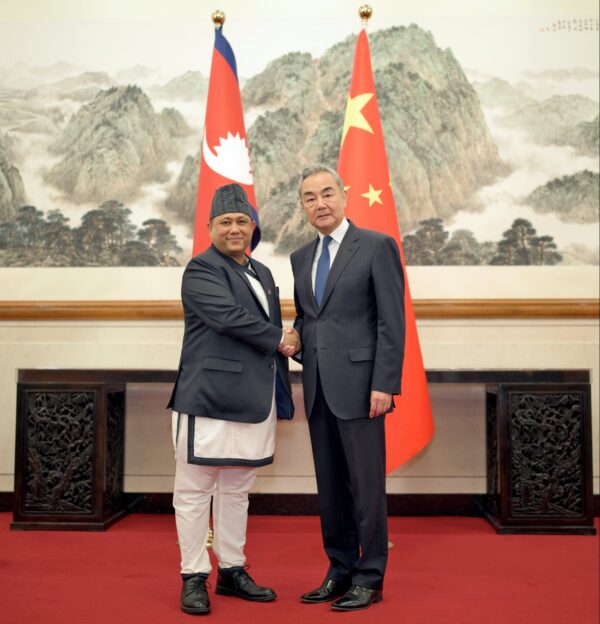
“A close neighbor is better than a distant relative,” Chinese Foreign Minister Wang Yi told his Nepali counterpart Shisir Khanal during their recent meeting in Beijing. Although Wang named no country, given the context in which he made the statement, the top Chinese diplomat could not have been more direct: he was talking about China (the “close neighbor”) and the U.S. (the “distant relative”).
The Nepali foreign minister was in Beijing to reassure the Chinese that Nepali soil would not be used for anti-China activities. In recent times, Chinese officials have repeatedly voiced their discontent with what they see as growing U.S. “interference” in Nepal, which, they believe, is aimed at minimizing China’s presence in the country.
China grew uneasy last September, when K.P. Sharma Oli was forced out as the Nepali prime minister — just a week after his much-hyped China visit. Both as prime minister and as leader of the Communist Party of Nepal-Unified Marxist Leninist (CPN-UML), Oli was someone who had cultivated close ties with Beijing. His China visit, among other things, was supposed to give impetus to the stalled Belt and Road Initiative (BRI) projects in Nepal.
Beijing was shocked when the rampaging Gen Z protestors literally chased Oli away from his official residence. Suddenly, the Chinese, who like to do business with strong power centers, faced the unenviable prospect of dealing with a completely new set of political actors in Nepal. What added to their unease were widespread rumors that the Americans had a big role, first in the protests, and then in giving shape to the interim government of Sushila Karki.
Amid this sea-change in Nepali politics, more and more top American officials started visiting Kathmandu and openly casting doubts on the Chinese intent behind pushing the BRI projects. They spoke of the rights of the Tibetan refugees in Nepal. These high-level American visits have continued even after the election of Balendra Shah as the new prime minister following the general elections in March 2026.
Nepal watchers in China believe that while even the core concerns of a “close neighbor” are sidelined, the government in Nepal is making every effort to accommodate the “distant relative.” The Americans have requested Nepal to “enhance support” for Tibetan refugees in the country. Starlink, the satellite internet provider founded by Elon Musk that the Chinese see as a part of the U.S. defense industry, has been in discussions with officials in Kathmandu to allow the company to operate in Nepal. American officials have also openly questioned the viability of BRI projects agreed between Nepal and China.
Moreover, the alleged links of Home Affairs Minister Sudan Gurung to the pro-Tibet movement in Nepal have added to Chinese suspicions. (Gurung has repeatedly denied any such links.) And why, China’s Nepal analysts ask, has the Tibetan government-in-exile in India been so welcoming of the change of guard in Kathmandu?
Chinese officials don’t think the government in Nepal has addressed any of their core concerns, especially related to the Americans. As a Chinese diplomat in Kathmandu put it to this author, “We have given the Shah government 100 days. If it does not address our concerns by that time, we will not be so patient.”
Perhaps what the Chinese want above anything else is for Shah to personally engage them and clearly commit to protecting their interests. China is not alone in this. Even India and the U.S., Nepal’s two other vital international partners, have been unhappy with Shah’s shunning of their officials. India has been talking up its “special relations,” arguing that its extensive relations with Nepal cannot be compared to Kathmandu’s ties with any other capital.
Yet Shah has been happy to let Rabi Lamichhane, chairman of the ruling Rastriya Swatantra Party, take the lead in handling India-Nepal ties. Likewise, he has trusted Foreign Minister Khanal with making the case for a “Nepal first” policy abroad and taking foreign partners into confidence.
Unless Nepal’s major international partners can build personal trust with the reclusive Nepali prime minister, it will be hard for them to do business with his government. More so for the Chinese, who are most comfortable dealing with strong executives.
For Shah, it is vital for Kathmandu to project strong agency before its foreign partners start taking Nepal seriously. In his understanding, previous Nepali governments were too eager to please external powers and too timid in making a strong case for Nepal on the global stage. In his view, calibrated distance from foreign affairs will bring Nepal more respect.
But Shah mistakes distance for agency. Abroad, such aloofness in the leader of a vulnerable state in a contested neighborhood has bred suspicions. Khanal had a rather difficult time convincing China that Nepal as a state is capable of leveraging its partnership with the U.S. to Nepal’s benefit while also ensuring that the partnership does not impinge on China’s interests. Khanal’s recent Beijing trip again showed the gulf in understanding between Kathmandu and Beijing of American involvement in Nepal.
It will take more than a single visit by the Nepali foreign minister to dispel these doubts. Whether or not Beijing’s fears of U.S. interference are justified, they are now shaping Chinese behavior toward Nepal.