New Security Law Firmly Aligns Hong Kong With Chinese Communist Party Ideology

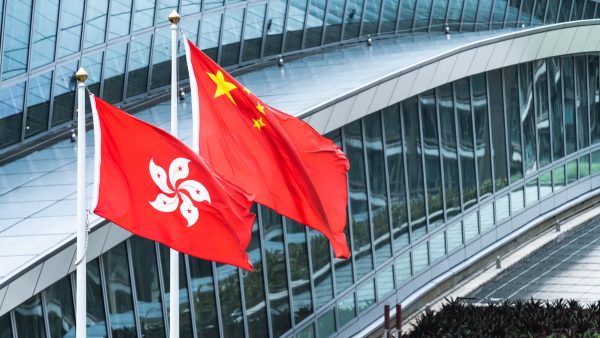
Since Beijing introduced its draconian Hong Kong National Security Law in 2020, Hong Kong’s authorities have arrested or scared into exile key opposition figures. Stringent electoral reforms ensured Hong Kong’s parliament, the Legislative Council or LegCo, is now stacked with “patriots.” China’s leadership is reaping the fruits of its efforts: On March 19 the LegCo passed the city’s homegrown Safeguarding National Security Ordinance (SNSO) by 89 votes to zero in a record-setting 11 days. That was a far cry from 21 years ago, when Hong Kong’s first attempt to implement…

The Latest Security Legislation in Hong Kong Betrays Beijing’s Insecurity

On Tuesday, Hong Kong’s legislature unanimously passed the Basic Law Article 23, the city’s homegrown national security law. The bill was approved only 11 days after it was introduced, and less than four years after Beijing imposed the draconian National Security Law (NSL) on the city, whose broad provisions criminalize an enormous range of activity and allows for violators to be tried on the mainland. Video of the proceedings showed every member of the Legislative Council raising their hand to approve Article 23, as a television screen on the wall…

China Changes Tack on Water Politics

Sixteen major rivers originate in China that supply fresh water to nearly 3 billion people in 14 Asian countries – more than a third of the world’s population. As “Asia’s water tower,” China has often been depicted as the upstream bully when it comes to water politics – taking what it needs for itself with little consideration for its downstream neighbors.  But with the growing connection between sustainable development and regional stability, China has an opportunity to use transboundary water management as a springboard for regional peace and cooperation. Its success…

Self-Censorship, Hong Kong’s Next Export 

Since around mid-2020, the Hong Kong government has initiated a series of measures aimed at curtailing civic society and the freedom of expression, impacting both the cultural and political spheres. Secretary for Security Chris Tang has emphasized the necessity to counteract what he terms “soft resistance” and has spoken of artistic creations as a “common modus operandi of those seeking to endanger national security.” This month the adoption of national security legislation to fulfill Article 23 of the Hong Kong Basic Law further consolidated this process.  The expanded scope of…

Taiwan and China Launched Joint Rescues of Capsized Fishing Boats

In a rare display of cooperation, Taiwan’s coast guard, following requests from China’s coast guard, initiated search and rescue missions with their counterparts for surviving sailors after a fishing boat capsized near the Taiwan-controlled Kinmen Islands and Matsu Islands, groups of heavily fortified islands only miles away from the Chinese mainland.  On March 14, Taiwan quickly dispatched four coast guard vessels with rescue divers on board to the disaster site near Kinmen, while China sent six helicopters and three vessels. The next day, another Chinese fishing boat capsized near the…

Hong Kong Lawmakers Unanimously Approve New National Security Law

Hong Kong lawmakers unanimously approved a new national security law Tuesday that grants the government more power to quash dissent, widely seen as the latest step in a sweeping political crackdown triggered by pro-democracy protests in 2019. The legislature passed the Safeguarding National Security Bill during a special session. The law will expand the authorities’ ability to prosecute citizens for offenses including “colluding with external forces” to commit illegal acts as well as charge them with treason, insurrection, espionage, and disclosing state secrets, among others. It comes on top of…

Why Angola’s Latest Visit to China Is Good for the G7

Whatever metric you are looking at, when it comes to Africa-China relations, Angola is typically close to (if not at) the top. As a result, President João Lourenço’s official visit to China last week, with stops in Beijing and Shandong, was one to watch, especially in terms of what it might offer regarding Angola’s 2050 vision. The president’s visit also represented the second visit of an African head of state to China this year, following Sierra Leone’s President Julius Maada Bio in early March. Both visits are important bellwethers as…

Sunflower Movement 10th Anniversary Reflects Taiwan’s Current Political Divisions

The 10th anniversary of the Sunflower Movement was commemorated on Monday with a rally in front of the Legislative Yuan, Taiwan’s legislature, in Taipei.  This takes place as part of a series of events organized by the Economic Democracy Union, one of the civil society groups originally involved in the movement. Key movement figures such as former student leaders Lin Fei-fan and Dennis Wei were among the speakers.  The Sunflower Movement was one of the largest social movements in Taiwanese history. The movement broke out on the eve of March…

Why Russia Will Keep Supporting China in the Indo-Pacific

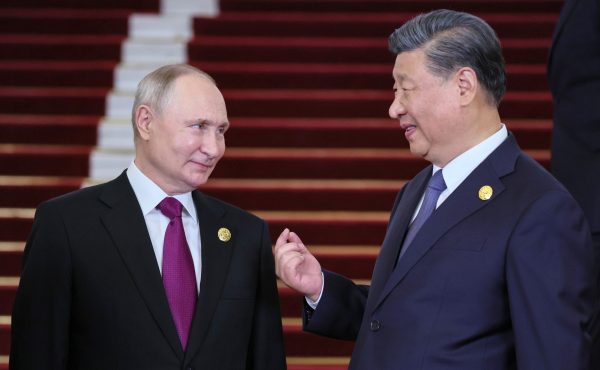
Russia’s foreign policy has been growing more helpful to China lately, with Moscow granting diplomatic support to Beijing on the Indo-Pacific issues and the scope of the Russian-Chinese joint military maneuvers increasing. This process has profound strategic reasons underneath it, and is therefore set to continue and further develop in the future. The Russian-Chinese joint statement on strategic cooperation from March 21, 2023, besides promising “decisive mutual support on the issues of protecting one another’s core interests,” included Russia’s vow to oppose Taiwan’s independence “in any form,” and “firmly support…

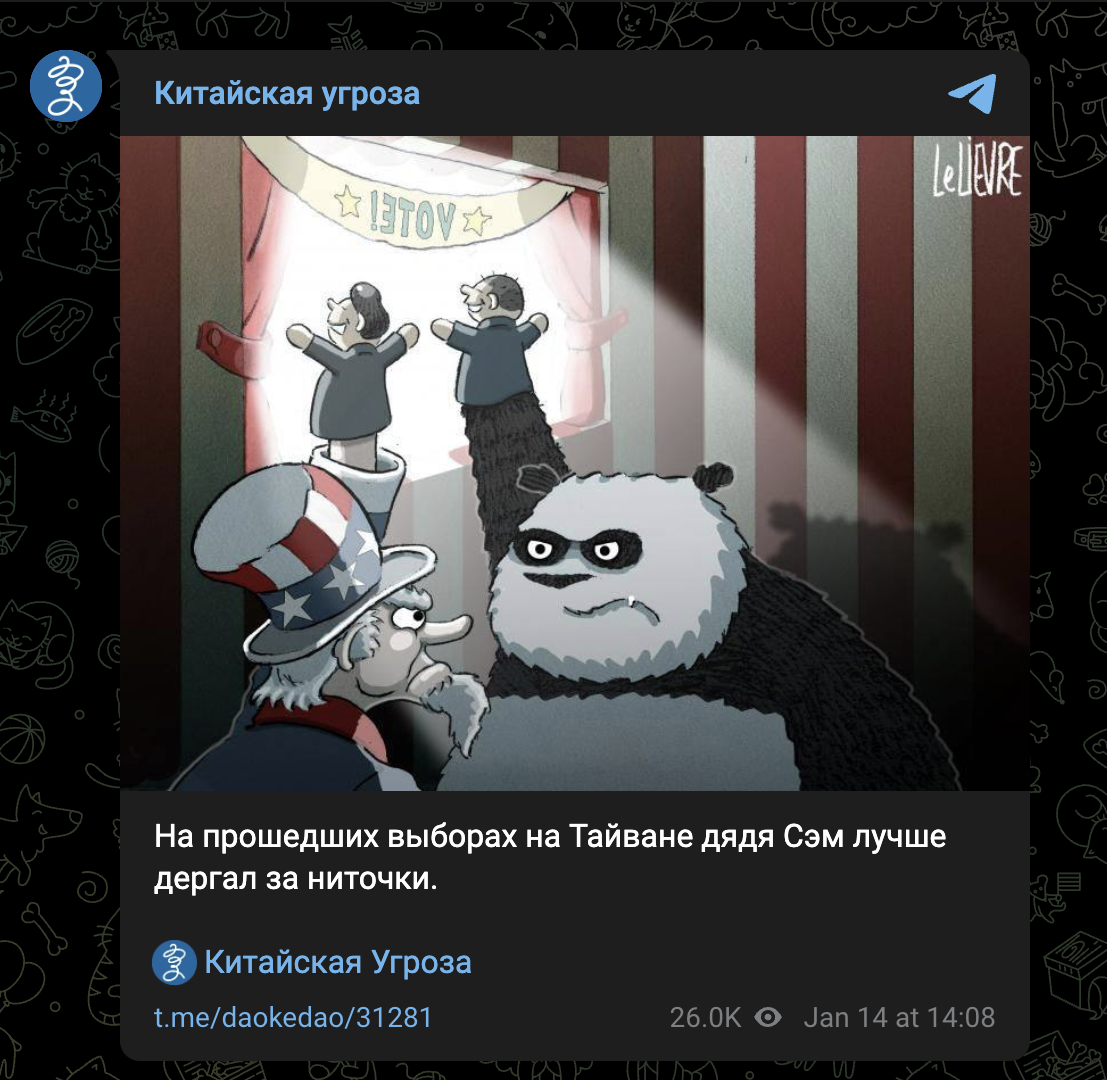
How Pro-Russia Influencers Framed Taiwan’s Elections on Telegram

Taiwan’s national elections on January 13 led to a clear victory for the Democratic Progressive Party (DPP)’s presidential candidate, Lai Ching-te, but a split legislature. According to Doublethink Lab, Taiwan was the target of frequent information operations that likely stemmed from China in the lead-up to the election. Particularly, Chinese state actors amplified stories that exacerbated internal conflict within Taiwan in the pre-election period, such as alleged scandals of DPP politicians, and completely fabricated stories closer to election day.  Doublethink Lab also investigated how pro-Kremlin Russian Telegram users with a…