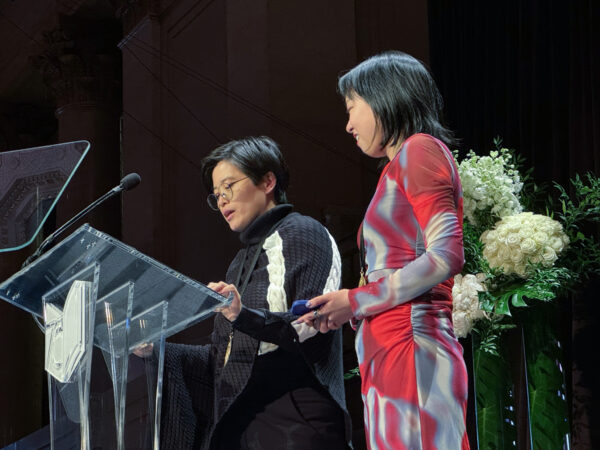
“Taiwan Travelogue” made history in late May as the first Taiwanese literary work to win the International Booker Prize. This also made the novel the first Mandarin-language novel to win the International Booker Prize in translation.
This was not the first major win for “Taiwan Travelogue.” Previously, in 2024, author Yang Shang-zi and translator Lin King had won the U.S. National Book Award for Translated Literature. This makes “Taiwan Travelogue” the first novel to win both the U.S. National Book Award and the International Booker Prize.
“Taiwan Travelogue” dovetails with many of the themes that have resonated strongly in Taiwan’s cultural representation abroad. The novel is set during the Japanese colonial period and focuses on the relationship between two women, Japanese author Aoyama Chizuko and her Taiwanese interpreter, Chi-chan. The subtext is that Chizuko is in love with Chi-chan, but their relationship is not that of equals, but rather of colonizer and colonized subject.
The Japanese colonial period, as well as Taiwan’s White Terror, have been recurring themes in contemporary Taiwanese cultural production. In a way, this is part of Taiwan’s grappling with its own contemporary identity, understood as having pluralistic influences ranging from Indigenous culture, Han settlement during the Ming and Qing dynasties, the Japanese colonial period, and the KMT’s retreat to Taiwan after the Chinese Civil War.
But, importantly, the 50-year Japanese colonial period is a way in which Taiwan’s contemporary history deviates sharply from that of the Chinese mainland through the course of the 20th century. Yang has, in comments, said that she hopes Chinese readers can come to understand how Taiwan’s history deviates from China as well as Taiwan’s complicated feelings toward Japan – a former colonizer, but one that is often romanticized. In line with this theme, “Taiwan Travelogue” depicts itself not as a fictional work, but as a recently discovered historical text – except with subtle suggestions that it may be a contemporary invention masquerading as a historical work, hence the many anachronisms.
The same-sex romance within “Taiwan Travelogue” also fits in Taiwan’s cultural zeitgeist. Particularly after Taiwan became the first country in Asia to legalize same-sex marriage in 2019, Taiwanese queer cinema and literature have loomed large internationally. Classic works, such as the films of Tsai Ming-liang, Ang Lee, or the novels of Qiu Miaojin, received new attention, as did newer documentary and film works, such as the documentary “Small Talk,” about the filmmaker’s relationship with her emotionally distant lesbian mother, or “Dear Ex,” which depicts a son who learns that his recently deceased father was gay. In another vein, Taiwanese drag queen Nymphia Wind became the first Asian winner of RuPaul’s Drag Race in 2024.
“Taiwan Travelogue” has been understood as a win for Taiwanese soft power on the world stage. According to Chi Ta-wei, a Taiwanese queer literature scholar and renowned science fiction author, Yang and King originally met through an Asian American Writers’ Workshop translation project that did not involve any funding from the Taiwanese government. But the Taiwanese government has sunk significant cultural resources into translating Taiwanese literature, comics, and film in past years as part of efforts to expand Taiwan’s cultural influence abroad. Apart from programs such as Books for Taiwan, which provide for the translation of Taiwanese comics and books, the government has also put a number of classic and contemporary Taiwanese movies and documentaries up for free viewing on English-language broadcaster Taiwan Plus.
But the success of “Taiwan Travelogue” has not been without controversy, mostly along partisan political lines. Pan-Green political figures, including President Lai Ching-te, Vice President Hsiao Bi-khim, and former President Tsai Ing-wen, were quick to congratulate Yang and King on their win. This was not the case with pan-Blue political figures, who were notably silent.
Partly, this may be due to the subject matter of the book. No less than China’s Taiwan Affairs Office leaned in on the victory, with spokesperson Chen Bin-hua calling on “writers on both sides of the Strait to maintain the national stance, respect historical facts, and deeply understand the enormous harm that Japan’s War of Aggression inflicted on the Chinese people.” For the Chinese government, it would appear that nothing less than a wholehearted condemnation of the Japanese colonial period could be accepted. This, too, may be the case for the KMT, which once formed a United Front with the Chinese Communist Party (CCP) against the Japanese during World War II.
Meanwhile, Yang – like many other cultural figures in Taiwan – is known to dislike the KMT. During the Great Recall Movement of 2025 – the attempt to recall all KMT legislators, a first in Taiwanese history – Yang was a prominent recall spokesperson. While she did not initially play a leading role in the movement, she stepped into the limelight after her partner was assaulted by a 73-year-old woman while campaigning for recall signatures.
The Great Recall Movement was sparked by the KMT drastically slashing the government budget in what was the largest series of budget cuts in Taiwanese history. One-third of the government’s operational budget was slashed – including not only defense spending, which continues to be a matter of controversy, but also cultural funding. Legislator Jessica Chen, in particular, attracted the ire of creatives after public comments referring to them as “beggars.” Chen then responded to criticisms by claiming to know the Three Hundred Tang Poems by heart – which was read as a suggestion of the superiority of Chinese culture, with the implication that contemporary Taiwanese culture was of no worth.
It may not be surprising, then, that Taiwan’s creatives were strongly in support of the recalls against the KMT, as shown though a petition by 1,043 Taiwanese authors, a separate petition by 6,500 comic artists and readers, and a third petition by a group of prominent directors. Apart from Yang, another prominent recall spokesperson was Lee Chiao, considered a giant of Taiwanese Hakka literature. In an interesting contrast to “Taiwan Travelogue,” Lee’s novels often center on the Taiwanese troops left to die in Southeast Asia after being abandoned by the Japanese imperial army. At the time of the Great Recall Movement, Lee was 90 years old, but served as a recall spokesperson in his native Miaoli, one of the centers of Hakka culture in Taiwan.
This perhaps serves to highlight some of the political tensions around what would otherwise be understood as soft power wins for Taiwan on the international stage. Though the depiction of Taiwan championed by many creatives today has been promoted by the Taiwanese government under Democratic Progressive Party (DPP) presidential administrations, this runs contrary to the vision of culture that the KMT advocates.
In comments after their International Booker Prize win, Yang and King reflected on Taiwan’s international status. King remarked that after the invasion of Ukraine by Russia, she had decided to translate only Taiwanese literary works. King remarked that she viewed contemporary Taiwanese literature as a “cacophony” rather than any singular identity. She also recounted the experience of Westerners remarking to her that they hoped to visit Taiwan while it still existed, saying she hoped Taiwan would never be used as the punchline of a joke in the future.
Yang, likewise, stated that she hoped that “Taiwan Travelogue” could provide an opportunity for dialogue with Chinese across the strait. In particular, she expressed a wish that the novel could “let more Chinese people understand what kind of future Taiwanese people want – which is not the same as what many in China imagine.”
The Diplomat is an affiliate of bookshop.org and will get a portion of the proceeds if you purchase a book using the link above.