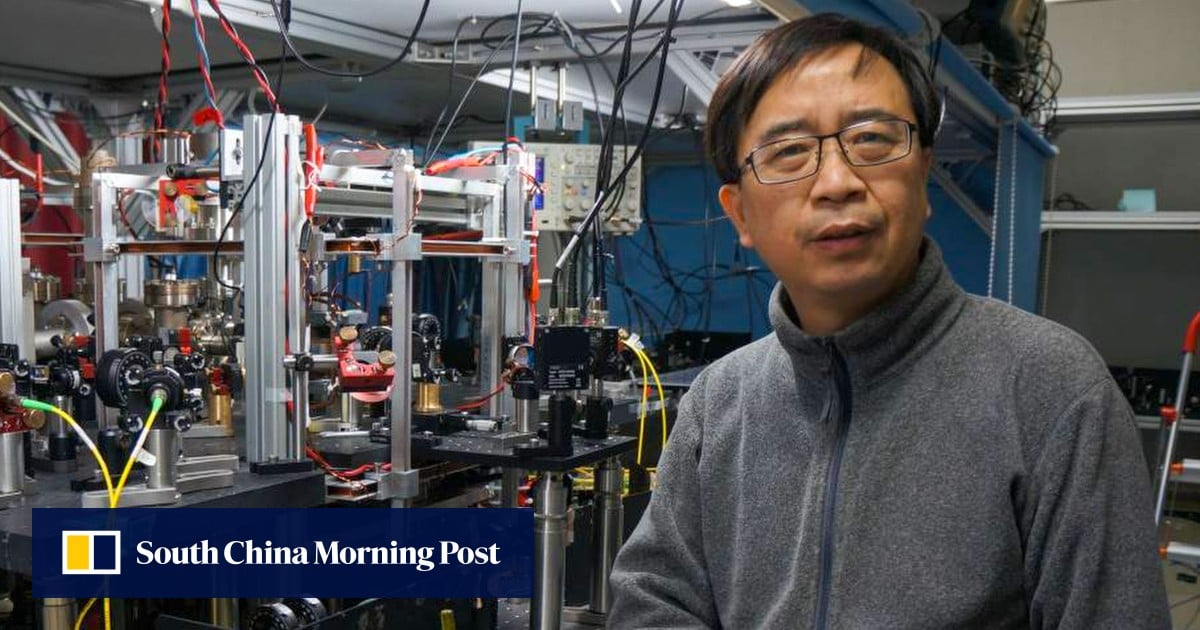
Pan is a laureate of the third Unesco-Russia Mendeleev International Prize in the Basic Sciences, an award commemorating Russian chemist Dmitri Mendeleev, creator of the periodic table.
The annual award, which is funded by the Russian government, honours two scientists for discoveries and innovations in basic sciences that drive global or regional transformation.
“[Pan] is recognised for his seminal contributions to large-scale secure quantum communications and scalable quantum computation,” Unesco said in a statement on July 10.
“His team developed the Micius satellite, enabling quantum key distribution and quantum teleportation over thousands of kilometres, and has demonstrated quantum computational advantage, bringing the prospect of a global quantum network from theory to reality.”
Pan, a professor of physics at the University of Science and Technology of China (USTC), shares this year’s honour with Sergei Sheiko, a chemistry professor at the University of North Carolina at Chapel Hill, who is recognised for his polymer physics research which transformed the rational design of soft materials.
In 2016, Pan’s team launched Micius, or Mozi, the world’s first quantum satellite, into low Earth orbit for long-distance quantum transmissions. Quantum communication offers a secure means of transferring information by using components of quantum mechanics in a way that resists eavesdropping.