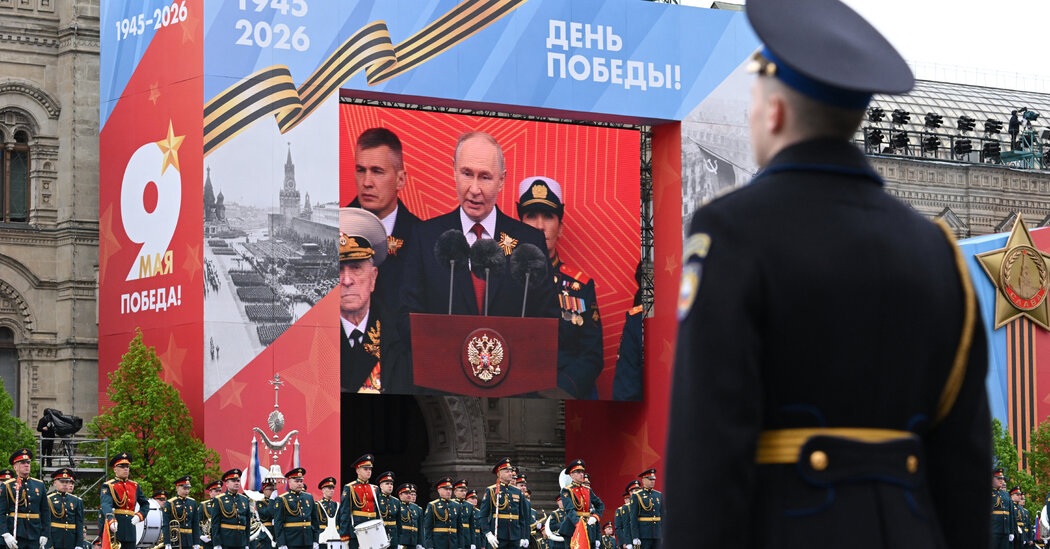
As Russia fails to gain ground in the war in Ukraine, President Vladimir V. Putin appears to be pursuing a wider conflict in Europe, increasingly targeting critical infrastructure and supply chains, one of Britain’s highest-ranking intelligence officials said in prepared remarks.
“Russia is scaling up its daily hybrid activity against the U.K. and Europe,” said Anne Keast-Butler, director of GCHQ, the British electronic surveillance agency, which has been countering what she called the Kremlin’s “reckless sabotage and assassination attempts.”
Ms. Keast-Butler’s remarks are part of an annual speech she is planning to make Wednesday afternoon at Bletchley Park, where Britain’s code breakers once deciphered enemy signals during World War II. Now, intelligence workers sit in hubs across the U.K., gathering electronic intercepts and trying to stay one step ahead of adversaries demonstrating “increasingly brazen behavior,” she said.
Her comments come at a volatile time in the world as the war in Ukraine is in its fifth year, conflict in the Middle East destabilizes the global economy and President Trump continuously rattles the NATO military alliance — a central check on Mr. Putin’s aggression.
She said that her agency is focused on thwarting the Russian threat and, in particular, the hybrid threats that Mr. Putin has relied upon to terrorize Europe with the goal of dividing NATO and sowing discord in the West. Hybrid tactics have included cyberattacks, sabotage, assassination and disinformation campaigns that are meant to destabilize countries’ economies and institutions.
Among the aggressions that European officials have blamed on Russia are a swarm of drones and explosives placed on a rail line in Poland; jamming aviation-navigation systems over Sweden; hacking a dam in Norway; and plotting to put incendiary devices on cargo planes. Lithuanian officials recently announced the arrests of nine people accused of plotting murders and sabotage across Europe at the behest of Russia’s military intelligence service, the G.R.U.