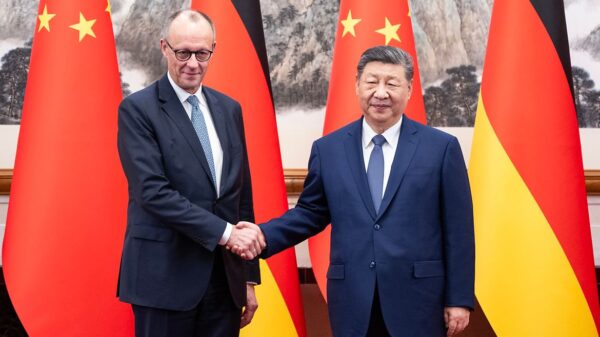
German Chancellor Friedrich Merz concluded his inaugural visit to China on February 26. The two-day trip saw Merz leading a senior business delegation, and committing to advance a “comprehensive strategic partnership” in meetings with President Xi Jinping and Premier Li Qiang. Merz’s visit followed trips to China by France’s Emmanuel Macron and the United Kingdom’s Keir Starmer, reflecting a broader European effort to stabilize relations with Beijing despite ongoing tensions over trade, market access, and strategic competition.
Despite talk of a “reset” in Sino-German relations, Merz’s trip was less about romance and more about realism. It should not be viewed as a strategic pivot, but as a focused attempt to rebalance an increasingly uneven economic relationship. Merz openly spoke about persistent trade distortions, pointing to Chinese overcapacity as a driver of widening imbalances.
The visit reflects the China policy of the current government, which has been fairly consistent: demand fairer market access for German firms, attract Chinese investment where it serves German interests, and cautiously pursue a “strategic partnership” that acknowledges China’s growing global weight, but also the responsibilities that come with it. At the same time, Merz signaled that economic engagement cannot be divorced from geopolitics, pressing Beijing to assume a more constructive role in restraining Russia’s war against Ukraine.
Economic cooperation has been the backbone of the China-Germany partnership, defined by industrial complementarity and mutual benefit. This framework, formalized in a 2004 strategic partnership and upgraded in 2014, generated prosperity but also entrenched structural dependencies. Under former Chancellor Angela Merkel’s doctrine of “Wandel durch Handel” (“change through trade”) economic pragmatism set the tone.
That tone shifted in 2019, when for the first time the Federation of German Industries (BDI) labeled China a “systemic competitor,” influencing the EU’s “partner, competitor, rival” formula. The 2020s marked a decisive shift: the pandemic, supply chain shocks, and Beijing’s alignment with Moscow exposed the vulnerabilities of overreliance. Under Chancellor Olaf Scholz, Berlin began more openly describing China as a rival, and the 2023 China Strategy aimed to reduce critical dependencies while preserving selective cooperation. Under Friedrich Merz, Berlin moved further toward the EU’s “de-risking” agenda, placing greater emphasis on competition, resilience, and systemic rivalry. Germany’s approach reflects the EU’s broader shift from optimism to caution, shaped by economic exposure, transatlantic pressures, and European ambitions.
Over the past decades, Germany and China developed a highly interdependent economic relationship rooted in industrial complementarity. German cars, machinery, and chemicals fueled China’s rapid industrial rise, while booming Chinese demand sustained Germany’s export-led growth. Since 2001, bilateral trade has increased nearly tenfold, from $27 billion to $298 billion in 2025, making China Germany’s most important trading partner, and accounting for more than 35 percent of total EU-China trade.
Investment ties reflect similar depth. By 2024, German Foreign Direct Investment in China had reached $80 billion, nearly 60 percent of all EU investment there, while China’s cumulative FDI in Germany stood at $35 billion, making it Germany’s tenth-largest investor and third-largest source of new FDI projects that year.
Yet, the long portrayed “win-win” cooperation model has exposed large structural imbalances. Chinese imports to Germany have risen sharply while German exports have stagnated, pushing the trade deficit to almost $100 billion in 2025, quadruple its level five years earlier. Controversial acquisitions such as Kuka and Aixtron, and mounting manufacturing job losses, around 10,000 per month in Germany, have further heightened perceptions of economic vulnerability.
Strains are most evident in the automotive and machinery sectors. German carmakers, the backbone of the German economy, entered China in the 1980s through joint ventures, transferring technology in exchange for market access and contributing to the rise China’s modern auto industry. Supported by heavy subsidies and policies such as “Made in China 2025,” Beijing built a comprehensive EV value chain by the mid-2010s, while German firms remained focused on combustion-engine technology.
China now produces over 30 million vehicles annually, around 40 percent of them new energy vehicles, and is expanding rapidly into global markets. By 2024, nearly half of car sales in China were electric, with local brands capturing around 70 percent of the market. BYD surpassed Volkswagen as China’s top-selling auto brand.
Amid shrinking market share, Volkswagen and its partner SAIC are closing their joint plant in Nanjing, while mounting competitive pressure has also forced the company to halt production at its Dresden facility, its first full factory closure in nearly 90 years. German manufacturers face a dual squeeze: eroding margins in China and rising competition from Chinese EV makers in third markets.
Germany’s technological relationship with China has shifted from one-way transfer to simultaneous cooperation and competition. Now, German firms co-develop EV, smart manufacturing, and green technologies in China, even as Chinese upscaling and import substitution erode German market share in EVs, batteries, and AI-driven software.
The 2016 takeover of Kuka by the Chinese Midea Group marked a turning point for Germany, prompting stricter foreign investment rules in sensitive sectors, de-risking, and stronger trade defenses. Concerns have intensified among German small and medium enterprises, and even IG Metall has backed protectionist measures once seen as taboo, signaling a shift in German industrial policy. China’s dominance in areas like chip production and critical mineral has left German manufacturers vulnerable to supply shocks, critical for technological development.
Yet German industry remains divided. While chemicals and machinery industries have adapted, some executives argue de-risking has gone too far, stressing the importance of China’s market for competitiveness and jobs. Automakers opposed the EU tariffs on Chinese EVs over fears of retaliation and market losses, and Germany voted against these measures. Rather than de-risking, some companies pursue “in China, for China” localization and selective partnerships. A recent survey by the German Chamber of Commerce in China found that over 90 percent of members plan to stay, with more than half seeking to expand.
Beyond economic concerns, Germany’s security outlook toward China has hardened amid rising concerns over espionage, cyberattacks, and Beijing’s global assertiveness. Chinese-linked hacking and high-profile espionage cases in the last years have eroded confidence in viewing China as a straightforward partner. In 2024, Berlin restricted Chinese vendors such as Huawei and ZTE from parts of its 5G network under the EU’s 5G Toolbox, yet Chinese equipment remains deeply embedded in Germany’s telecom infrastructure, highlighting the difficulty of reducing technological dependence. New measures, including the 2025 KRITIS law implementing EU standards, underscore Berlin’s shift toward resilience against sabotage and cyber threats, reflecting a more strategic and guarded China policy.
From a more traditional security perspective, China’s actions in the South China Sea are seen as a challenge to the rules-based order, posing risks to Asia’s security and Europe’s economic interests, according to Foreign Minister Johann Wadephul. Above all, Beijing’s sustained backing of Russia for its war in Ukraine has reinforced views of a systemic rivalry.
As the China-Germany relationship has grown more asymmetric and competitive, Berlin has reassessed its long-standing assumptions in response to China’s industrial ambitions, economic headwinds, and intensifying geopolitical competition. As Europe’s largest economy, Germany, has been central to shaping the EU’s de-risking strategy toward China, while seeking strategic pragmatism over confrontation and advocating for a “reliable and fair partnership,” despite mounting doubts about its viability.
On the other side, mindful of Berlin’s weight, Beijing has adopted a dual-track strategy: engaging Germany through selective market access and targeted cooperation, while resisting Brussels when EU initiatives are seen as undermining Chinese interests. In his meeting with Merz, Xi Jinping called for stronger strategic dialogue and greater mutual trust, underscoring that stable China — Germany relations are essential to both European and global stability.
Translating de-risking into a coherent strategy remains politically and economically fraught for an export-driven country like Germany, so deeply economically tied to China. Amid shifting transatlantic dynamics, Berlin’s choices will be decisive for Europe. As Merz heads to Washington next month, the direction he charts may prove decisive for whether the EU can forge a comprehensive China policy, balancing resilience with competitiveness while aligning European unity with stronger transatlantic coordination.