Unlock the Editor’s Digest for free
Roula Khalaf, Editor of the FT, selects her favourite stories in this weekly newsletter.
Friedrich Merz said he would seek to forge a “balanced, reliable, regulated and fair” partnership with Chinese President Xi Jinping as he embarked on his first visit to Beijing as German chancellor amid mounting trade tensions between the two countries.
Speaking shortly before boarding his plane, the German leader said he would discuss how to address what he called Chinese “overcapacity” and “export restrictions” as well as competitive “distortions”.
Merz called for both Germany and China to contain risks stemming from mutual trade dependencies, saying these “de-risking” efforts should focus on supply chains.
His two-day visit comes as Europe’s largest economy faces intensifying deindustrialisation pressures.
Germany’s export-oriented manufacturers have been squeezed by cheaper Chinese goods, notably electric vehicles and steel, while its automotive and defence sectors have become deeply dependent on China for critical minerals such as rare earths.
The consequences were “dramatic” for German industry, said Thorsten Benner, political scientist at the Berlin-based Global Public Policy Institute.
Benner wrote in a note entitled “Germany’s China Shock” that Beijing was using state authoritarianism to achieve “global dominance” in traditional German sectors such as cars, machinery and chemicals, as well as in high-tech fields such as robotics.
Germany’s trade deficit with China, its largest trading partner, widened to a record €87bn last year, an increase of €20bn compared to the previous year, according to Benner. German industrial companies have shed more than 120,000 jobs in 2025, estimates EY, while the overall economy has been stagnating.
Last year, China imposed sweeping restrictions on rare earth exports, used in cars to wind turbines and defence equipment. Then Chinese-owned chipmaker Nexperia, which operates plants in Germany, threatened to halt exports from China, prompting car manufacturers to warn of production disruptions.
Merz, who will meet Xi on Wednesday, is expected to press the Chinese leader to curb industrial overcapacity that is leading to cheap products flooding European markets and to say Xi should halt subsidies for his own national champions, according to officials.
The chancellor will also explain why Germany needs to grow “more resilient” — a reference to de-risking and diversifying its supply chain.
“China is asserting its claim to global leadership,” Merz told the Munich Security Conference earlier this month. “China systematically exploits the dependencies of others. It is reinterpreting the international order to suit its own interests.”
However, Merz, who is travelling with 30 companies, will in China also emphasise the benefits of a rebalanced relationship. Many large German groups, including carmakers that are slashing jobs in Germany, have urged him to prevent any escalation in trade tensions because they want to continue to invest in China, a market they consider crucial for profits and innovation.
Merz’s visit to Beijing follows trips by the leaders of Spain, the UK, France, Australia and South Korea, which are all seeking to improve relations with China following the chaos caused by US President Donald Trump’s tariffs blitz and his rough treatment of Nato allies from Denmark to Canada.
Chinese propaganda has sought to use these visits to paint a picture of Beijing as a pillar of certainty in an increasingly multi-polar world.
This is despite problems stemming from China’s own policies, such as its huge trade surpluses with Europe, its tacit support for Russia’s full-scale invasion of Ukraine and its military intimidation of Taiwan — topics that Merz is expected to discuss with Xi.
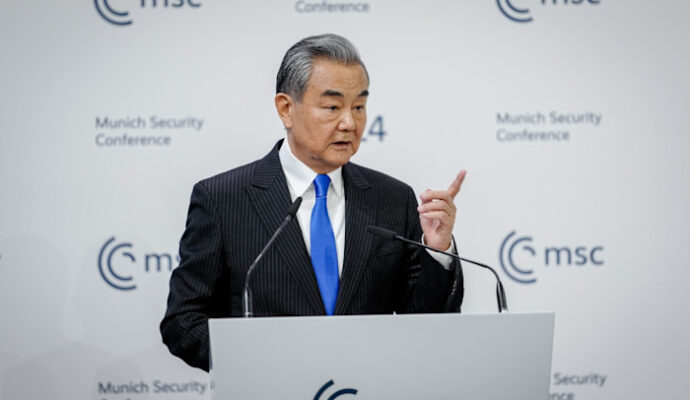
With Trump, China also sees an opportunity to drive a wedge between Washington and its European allies. At the Munich Security Conference, Chinese foreign minister Wang Yi told Merz that the chancellor’s speech at the opening ceremony “reflected Germany and Europe’s expectation of strategic autonomy and self-reliance”.
“China supports Germany in playing a greater role in this regard,” Wang said.
Chinese state-owned media have sought to underline this message, urging Berlin to better align itself with German business, which wants to stay engaged in China given its huge industrial base and the reliance of companies such as Volkswagen on its market.
“There has long been a gap between the German government and German businesses in their assessment of China,” Jin Ling, director of the global governance department of the China Institute of International Studies, told China Daily, a state newspaper.