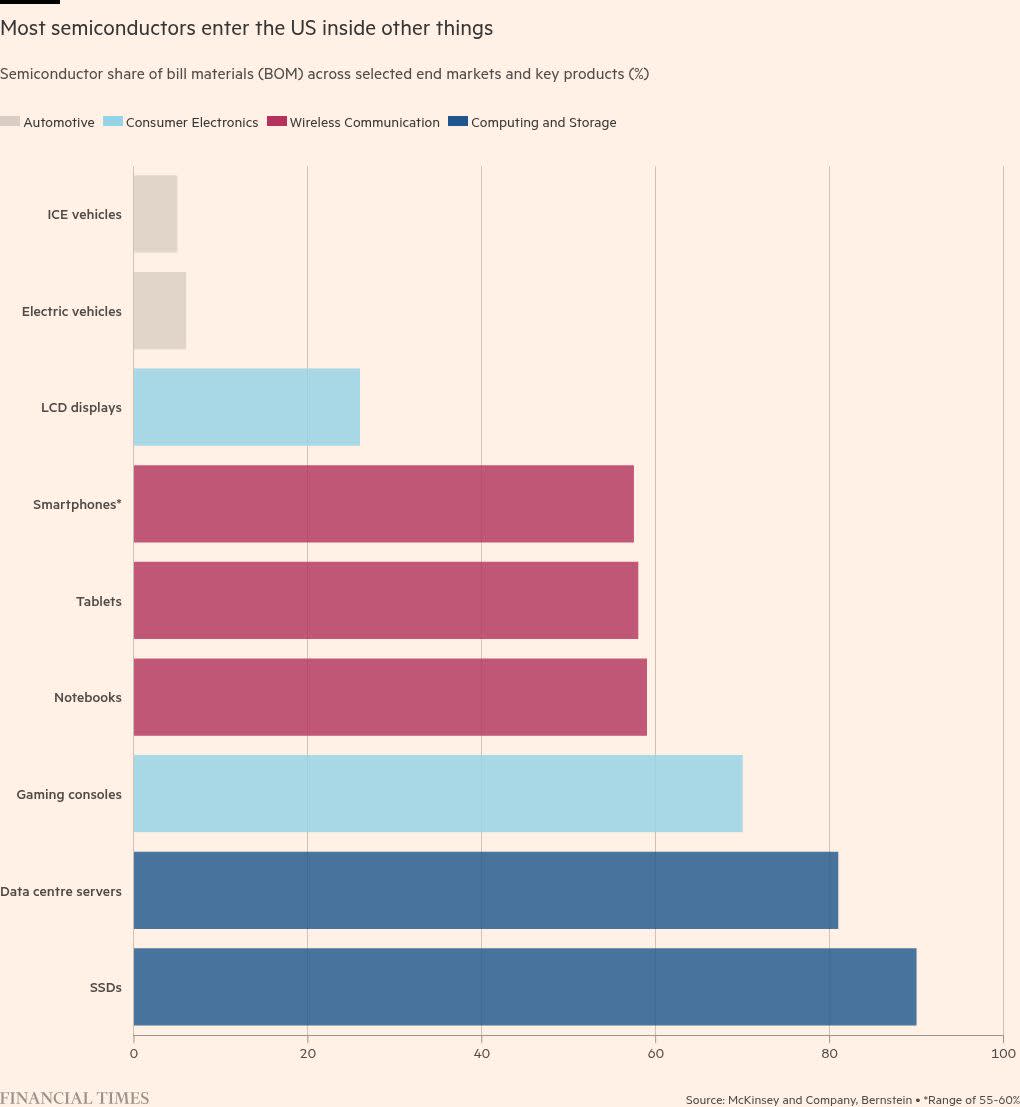
Donald Trump’s decision to exempt Apple from looming semiconductor tariffs has cheered investors who took it as a sign that tech vendors and their suppliers could avoid the levies as long as they pledged US investment.
But industry insiders say the Trump administration’s investigation into chips — including the tools and materials used to make them, and products that contain them — will still hit many companies that lack Apple’s lobbying muscle or the money to build factories in the US.
“Other vendors of devices from notebooks to smartphones would equally have to prove that their direct investment, as well as that of their supply chain, into the US is material enough for them to get an exemption,” said Nicolas Gaudois, head of Asia-Pacific technology research at UBS. “What about all the vendors who cannot demonstrate [that]?”
He added that all the smaller vendors who cannot demonstrate that would possibly face a 100 per cent tariff.
The so-called Section 232 investigation is one of nine probes in which the Trump administration is considering sectoral tariffs on industries including cars, steel, pharmaceuticals and drones, on grounds that the US needs to protect its markets for national security.
The semiconductor investigation is one of the most complex and closely watched given chips’ importance to the modern global economy, and the deals that the US reaches with some companies — and tariffs it might apply to others — could quickly trigger competitive shifts in the chip industry.
On Wednesday Trump said the chip tariff rate would be “approximately 100 per cent”, adding that it would not apply to those building production capacity in the US.
He named Apple as a beneficiary of that exemption after the iPhone maker raised its pledge for US investments by $100bn to $600bn.
Others are not in the same position. An executive at a Japanese chipmaker that supplies Apple said a “huge issue” is that it has hundreds of suppliers “who would have no capacity to go to the US”.
The person said that state-backed agencies that could support Japanese investment in the US were more comfortable with lending to traditional sectors such as steel and shipbuilding. Tokyo has committed to investments worth $550bn as part of its bilateral tariff deal with Washington.
Executives and analysts said the Trump administration’s opaque, chaotic and transactional approach to tariffs made it hard to gauge what companies have to do in order to be spared.
Taking Apple as an example, one observer called the investments referenced for achieving an exemption for iPhones a “hodgepodge”. They include investment pledges not by Apple itself but by its largest supplier Foxconn, as well as projects that are earmarked for assembly of servers, not smartphones.
“We are having a useful dialogue with [the US Department of] Commerce, but they don’t know what is going to happen,” said an executive at a chipmaker with capacity in the US. “It is unpredictable because Trump decides, he conducts policy extortion, and he is ad hoc transactional.”
Other industry executives involved in discussions with the Commerce department said they expected the probe to result in a patchwork of company- and country-specific deals.
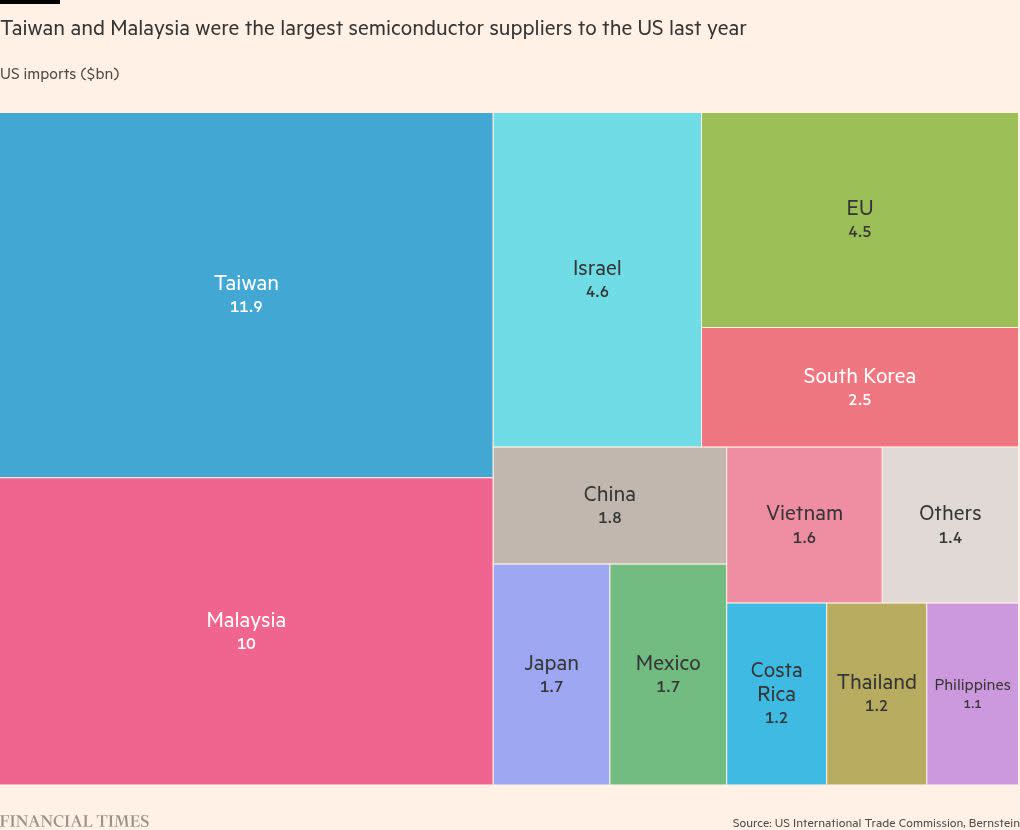
Two said Taiwan Semiconductor Manufacturing Company would be exempt because it is building fabrication plants, or fabs, in Arizona, which the world’s largest chip manufacturer has said will eventually add up to investments of $165bn.
Analysts said Korean smartphone and chip producer Samsung’s fab investments in Texas were large enough to give it cover too.
Then there are country-specific arrangements. Sravan Kundojjala, of chip consultancy SemiAnalysis, said Washington was pursuing deals with key allies or manufacturing centres including South Korea, EU, Taiwan and Japan to reduce any disruption to chip supplies.