Planet closer to destruction as Russia, China and US become more aggressive and nationalistic, says advocacy group Earth is closer than it has ever been to destruction as Russia, China, the US and other countries become “increasingly aggressive, adversarial, and nationalistic”, a science-oriented advocacy group said on Tuesday as it advanced its Doomsday Clock to 85 seconds until midnight. The Bulletin of the Atomic Scientist members had an initial demonstration on Friday and then announced their results on Tuesday. Continue reading… The Guardian
Tag: India
The Guardian view on Europe’s payments problem: sovereignty starts at the till | Editorial
When the centre-left French politician Aurore Lalucq posted a warning last Wednesday that Donald Trump could cut off Europe from international payment systems, the clip went viral. To many, her message made sense. After all, if Mr Trump was prepared to test allies’ boundaries over Greenland, it is not far-fetched to imagine Visa and Mastercard becoming used against a recalcitrant Europe. The US can turn off payment systems it controls. Russia learned this first-hand after sanctions were rightly applied for its invasion of Ukraine. As up to 60% of Russian…
The Guardian view on food security: Britain can no longer trust markets alone | Editorial
Food policy across much of the world is changing. But not in Britain. That may be a costly mistake as the prices of essentials rise because of the climate emergency, geopolitical tensions and the fragility of just-in-time supply chains. Many capitals are now reviving their strategic food reserves. European nations such as Sweden, Finland, Norway and Germany are rebuilding stocks dismantled after the cold war. Climate shocks have led to Egypt and Bangladesh boosting similar programmes. Countries such as Brazil and Indonesia – sensitive to the food needs of their…
A hovering helicopter and a winter whiteout: photos of the day – Tuesday
The Guardian’s picture editors select some of the most powerful photos from around the world Continue reading… The Guardian
Coal power generation falls in China and India for first time since 1970s
Coal power generation fell in China and India for the first time since the 1970s last year, in a “historic” moment that could bring a decline in global emissions, according to analysis. The simultaneous fall in coal-powered electricity in the world’s biggest coal-consuming countries had not happened since 1973, according to analysts at the Centre for Research on Energy and Clean Air, and was driven by a record roll-out of clean energy projects. The research, commissioned by the climate news website Carbon Brief, found that electricity generated by coal plants…
Five tech trends we’ll be watching in 2026
Hello, and welcome to TechScape. I’m your host, Blake Montgomery, wishing you a happy New Year’s Eve filled with cheer, champagne and Mariah Carey’s comically awful rendition of Auld Lang Syne. Today, we’re looking forward to the next year in technology news. I am watching five trends I think will define the year: datacenters will see rapid proliferation beyond the US and China; billionaires will reap billions more; self-driving cars will park themselves in a slew of brand-new locales; AI will find its niche at work; and consumer tech will…
How Did the C.I.A. Lose a Nuclear Device in the Himalayas?
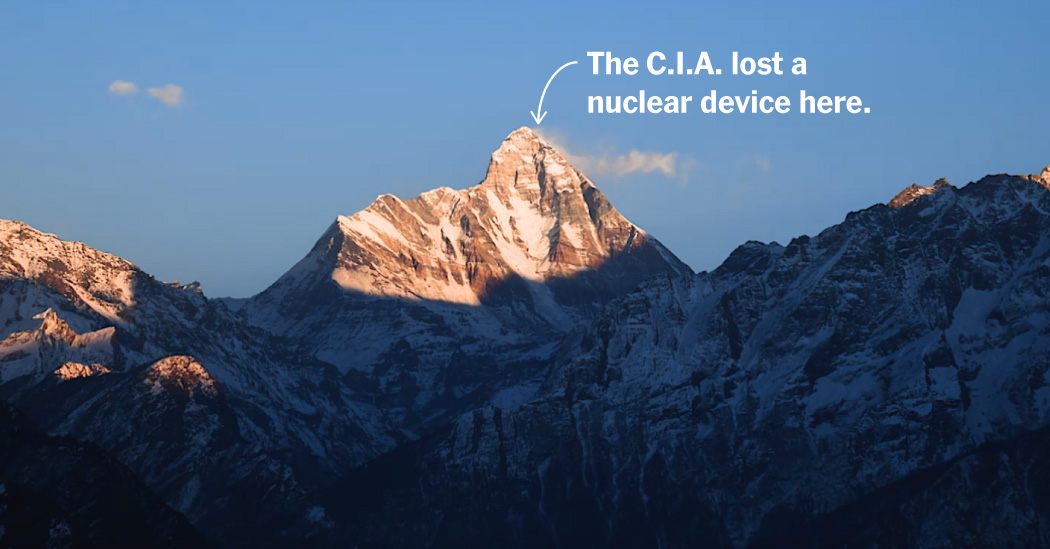
The mission demanded the utmost secrecy. A team of American climbers, handpicked by the C.I.A. for their mountaineering skills — and their willingness to keep their mouths shut — were fighting their way up one of the highest mountains in the Himalayas. Step by step, they trudged up the razor-toothed ridge, the wind slamming their faces, their crampons clinging precariously to the ice. One misplaced foot, one careless slip, and it was a 2,000-foot drop, straight down. Just below the peak, the Americans and their Indian comrades got everything ready:…
‘A shift no country can ignore’: where global emissions stand, 10 years after the Paris climate agreement
Ten years on from the historic Paris climate summit, which ended with the world’s first and only global agreement to curb greenhouse gas emissions, it is easy to dwell on its failures. But the successes go less remarked. Renewable energy smashed records last year, growing by 15% and accounting for more than 90% of all new power generation capacity. Investment in clean energy topped $2tn, outstripping that into fossil fuels by two to one. Electric vehicles now account for about a fifth of new cars sold around the world. Low-carbon…
How three Uyghur brothers fled China – to spend 12 years in an Indian prison
On the evening of 12 June 2013, according to court documents, three “Chinese intruders” were arrested by the Indian army in Sultan Chusku, a remote and uninhabited desert area in the mountainous northern region of Ladakh. The three Thursun brothers – Adil, 23, Abdul Khaliq, 22 and Salamu, 20 – had found themselves in an area of unmarked and disputed borders after a 13-day journey by bus and foot over the rugged Himalayan terrain through China’s Xinjiang province, which borders Ladakh. The men told army officials that they had fled…
Putin says he will never bow to US but concedes sanctions may cause ‘some losses’
Vladimir Putin has said Russia will never bow to US pressure but conceded new sanctions could cause some economic pain, as China and India were reported to be scaling back Russian oil imports after Washington targeted Moscow’s two largest producers. The US on Wednesday imposed sanctions on Rosneft and Lukoil, as well as nearly three dozen of their subsidiaries, as the Trump administration increased pressure on the Kremlin to negotiate an end to its war against Ukraine. The EU separately discussed a loan for Ukraine secured on frozen Russian assets…