China could cut off supplies to Taiwan-controlled Pratas Island, but forcing Taipei to abandon the remote outpost would require a sustained operation that might be too risky for Beijing, analysts told Radio Free Asia.
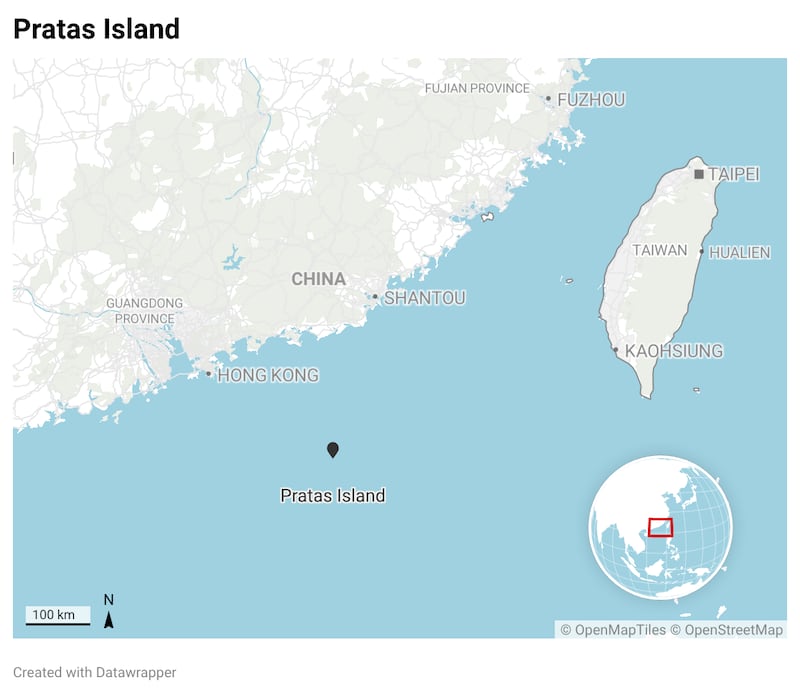
The tiny atoll known as Dongsha Island in Chinese lies more than 400 kilometers (250 miles) from Taiwan’s main island, about 260 kilometers (160 miles) from the Chinese mainland in the northern South China Sea.
The island’s isolation makes maintaining access by sea and air central to sustaining the coast guard and military personnel stationed there.
Beijing likely has the power to cut Pratas off completely, but such a move might not be necessary at all, Benjamin Blandin, a maritime security expert and visiting research fellow at Taiwan’s Institute for National Defense and Security Research, told RFA.
“China could achieve significant strategic benefits without imposing a complete blockade or forcing an immediate Taiwanese withdrawal,” said Blandin.
For Beijing, the potential gains could include regulating selected activities or compelling Taiwan to negotiate access, Blandin said. Such restrictions could erode Taipei’s authority even while Taiwanese personnel remained on the island.
But disrupting deliveries and making the outpost impossible to sustain are different objectives, Sylwia M. Gorska, a doctoral candidate in international relations at Britain’s University of Central Lancashire, told RFA.
“Making Taiwan’s presence unsustainable would require much more extensive restrictions, particularly given the island’s existing air and maritime supply options,” Gorska told RFA.
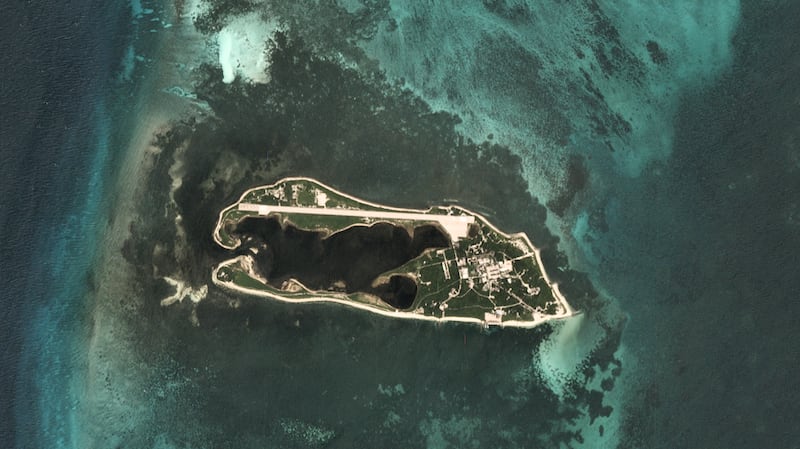
The portion of the atoll above sea level features an air strip and two piers.
Both analysts cautioned that recent encounters near Pratas do not establish that Beijing has decided to cut the island off, though these encounters have sharpened concerns about access.
Posturing coast guards
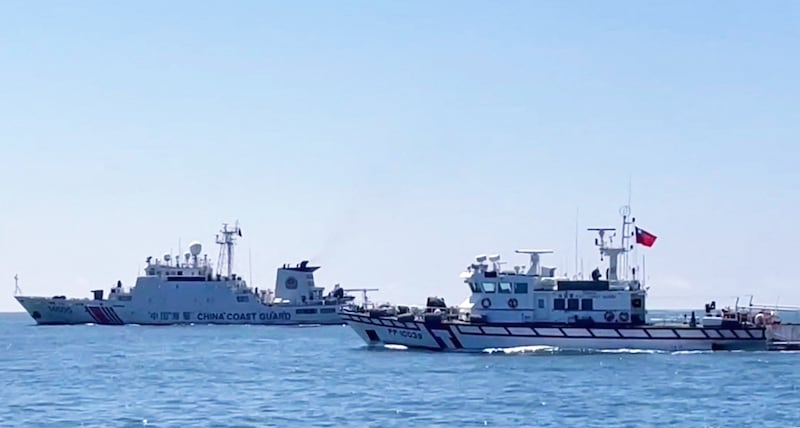
Taiwan’s coast guard on Sunday accused China of “harassment” after a Chinese coast guard ship on Saturday went into a restricted area of water near the atoll. A Taiwan coast guard vessel got as close as 1 nautical mile and asked the Chinese ship to leave.
Taipei called on China to “immediately cease” its acts of harassment, after what it said was the 13th such incursion near Pratas Island this year.
China maintains that the atoll is within its sovereign territory and called the incident a “routine law enforcement patrol.”
It was the third Pratas-related incident between the two countries in October alone, with similar incidents occurring Oct. 18 and Oct. 1.
Such encounters challenge Taiwan’s authority, the analysts said, but the more consequential test would involve Chinese ships issuing instructions to Taiwanese supply missions, then enforcing compliance.
Blandin identified three potentially overlapping stages: normalizing China’s maritime presence, asserting jurisdiction, and establishing effective control over access.
Demands for identification, inspections or course changes would indicate a move toward exercising authority, he said, adding that repeated obstruction of deliveries, personnel rotations or emergency evacuations would provide stronger evidence of an isolation campaign.
“The distinction between challenging Taiwan’s maritime authority and actively preventing the replenishment of its outposts is fundamental,” Blandin said.
Gorska said requirements for advance authorization or compulsory inspections would signal an attempt to regulate access. Persistent obstruction of successive deliveries, particularly alongside interference with flights, would indicate a more extensive effort to isolate Pratas.
“The principal concern is that Beijing may eventually seek to enforce the authority it is currently asserting, thereby transforming jurisdictional claims into restrictions on access,” she said.
Keeping supplies moving
Taiwan has strengthened its local patrol capabilities. Its coast guard said in September that a wharf renovation had been completed on July 1, allowing newly built 100-ton patrol boats to be stationed at Pratas alongside regular deployments of larger patrol ships nearby.
Those improvements strengthen the response around the atoll but do not guarantee security along its supply routes, Gorska said.
Larger reserves would give Taiwan more time to respond to disrupted deliveries, while maintaining maritime and air transport would provide flexibility. Blandin said sea transport would remain important for substantial quantities of equipment and provisions, with aircraft offering a complementary option when conditions permitted.
Escorting deliveries could help preserve access, but repeated Chinese obstructions would force difficult decisions about how far Taiwan should go to challenge them.
Taipei could deploy additional coast guard vessels, improve surveillance or involve military assets more directly, Blandin said. Each option would have to be weighed against the risk of escalation.
“Beijing’s main challenge would be sustaining those restrictions without losing control over the level of confrontation,” Gorska said.
Stopping an individual delivery leaves room to retreat or negotiate, she said. Repeatedly preventing escorted ships or aircraft from reaching Pratas would carry substantially greater risks and could provoke a wider cross-Strait crisis.
Lessons from the Philippines
The Philippines’ efforts to supply its outpost aboard the grounded BRP Sierra Madre at Second Thomas Shoal offer a comparison, although the geography, logistical needs and security arrangements differ.
Blandin said Manila’s persistence in continuing deliveries, along with documenting and publicizing confrontations, offered lessons for Taiwan. Defensive equipment, surveillance and proportionate responses could improve resilience, but none would guarantee access against sustained interference.
Gorska said practical arrangements to prevent dangerous encounters also carried a political challenge: communication should not become an acceptance of Beijing’s claimed authority to approve deliveries.
The comparison has another major limit. The Philippines has a mutual defense treaty with Washington, and U.S. defense guidelines explicitly include armed attacks on Philippine coast guard vessels in the South China Sea within those commitments. Taiwan has no equivalent treaty.
The Taiwan Relations Act treats efforts to determine Taiwan’s future through nonpeaceful means, including boycotts or embargoes, as a matter of grave concern to the United States. It does not specify a U.S. military response to interference with supplies to Pratas.
That uncertainty would factor into Beijing’s calculations, Gorska said.
For Blandin, China’s ability to deploy ships around Pratas is only the beginning.
“The central question is therefore not simply whether China possesses the capabilities to isolate Pratas, but whether it could sustain such an operation and convert maritime coercion into lasting territorial control at an acceptable political, military and diplomatic cost.”
Edited by Eugene Whong.