Unlock the Editor’s Digest for free
Roula Khalaf, Editor of the FT, selects her favourite stories in this weekly newsletter.
Hong Kong’s stock exchange operator has posted a second consecutive year of record profits after the city became one of the top listing destinations worldwide.
Net profit rose 36 per cent to HK$17.8bn (US$2.3bn) in 2025, the company said on Thursday. Core business revenues, which include fees from trading and clearing, rose 32 per cent to HK$27.1bn.
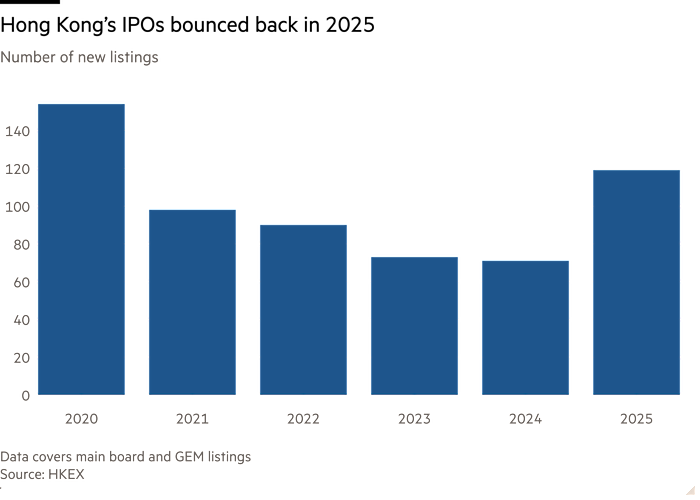
The results show the scale of Hong Kong’s comeback as a hub for initial public offerings and trading following a slump in 2023.
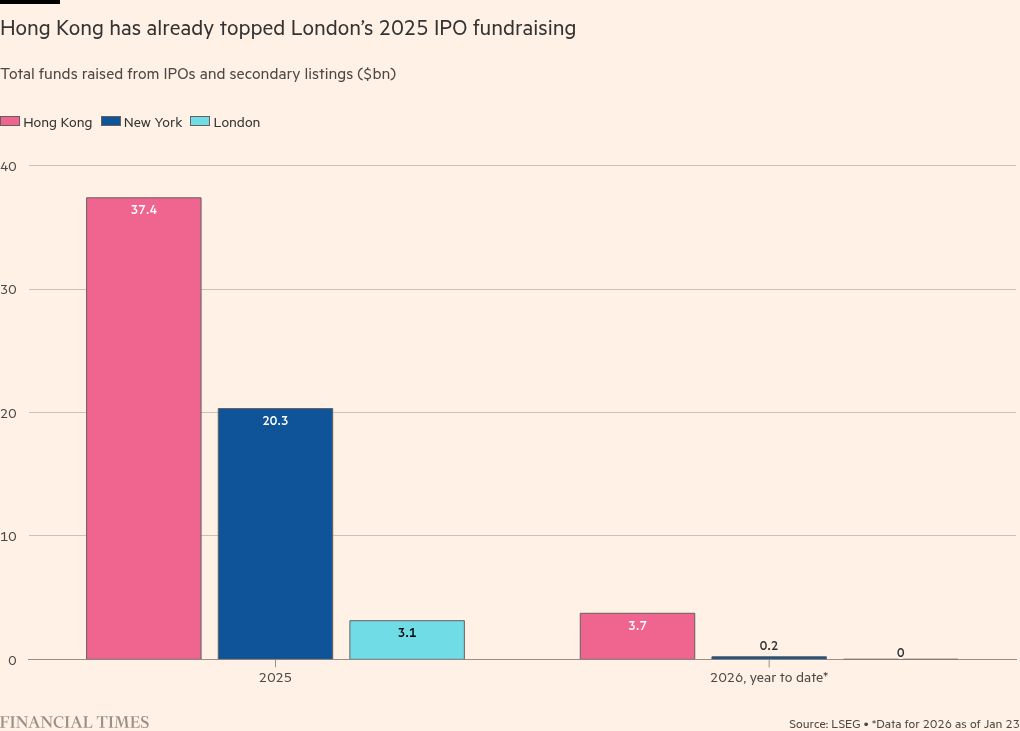
It was the second most active IPO destination last year, behind only the US. More money was raised from Hong Kong listings in the first two weeks of 2026 than in London in the whole of 2025.
The performance is a boost for chief executive Bonnie Chan, a former Davis Polk capital markets partner who took over from Argentine investment banker Nicolas Aguzin in 2024 with a mandate to revitalise the exchange in the face of a weak post-pandemic recovery and growing competition from mainland China.
In 2025, Chan’s report card was clear: 119 listings raising a total of HK$287bn, up more than 200 per cent year on year.
“Global investors returned with conviction; innovation from the Chinese mainland and across Asia kept our markets vibrant; liquidity deepened; pipelines strengthened; and capital connected with opportunities,” Chan said in a statement following the exchange’s results.
Average daily turnover for the full year rose 90 per cent to HK$250bn in a sign traders and investors were piling into Hong Kong-listed stocks.
HKEX shares rose 0.5 per cent on Thursday after the earnings release.
Chan emphasised that HKEX was not only dependent on IPOs and was also expanding its product offerings across fixed income and derivatives.
“We are developing a multi-asset ecosystem which, with global investors increasingly seeking diversification opportunities, will be key to reinforcing the resilience and competitiveness of Hong Kong,” she said.
HKEX last year said it would take a 20 per cent stake in CMU OmniClear, which is building a settlement house to rival Belgium’s Euroclear.
The HKEX-owned London Metal Exchange also approved Hong Kong as an official warehouse location in a boost for the territory’s aim of becoming a commodities hub linking China’s metals market with the rest of the world.
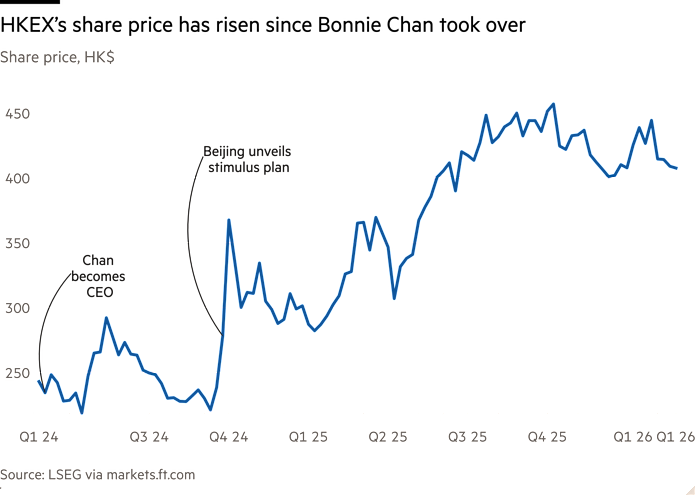
But ultimately, HKEX has benefited from two forces in the past year: US-China tensions that have pushed mainland companies to list in Hong Kong and an easing of regulatory requirements from Beijing for fundraising in the city.
“China geopolitical tensions have accelerated capital repatriation,” said Julia Charlton, founding partner at Charltons law firm in Hong Kong, who added that “three-quarters of the largest Chinese firms listed in New York now [have] parallel Hong Kong listings as a risk mitigation strategy.”
However the proportion of newly listed stocks that were flat or down on their first day nudged up in the final two months of 2025, suggesting concerns that Hong Kong’s market might be overheated.
Hong Kong’s financial authorities, including HKEX and the Securities and Futures Commission, have also warned bankers on the quality of some IPO paperwork.
“The situation may also be exaggerated by the fact that many of the tech sector Chinese companies listing on the HKEX are not profit making and some, for example in the biotech sector, may not be revenue generating, adding to investor risk,” Charlton said.
Data visualisation by Haohsiang Ko