Unlock the Editor’s Digest for free
Roula Khalaf, Editor of the FT, selects her favourite stories in this weekly newsletter.
Volatility, claims Xu Xudong, is the key to making money in the gold business. And for this wholesaler, the past year has been an embarrassment of riches.
“It takes volatility to heat the market up, otherwise it’s just flat,” he said, sipping tea in the Shuibei gold wholesale district of Shenzhen in southern China.
The future, he added, was bright, at least for the remaining three years of US President Donald Trump’s term. “I think we need him to stay in office.”
Xu’s confidence reflected the defiant mood in Shuibei — a manufacturing, wholesale and retail hub that handles about 70 per cent of the Shanghai Gold Exchange’s annual physical deliveries — days after a host of precious metals notched some of their steepest losses in decades.
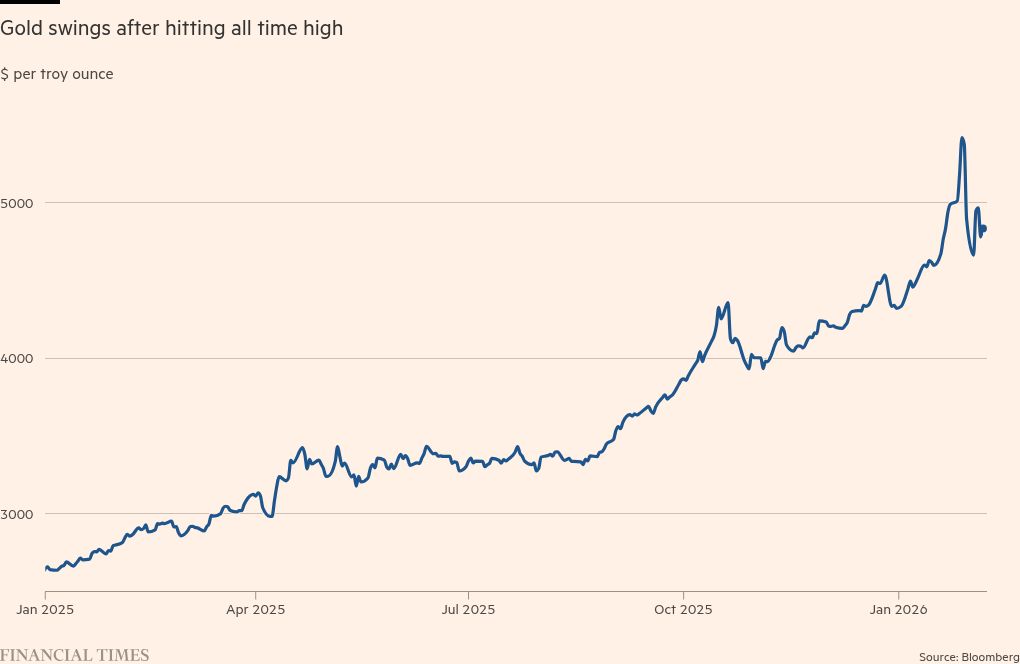
The price of gold has whipsawed, crashing after Trump recommended Kevin Warsh as the next chair of the Federal Reserve. The fall brought an end to a blistering rally that had pushed the yellow metal to a record high of $5,595 a troy ounce.
But with gold edging higher this week and still more than 80 per cent higher than it was at the start of 2025, Shuibei wholesalers were confident they could outlast the turbulence.
Across China, gold has long been an important store of value and a physical alternative to low-interest deposits in state banks. In the run-up to lunar new year, gold and precious metal sellers roam Shuibei’s leafy streets, moving between its dozens of gold, silver, jade and platinum malls.
“The metals craze started around the end of 2022,” said Huang Qianqian, referring to the dash to haven assets in the wake of Russia’s full-scale invasion of Ukraine. She rushes around the small ground-floor shop of one shop, packing and binding thin gold bars marked with lunar new year messages together with elastic bands.
“In the past we did less business in a year than we do now in one month. Since 2023, 2024 our volume has been pretty big . . . We handle more than 10,000 of these a day,” she said.
The optimism has not just been confined to gold. Li Zhaofeng, another wholesaler, said that in recent months sellers in the wholesale district had even started selling copper bars to capitalise on the demand for metals. “Nowadays, the whole precious metals market is pretty good,” he added.
After gold fell in recent days, Gu Qianhong, who runs a stall selling gold trinkets and silver bars in the basement of one of the area’s malls, said that sales had slowed. “Chinese people buy high and they don’t buy low,” he added. “They might be able to take the fall in the gold price, but the [steeper] fall in the silver price will likely be too much.” Silver fell more than 26 per cent on the day of Warsh’s nomination and is now trading around $71.3 a troy ounce, down from its peak of $121.7 a troy ounce.
The potential for losses became clear when videos posted online showed angry people flooding the streets of Shuibei to demand refunds from online trading platform Jieworui. Posts said users had been unable to withdraw funds from the platform.
The platform, a hybrid of a private futures exchange and a physical exchange, promised relatively higher returns on gold deposits, while touting a free jewellery-making service, said Darren Leng, a Shenzhen-based partner at Zhonglun W&D Law Firm. As prices crashed, investors rushed to redeem their holdings, triggering a liquidity crunch at Jieworui, Leng said.
Jieworui is now offering investors haircuts of up to 90 per cent on their principal. In a notice to investors seen by the FT, the company said: “Had the run on redemptions not occurred, the company would have been able to complete all payments smoothly. After the run began, operations were severely disrupted . . . making normal business operations unsustainable.”
It added that it has applied for its assets to be placed under government supervision. “Even in the worst-case scenario, the company will still repay everyone’s returns on a pro-rata basis,” it said. The platform had begun repayments under government supervision, according to a local government notice published in state media.
One Shenzhen-based investor, surnamed Chen, told the FT he feared a paper loss of about Rmb50,000 ($7,200). “It’s shameful,” Chen said. “I felt awful and didn’t dare tell my family about the loss. I only made additional investments around January 19, and now I feel spooked.”
The Shenzhen office of Jieworui was empty when the FT visited. The company did not respond to calls or emails.
Elsewhere in Shuibei, dealers say the recent buoyancy of precious metals has insulated dealers from significant losses.
“If you’re talking about sales, [the recent decline] has affected us, but it hasn’t affected the returns on our capital, because we bought in at a relatively low price,” said platinum dealer and wholesaler Wei Xinrui.
But she would not be drawn on whether the price would recover. “It’s impossible to tell. I also want to buy some myself.”
Additional reporting by Cheng Leng in Beijing