Unlock the Editor’s Digest for free
Roula Khalaf, Editor of the FT, selects her favourite stories in this weekly newsletter.
The world’s two largest chipmakers have warned that investment in new capacity will not come fast enough to alleviate an AI-driven supply squeeze in semiconductors.
Samsung Electronics and SK Hynix said in earnings calls on Thursday that they would increase capital spending “substantially” this year but expected chip shortages to exacerbate in the short term as heightened demand for memory chips in AI data centres tested their capacity.
“We are planning a substantial increase in our capital expenditure in 2026 as AI-driven demand is likely to continue,” said Kim Jae-june, executive vice-president of Samsung’s memory business. “But supply shortages are likely to worsen as capacity expansion is expected to be limited this year and next.”
Chipmakers are reporting record earnings on the back of the AI boom. Net profit at SK Hynix more than doubled to Won42.9tn ($30bn) last year, while at Samsung it rose 31 per cent to Won45.2tn. Their shares have surged 330 per cent and 200 per cent, respectively, in the past 12 months.
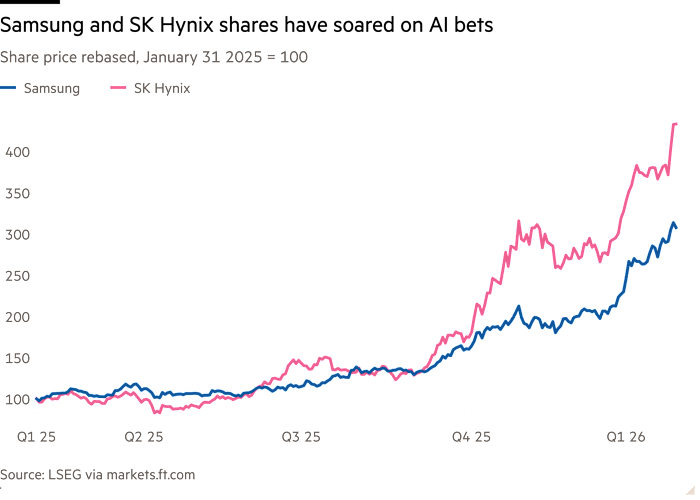
The chipmakers are benefiting from multiyear contracts with technology companies hoping to secure semiconductors for their data centre build-outs. These deals have constrained supply for other chip customers, including makers of phones and consumer electronics.
SK Hynix said it expected chip supply to remain tight “for the time being”. The company said it would maintain capital spending at mid-30 per cent of revenues, despite sales surging.
“Demand is growing sharply, but it takes time to expand capacity, so the mismatch in demand and supply is worsening, pushing chip prices higher,” said Song Hyun-jong, president of SK Hynix, on Thursday.
Analysts said the memory chip business, which was once defined by sharp boom-and-bust cycles, was now going through a structural change thanks to the emergence of high-bandwidth memory chips used in AI hardware.
“The memory market is shifting toward semi-customisation, with memory customers required to sign a contract a year prior to actual product delivery,” said Peter Lee, analyst at Citigroup, in a note this week.
Lee expects average prices of dynamic random-access memory chips, which include HBM chips for AI servers, to jump 120 per cent this year, while prices for Nand flash memory chips, which are used to store data without power, to rise 90 per cent.
SK Hynix said it aimed to maintain its “overwhelming” market share in HBM4 chips. The company controls more than 60 per cent of the overall HBM market, according to Macquarie Equity Research.
But competition is intensifying in the most advanced HBM chips to be used for Nvidia’s upcoming Vera Rubin processors.
Samsung is in the final stage of completing the qualification process for supplying HBM4 chips to Nvidia. It plans to deliver them in February and expects HBM revenues to more than triple this year.
“Memory is a chokepoint now, and I expect this tightness to be structural through at least Q4 2027,” said Kwon Seok-joon, a professor at Sungkyunkwan University in Seoul. “The timing depends on AI capex and how fast new capacity actually comes online.”
Additional reporting by Daniel Tudor in Seoul