On the day Xi Jinping publicly purged his top general, it was business as usual for the People’s Liberation Army, which sent 29 aircraft and six warships towards Taiwan, as it trains for taking the island the Chinese leader insists Beijing must eventually control.
But analysts and intelligence officials believe that President Xi’s toppling of General Zhang Youxia, the crowning act of what has become the most sweeping purge in the PLA’s history, means China’s military is entering uncharted waters.
While many experts argued that Zhang’s downfall, which was announced on Saturday, would not itself severely disrupt the PLA’s ability to train and patrol, some said the purge could delay its progress towards goals set by Xi including, according to US intelligence, being ready to invade Taiwan by 2027.
The Communist Party leadership is investigating both Zhang — first vice-chair of the Central Military Commission and by many accounts Xi’s right hand in modernising the military — and Liu Zhenli, the CMC’s chief of staff, on suspicion of corruption and undermining Xi’s authority.
“The purge of Zhang and Liu will push back Beijing’s ability to launch an invasion of Taiwan; they cannot be ready by 2027 under these circumstances,” said one intelligence official in east Asia.
But the official added that younger replacements for generals purged in the past tended to be more professional, more nationalistic and more beholden to the Chinese leader. “That means if you assume that Xi is itching to attack Taiwan, the military threat will grow much more formidable a few years down the line,” the official said.
Xi has not publicly set any military goals on Taiwan. But he has ordered the PLA to become a high-tech force by 2027 and accelerate progress towards becoming a fully modernised military by 2035 and a world-class force on par with the US by 2049.
The need to replace purged officers at the top of nearly all military institutions in charge of strategy, planning, command, training and wartime operations could rapidly create an officer corps more devoted to Xi’s goals.
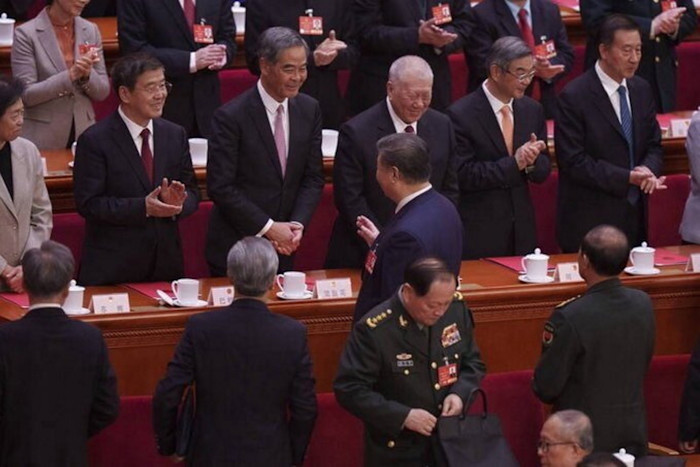
Since becoming party chief in 2012, Xi has removed at least 80 senior PLA officers at the rank of lieutenant-general or vice admiral and above, according to a tally by Andrew Erickson, an expert on Chinese military affairs at the US Naval War College. According to an FT count, at least 50 of those removals have happened since 2023.
The purges have ensnared the leaders of almost all the service branches and the regional commands that would direct operations in wartime and, in many cases, several of their senior officers.
James Char, assistant professor at Singapore’s S Rajaratnam School of International Studies, said that in most cases since the second half of 2025, Xi has tapped second-line PLA leaders to fill such roles across CMC departments and theatre commands on an interim basis.
Xi promoted Zhang Shengmin, now the only remaining active CMC member other than himself, to vice-chair of the commission in October, and new commanders for the eastern and central theatre commands were announced last month. But various other key responsibilities have been taken over by lower-ranked deputies.
“The PLA’s deep bench means there will always be someone younger and more professional to take over from those who have been deposed,” said Char, who has been tracking Xi’s military purges.
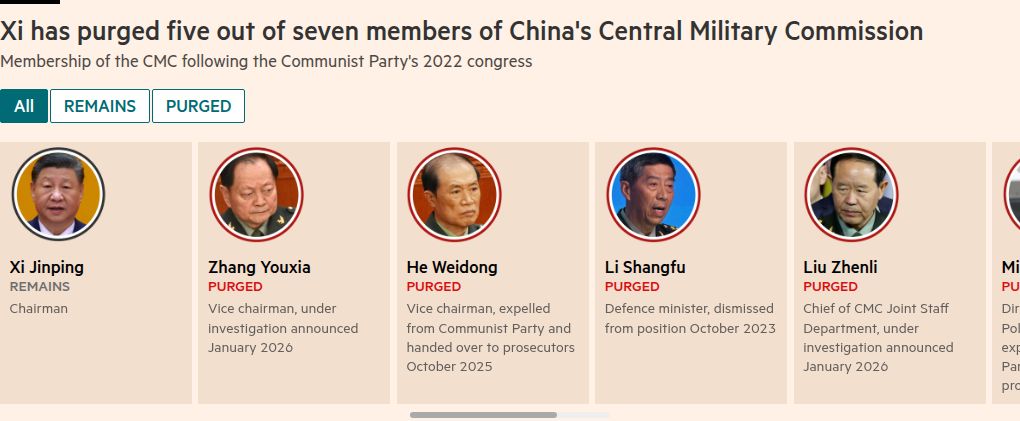
The purge of Zhang and Liu, following that of two other CMC members last year and one in 2023, has completed the hollowing out of a body that was designed to direct military strategy and operations through group consultation.
Zhang and Liu were together responsible for reforming PLA training to prepare it for future combat. Joshua Arostegui, research director of the China Landpower Studies Center at the US Army War College, said their joint departure had clear “warfighting readiness implications”.
“Their simultaneous removal leaves a gap near the top of the chain of command that would direct how and to what extent the military will train, equip and fight,” Arostegui said. “If their subordinates had fully bought into their vision, it will take time for them to adjust to changes that would likely come following a change in leadership.”
But analysts said the implications of the neutering of the CMC would depend on Xi’s motives for axing Zhang and Liu.
Tristan Tang, a non-resident fellow at the Pacific Forum think-tank, believes Zhang was ousted because he did not follow Xi’s preferred roadmap for development of a force able to take Taiwan.
Xi’s speech at last year’s session of China’s rubber-stamp legislature and documents drafted under his direct leadership signalled his “greater haste”, including for achievement by 2027 of joint operational capability for a Taiwan invasion, Tang wrote in a research note published on Monday.
Zhang instead favoured tackling long-standing PLA weaknesses by next year and then aiming to build towards a 2035 goal, wrote Tang, who expects Xi to replace Zhang and Liu with successors more willing to accelerate joint operations training.
“As a result, while the Chinese military remains unlikely to invade Taiwan in the near term, PLA training and exercise activity may become more aggressive and more frequent than in recent years,” Tang said.
Others do not agree that differences on modernisation priorities or speed of execution caused Xi to sour on Zhang.
“If there really were differences in judgment on professional military issues . . . wouldn’t it have been less of a public relations disaster for the PRC [People’s Republic of China] and PLA for Xi to remove him in a dignified manner and thank him for his service than portraying him as a disloyal, corrupt scoundrel?” asked Dennis Blasko, a former US Army officer and military intelligence officer who researches the PLA.
Blasko said leadership changes appeared to have little immediate impact on PLA operational units and activities, mainly because training schedules are prepared for a full year and follow conscription and demobilisation cycles.
The CMC’s role had already been reduced by the creation under it of a Joint Operations Command Centre designed to oversee combat and co-ordinate operations between regional commands, analysts said.
Arostegui said that, even when fully staffed, the CMC was not competent enough as a body to provide detailed management of wartime actions.
“It is difficult to envision significant effects from the removal of those members on the PLA’s current capabilities to carry out combat operations,” he said, though added there was one possible exception.
“If Xi removed Zhang and Liu because they refused to move forward with more aggressive timelines and plans, they might be replaced with leaders that willingly implement unwise policies that could harm combat readiness,” Arostegui said.