Unlock the Editor’s Digest for free
Roula Khalaf, Editor of the FT, selects her favourite stories in this weekly newsletter.
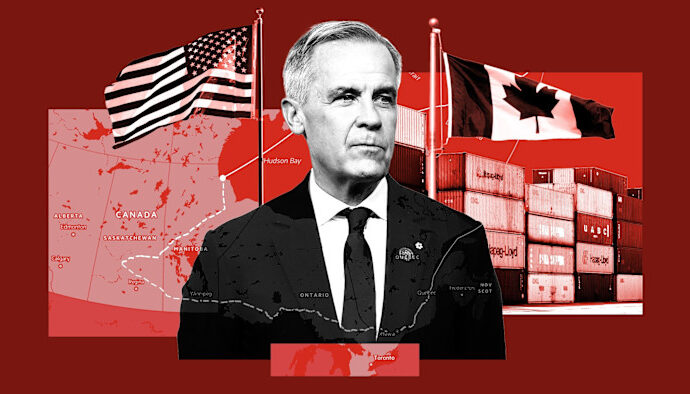
Canada and China have agreed to lift trade barriers on electric vehicles and canola, as Prime Minister Mark Carney met Xi Jinping in Beijing on Friday in an effort to mend strained ties between the countries.
Carney, the first Canadian prime minister to visit Beijing in almost a decade, is turning to the world’s second-largest economy as part of an effort to double exports to non-US partners over the next decade.
For Xi, the trip offers a chance to take advantage of President Donald Trump’s erratic policies towards Canada and bring an important US economic partner and Nato ally closer into its orbit.
Under the agreements signed on Friday, Canada will accept imports of 49,000 Chinese electric vehicles at a most-favoured nation tariff rate of 6.1 per cent, down from 100 per cent.
In exchange, China will slash tariffs on Canadian canola imports to 15 per cent from March 1, down from an effective rate of about 85 per cent. Total Canadian canola exports to China were valued at almost C$5bn (US$3.6bn) in 2024.
China will also permit visa-free travel for Canadians, according to Carney. The prime minister said the agreements covering trade, energy and agrifood would create “massive opportunities” for both countries.
“We are forging a new strategic partnership that builds on the best of our past, reflects the world as it is today and benefits the people of both our nations,” he said.
Xi told his Canadian counterpart they needed to build “a new type of China-Canada strategic partnership” to “better benefit the peoples of the two countries” and “world peace”.
Carney’s visit to Beijing is the first by a Canadian leader since Justin Trudeau in late 2017.
Relations between the two countries deteriorated in 2018 when China detained two Canadians in response to Canada’s arrest of Meng Wanzhou, the chief financial officer of Chinese telecommunications equipment group Huawei, following a US extradition request.
Ties began to improve in June when Carney and premier Li Qiang, China’s second-ranked leader, agreed to “regularise channels of communication”. Carney then met Xi during a summit of the Association of Southeast Asian Nations in October.
Chinese officials and state media were enthusiastic about this week’s visit.
Carney’s trip “is of pivotal and symbolic significance for bilateral relations”, state news agency Xinhua quoted China’s foreign minister Wang Yi as telling his Canadian counterpart on Thursday.
China wanted to “strengthen communication with Canada, enhance trust, eliminate interference, deepen co-operation”, Wang added.
Carney on Thursday also met Li and Zhao Leji, the head of China’s rubber-stamp parliament, the National People’s Congress.
“Our countries align in many areas, such as clean energy, agriculture and finance,” Carney wrote in a post on social media site X after meeting Li.
Ottawa’s official Indo-Pacific strategy released in November 2022 described China as “an increasingly disruptive global power” but added its “economy offers significant opportunities for Canadian exporters”.
On the eve of the trip, Carney said that Canada was “forging new partnerships around the world to transform our economy from one that has been reliant on a single trade partner to one that is stronger and more resilient to global shocks”.
Zhao Minghao, professor at the Institute of International Studies at Fudan University in Shanghai, said: “Most US allies are doing some de-risking from the US, so this is a very important opportunity for China to warm up its ties with Canada.”
Despite the show of friendship, restoring genuine goodwill between Ottawa and Beijing would be difficult, analysts said.
Canada’s security services accuse China of meddling in its elections, threatening members of the Chinese diaspora — in particular Hong Kong activists — and of being its top cyber security threat.
Carney has been under pressure from canola farmers, the lobster industry and fishermen to persuade Beijing to lift devastating tariffs imposed last year.
Under the agreement, Canada said it expected China would lift tariffs on canola meal, lobsters, crabs and peas from March 1 until at least the end of the year.
Ottawa has since October 2024 imposed 100 per cent tariffs on Chinese EVs and 25 per cent levies on Chinese steel and aluminium, closed Chinese-owned social media app TikTok’s offices in Canada and banned Chinese surveillance camera manufacturer Hikvision.