Stay informed with free updates
Simply sign up to the Chinese economy myFT Digest — delivered directly to your inbox.
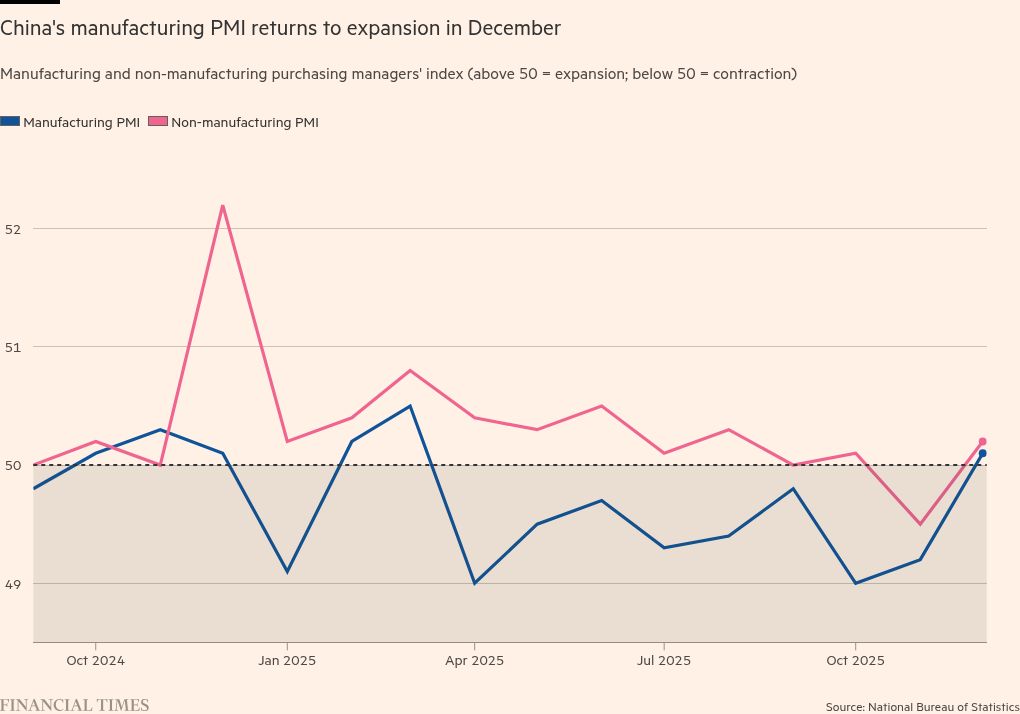
China’s factory activity returned to growth in December, snapping a record eight-month contraction as Beijing tries to spark optimism in the world’s second-biggest economy.
The official manufacturing purchasing managers’ index rose to 50.1 this month from 49.2 in November, according to the data released on Wednesday by the National Bureau of Statistics. The reading was also ahead of the 49.2 expected by analysts in separate polls by Bloomberg and Reuters.
The non-manufacturing PMI, which tracks construction and services, also swung back to growth in December, registering a reading of 50.2 following a three-year low of 49.5 a month earlier. A reading below 50 signals a contraction in activity.
Huo Lihui, a statistician at the NBS, said in a statement that the results showed “production and demand have both expanded significantly”.
But Julian Evans-Pritchard, head of China economics at Capital Economics, cautioned that the positive readings probably reflected a “shortlived upturn in activity” following an improvement in fiscal spending, rather than the start of a more sustained pick-up.
“The big picture is that the structural headwinds from the property downturn and industrial overcapacity are set to persist in 2026 and there appears to be limited appetite among policymakers for a big increase in demand-side stimulus,” he said.
While exports of low-cost and high-tech products have surged, China’s economy has been wracked by deflationary constraints, flagging domestic demand and falling investment. These have put pressure on Xi Jinping’s administration to find long-term drivers of strong growth to offset the years-long crisis in the debt-fuelled property sector.
Beijing has pledged to boost efforts to strengthen consumption, a persistent economic laggard, in the country of 1.4bn people. The National Development and Reform Commission, a top government economic planning agency, on Tuesday announced plans to sell its first Rmb62.5bn ($8.9bn) tranche of ultra long-term special government bonds to support its consumer goods trade-in scheme.
The trade-in scheme, now entering its third year, was launched in 2024 and expanded this year to combat lacklustre consumer confidence. The subsidies will continue to cover smartphones and other consumer electronics as well as offering discounts for electric vehicle purchases, highlighting Beijing’s emphasis on high-tech manufacturing sectors.
The 2026 scheme has been expanded to new “smart” products including watches, glasses and home appliances.
Xi this month urged officials to more urgently address the problem of insufficient domestic demand, which he said was an imperative for “economic stability and economic security”.
He also called on them to boost flailing investment after a shock decline reported in October, while at the same time urging more discipline to avoid over-investment and unsustainable competition in some manufacturing industries.
Despite pressures from US President Donald Trump’s trade war and tensions with western trading partners, Xi’s administration has resisted calls to deploy broader consumer-focused stimulus and roll out sweeping social security reforms. Many economists believe bolder measures are needed to improve sentiment.
Beijing’s next five-year plan, which will take effect in March, highlighted the importance of boosting consumption but remained focused on stepping up high-tech manufacturing and improving “self reliance” in science and industry in the face of the long-term rivalry with the US.
Data visualisation by Haohsiang Ko in Hong Kong. Additional contributions by Tina Hu in Beijing