Good morning. What a year! It’s been an intense 12 months for India. We had a terror attack, a war, a trade stand-off, a deadly plane crash. The markets were down, and then they were up, even though it didn’t ever quite feel like it since it was on a narrow band of stocks. Politically and economically, it was . . . a lot.
I spent the last week looking back at all the stories we have covered during the year to identify the large themes of 2025 and the impact they will have on 2026.
Operation Sindoor
Following the terror attack in Pahalgam in Kashmir, which killed 26 people, India launched missile strikes on the infrastructure of Pakistan’s militant groups on May 7. Islamabad retaliated, and border skirmishes followed over the next three days. On May 10, it looked like things were taking a turn for the worse after India accused Pakistan of launching attacks on its air bases. But both sides announced a ceasefire later that day.
The obvious impact of this escalation — the first major one in a couple of decades — was the further souring of India-Pakistan relations. But what is more significant is the realignment of Washington. In the months since the ceasefire, US President Donald Trump has taunted India through his growing friendship with Pakistan’s army chief Field Marshal Asim Munir. He has also, despite India’s vehement denial, tried to take the credit for the truce.
This year, India recalibrated its foreign policy. Prime Minister Narendra Modi travelled to China for the first time in seven years and met President Xi Jinping. The two countries reaffirmed their commitment to “co-operation based on mutual respect, mutual interest and mutual sensitivity”. In December, Russian President Vladimir Putin visited New Delhi.
India has been careful not to overtly provoke Trump, but it has also shown that it will not be pushed over by him. In 2026, India will have to continue walking this tightrope. While New Delhi’s relations with Beijing have thawed, both parties are still wary of each other. The recent escalation of troubles in Bangladesh will also have a bearing on the region. India will have to manage a tricky balance of allying with the US, China and Russia, while also dealing with tensions in its neighbourhood.
US-India trade deal
Few things have attracted more ink than the US-India trade deal that never happened. In the beginning, after Trump’s election victory, there was much jubilation in New Delhi about getting a friendly administration in the White House. In February, Modi was one of the first foreign leaders to visit Washington. It seemed then that India would be one of the first countries to sign a trade agreement with Trump too.
A deal was expected in May, then June, then July . . . and then talks began to stall. In August, Trump’s reciprocal tariffs kicked in, and by the end of the month, he had announced an additional 25 per cent tariff to punish India for buying Russian oil. No matter how optimistic commerce minister Piyush Goyal tried to sound, it was clear that chances of a deal had dimmed.
Commerce secretary Rajesh Agarwal said this month that there was a fair expectation that both countries would be able to agree on a lower reciprocal tariff and that India was “positively engaged” with the US on the deal. Trump and Modi have spoken to each other in the past fortnight, and both sides have put out warm, fuzzy statements. According to Indian officials, the terms of the deal have been finalised and it is awaiting the president’s signature. Come 2026, a deal looks more certain — or at least as certain as one can be with the Trump administration. And once done, it will mitigate at least some of the immediate uncertainties in the export sector.
Tax reforms
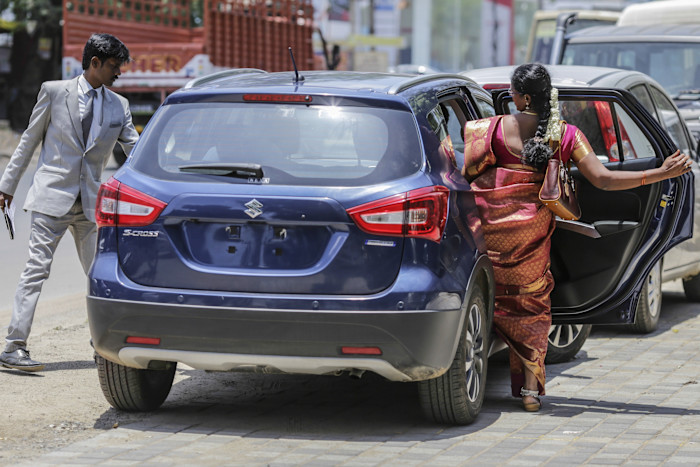
By August, when it began to look like a trade deal with the US was not going to be a shoo-in, the Modi government decided it was time to focus on domestic growth. Several reforms have been launched since, but the most significant one was the much-needed simplification of India’s goods and tax services. Four tax rates were rationalised to two, and several anomalies in the system — such as the popcorn tax (under which three kinds of popcorn were taxed in three different ways) — were eliminated.
This was timed to make the most of the festival season, from September to November, when domestic consumption usually peaks. The immediate result of the GST reforms has been a bit mixed. While some sectors, especially automobiles, are witnessing a healthy uptick, several others have yet to see significant surges.
There were other reforms too, especially in the banking sector, which are meant to deepen and broaden the market as well as make borrowing and project funding less cumbersome. The new labour codes are also significant.
The direction of some of these reforms is correct, even if immediate results are not always visible. But there is a lot more that needs to be done, especially to improve the ease of doing business in India. The hope is that the administration will continue this process in 2026, rather than revert to knee-jerk responses in the face of adversity.
Rupee
The rupee, which has been on a downward slide, got a bruising this year. It lost 6 per cent in 2025, touching an all-time low of 91.14 against the US dollar. There have been very few positive cues for the currency. Occasionally, the central bank has stepped in with some measures to shore up the value, but these have been arbitrary and ineffective overall.
The prognosis for the rupee in 2026 is not very good. It could quite likely breach the 100-to-the-dollar mark, according to some traders I spoke to. Analysts, some of whom were very concerned when the rupee was almost 50 to the dollar, now seem to suggest that the depreciation in the currency will not have a significant negative impact on the economy. I have not fully understood the logic behind their nonchalance. Exporters will benefit, but that is not India’s largest sector. Thankfully, crude prices are low, and so India’s fuel bill is still within manageable levels. If oil prices trend upwards in 2026, however, then a weak rupee would make the hit to the economy a double blow.
Manufacturing and PLI
India’s production-linked incentive (PLI) scheme fired on all cylinders this year, especially in electronics and semiconductors. India now has more than 300 mobile phone manufacturing units, and it is the second-largest producer in the world, according to official data.
In the early part of the year, Apple and other large tech companies expanded their production capacity in India as part of a “China plus one” strategy. In fact, Apple supplier Foxconn and Tata Electronics were two of the biggest beneficiaries of the original scheme, which is scheduled to end in 2026.
In March, the cabinet extended the scheme to also cover non-semiconductor electronic components and approved an outlay of $2.75bn. Over the next six years, this is expected to attract more than $7bn in investment and create almost 100,000 direct jobs.
Next year, the government will probably expand the PLI to other sections of electronics and components manufacturing. Overall, the schemes have been successful only in a few sectors and in 2025, the government had to allow a $23bn programme for domestic manufacturing to lapse as the sector slowed down. The administration will instead double down on what is working. There will be more clues as to exactly where it will put its money early in the new year, when finance minister Nirmala Sitharaman presents her budget in February.
Signing off now for the rest of this year. Regular programming will resume on January 6. Wishing you good health and great happiness in 2026!
Recommended stories
India’s turbulent year in aviation.
US-Ukraine talks fail to deliver breakthrough on peace deal.
China launches military drills around Taiwan.
Europe’s growth prospects depend on how much Germany spends.
Move over, Tokyo — the world has a new biggest city.
Unforgettable stories from 138 years of FT history.
Sixty watches we loved in 2025.
Thank you for reading. India Business Briefing is edited by Tee Zhuo. Please send feedback, suggestions (and gossip) to indiabrief@ft.com.