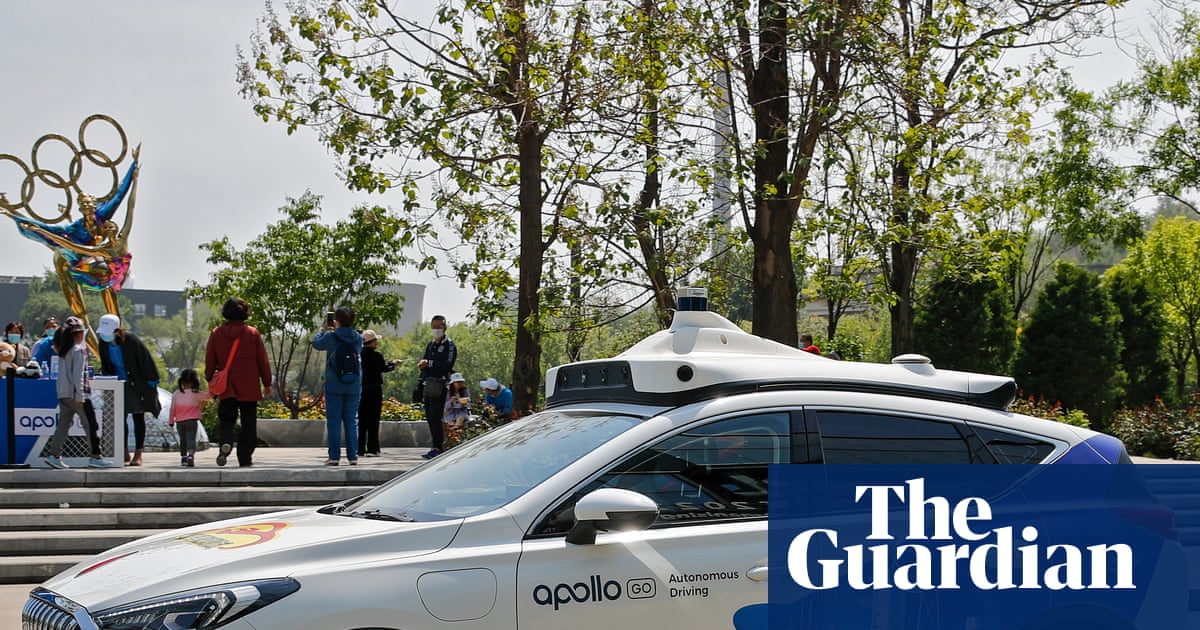
Chinese robotaxis are due to be on the streets of London next year after the US ride-hailing companies Lyft and Uber announced tie-ups with Beijing-based Baidu to deploy its self-driving technology.
Lyft is the third firm to announce plans to introduce self-driving taxis to the UK capital next year, after Uber and Waymo, the main operator of robotaxis in the US.
Its ride-hailing services are the major rival to Uber’s in the US and Canada, and this year Lyft expanded into Europe after acquiring the Freenow app in the summer.
While Uber had signed a deal to work with Baidu in the summer in other global markets, it had not until now said that the Chinese tech company’s Apollo Go cars were planned for London. It had previously announced its services would be operated with self-driving technology from the UK-US firm Wayve.
Lyft said it planned to start tests with dozens of self-driving Apollo Go cars in London in 2026.
David Risher, the chief executive of Lyft, said its vision was for a “hybrid network” of autonomous vehicles and human drivers “working together to serve London’s diverse transportation needs now and beyond – from late-night trips home to Heathrow rides, to early commutes across town, and everything in between”.
He said the company was committed to working closely with Transport for London and local authorities “to ensure these vehicles enhance London’s transportation ecosystem”.
Uber, meanwhile, swiftly announced on X its own plans to use Baidu’s autonomous vehicles in London. It said: “Testing is expected to start in the first half of 2026, under the UK’s frontier plan to begin trials for self-driving vehicles. We’re excited to accelerate Britain’s leadership in the future of mobility, bringing another safe and reliable travel option to Londoners next year.”
An Uber spokesperson confirmed the Baidu trials would be in addition to those with Wayve.
Baidu’s Apollo Go is Asia’s leader in autonomous ride-hailing, operating in 22 cities and providing about 250,000 fully driverless rides a week. Uber said that Baidu’s RT6 electric vehicles were purpose-built for rideshare and “focused on giving people a reliable, high comfort ride”.
News that the Chinese technology company could be the driving force behind London’s autonomous trials next year may heighten security concerns in some quarters, after warnings that even normal electric vehicles could be used for spying purposes.
The race to bring robotaxis to London has been pushed by the UK government, which is looking to pass laws to swiftly open up Britain as a European frontrunner in driverless technology.
The announcement by Waymo in October fuelled particular interest, with the company’s robotaxis now well established in San Francisco and expanding to other US cities including Austin, Texas.
A major power outage in San Francisco this weekend led to traffic jams caused by stationary Waymo vehicles, adding fresh concerns to official scrutiny of the reliability of the technology.