Unlock the Editor’s Digest for free
Roula Khalaf, Editor of the FT, selects her favourite stories in this weekly newsletter.
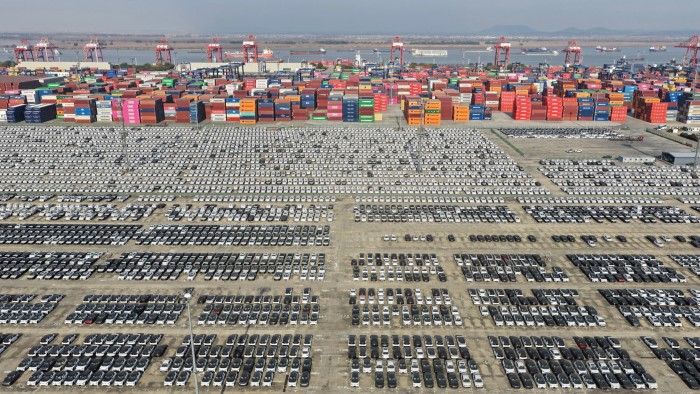
In its push for manufacturing and technological dominance, China continues to clear one milestone after another. In the early 2020s, it overtook Germany and Japan to become the world’s largest auto exporter. In January, the Hangzhou-based artificial intelligence start-up DeepSeek stunned US Big Tech companies with its own low-cost large language model. Another marker came this week, when official customs data revealed that China’s trade surplus in goods topped a record $1tn in just the first 11 months of this year.
What does this latest landmark signify? At first glance, it underlines the scale and effectiveness of Beijing’s industrial strategy. The country has consistently generated mammoth supplies of in-demand goods ranging from rare earth elements to now increasingly high-tech products such as electric vehicles and green technologies. This means that even as the US has raised trade barriers in recent years, Chinese producers have been able to break into other markets across Europe and the developing world.
Yet the sheer size of the surplus also highlights deepening strains in China’s economic model. Domestic demand remains weak. Households are still grappling with the fallout from the property sector downturn, and government stimulus has so far failed to generate a sustained rebound in consumer spending. As a result, Chinese industry has become increasingly reliant on external demand to absorb its enormous output of low-priced goods.
As more trading partners grow alert to the threat cheap Chinese imports pose to their domestic manufacturing bases, the risk is that Beijing’s access to foreign consumers could narrow. After his visit to Beijing last week, French President Emmanuel Macron warned that the EU could be forced to take “strong measures” to address its widening trade imbalance with China, following America’s lead. Despite their domestic appetite for cheap Chinese goods, some emerging markets are weighing steps to protect their markets too. Pressure will also mount on the country to revalue its exchange rate and on its companies to share intellectual property as a condition for setting up abroad as they try to retain access to foreign markets.
Even so, the $1tn figure will alarm western capitals far more than it unsettles Beijing. It highlights how far western productive capacity has fallen behind — and how much leverage China has accumulated in critical sectors and technologies. While Beijing faces persistent accusations of unfair trade practices, the west has also undermined its own position.
Europe has been slow to cut red tape, lower energy costs and accelerate technology adoption, which would bolster its competitiveness. Efforts to deepen trade ties beyond traditional partners have been similarly lacklustre, limiting opportunities to build scale and resilience. US President Donald Trump’s embrace of “America First” has compounded these challenges.
China’s outsized trade surplus is therefore a warning for those on both sides of the ledger. For Beijing, it re-emphasises the urgency of reviving domestic demand, not only to avert a deflationary spiral driven by overcapacity, but also to reduce its growing dependence on foreign consumers. For the west, and Europe in particular, it reinforces the need to craft a credible, long-term trade and industrial strategy. Indeed, where Chinese dumping or security risks are evident, swift and co-ordinated countermeasures are needed.
China’s latest milestone underscores its industrial power and the west’s drift, but, above all, a trade imbalance that is growing ever harder for both sides to sustain.