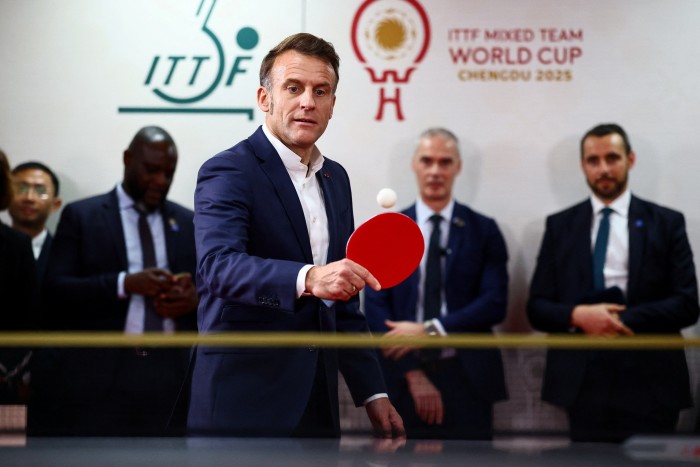
Emmanuel Macron went to China this week bearing gifts of Hermès scarves and returned with promises of pandas, but the apparent bonhomie between the French president and Chinese counterpart Xi Jinping could not hide a growing malaise in ties between their two nations.
Though Macron seemed to relish his rock star reception by screaming students at Sichuan University, his central message was of mounting fear in European capitals that China’s export-driven economic model poses an existential threat to their own industries.
“These imbalances are becoming unbearable,” Macron said at a joint appearance with Xi in Beijing on Thursday.
It was a remark that reflected sharpening French demands on Beijing to spur consumption and curb exports — and one Macron repeated to rapt Sichuan students and at a gathering with French and Chinese business leaders during what was his fourth trip to the country as president.
France’s goods trade deficit with China has doubled in the past decade to hit €47bn in 2024. French investment in the Asian nation over the same period is nearly quadruple China’s into France.
Paris is demanding Beijing recalibrate its trade and investment relationship with the EU.
“We are at the last stop before a crisis,” a French official warned.
“If we don’t change course, we will worsen global fragmentation,” the official added, suggesting Paris would have to consider “protective measures”.
<div data-o-component="o-expander" class="o-expander o-expander__info-box" data-o-expander-shrink-to="hidden" data-trackable="clip-info-box" data-o-expander-collapsed-toggle-text="Show video info” data-o-expander-expanded-toggle-text=”Hide video info“>
The EU is considering setting “made in Europe” targets of up to 70 per cent for the content of certain products such as cars, as it pushes to prioritise domestic goods and cut reliance on China.
Brussels is also planning to tighten foreign investment rules to ensure Chinese companies do not gain advantage from the bloc’s open market without generating benefits for local workers and sharing technology.
Macron, who was accompanied on his trip by about 40 French business leaders, called for China to transfer technology to France in areas such as clean tech and batteries — a stark reminder of the shifting balance of power in crucial industrial sectors.
The French president also defended EU trade investigations into Chinese electric vehicles, saying the bloc was taking a company-by-company approach.
“We need more tech neutrality and a European preference” for domestic industries such as automobiles, Macron said in Chengdu, capital of China’s south-western Sichuan province.
“This is not at all aggressive or protectionist. The Americans and other players in the North American market do it, the Chinese do it,” the president said. “The major risk for Europeans is accelerated deindustrialisation.”
Global imbalances are set to dominate the G7 agenda next year, when France takes over the presidency of the group.
These disparities are “now at the heart of multilateral discussions”, Macron wrote in a letter seen by the Financial Times to economist Hélène Rey, whom he has appointed to lead a task force to oversee the issue of imbalances. “When they are excessive, they pose risks to global growth and financial stability.”
Rey said of her G7 mission: “I am hoping that there will be some positivity towards multilateralism in our discussions, but I obviously cannot guarantee it,” referring to the US and China’s turn away from global institutions such as the World Trade Organization.
During Macron’s China trip, he and Xi were keen to show goodwill despite their differences over such issues.
China’s president and his wife Peng Liyuan accompanied Macron and his wife Brigitte to Chengdu, a level of personal contact that reflected the importance Xi places on relations with France.
China also agreed to send a pair of pandas to France to replace two that returned to their home country last month. For their part, the French couple gave Xi and Peng champagne and Hermès scarves.
Experts say Beijing believes Paris can help steer Europe towards a foreign policy more independent of the US and friendlier to China. Trump’s tariff blitz and his ambivalence on Ukraine have strained US-EU relations, giving Beijing an opening to try to drive a wedge into transatlantic ties.
A senior European diplomat in Beijing said China was conducting a “campaign” to court individual EU member states while blaming Brussels for strains in its relations with the bloc.
In Beijing’s view, “all member states should behave like Hungary”, the diplomat said, referring to Hungarian Prime Minister Viktor Orbán’s pro-Russia and pro-China policies.
The Chinese Communist party’s Global Times tabloid on Friday lavished praise on Macron, saying France played “a unique bridging role in China-EU relations” and invoking the country’s “responsibility” to help the bloc develop a “more objective, rational and independent” policy towards China.
China’s commerce ministry on Friday repeated promises to eliminate restrictive measures in the domestic market and to spur consumption. But experts say Beijing has little intention of drastically altering its economic model.
Trade tensions between China and the bloc have sparked anti-dumping investigations in both directions.
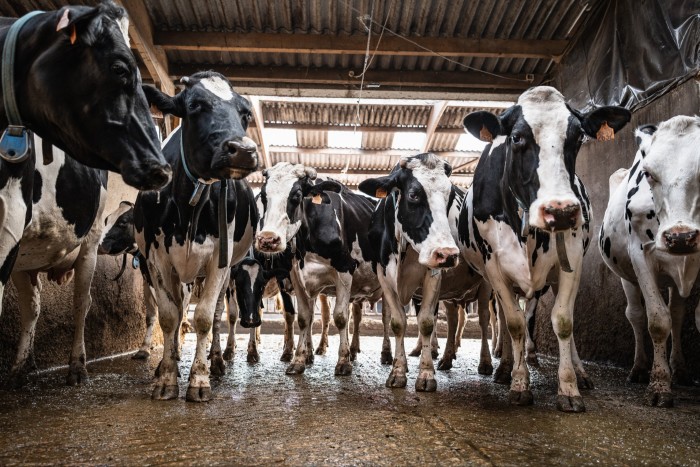
The EU dairy sector is awaiting a ruling on a probe Beijing launched last year in retaliation against Brussels’ imposition of additional levies on Chinese EV imports. The Asian nation could impose tariffs of as much as 40 per cent on dairy products on top of existing duties.
That would essentially close the Chinese market to European producers, according Francois-Xavier Huard, president of France’s national dairy federation.
Still, Huard said closed-door meetings in Beijing this week between Chinese officials and French ministers and business representatives including the chief executives of Airbus, Danone and Marseille-based shipping group CMA CGM had been “more relaxed than you might expect”.
“It’s often like this in business relations in China,” he said. “The big meetings remain general and open the door, then the technical talks follow.”
Policymakers in Beijing doubt Europe has the unity or the stomach to bear the consequences of erecting new barriers to cheap and high-quality Chinese goods.
Such moves would raise costs for price-sensitive consumers at home and expose European companies, which have continued to invest in Chinese manufacturing while downscaling at home, to retaliation by Beijing.
But the European diplomat warned Beijing was playing a risky game. “We are the largest single market — do they want us to close it?” the diplomat said.