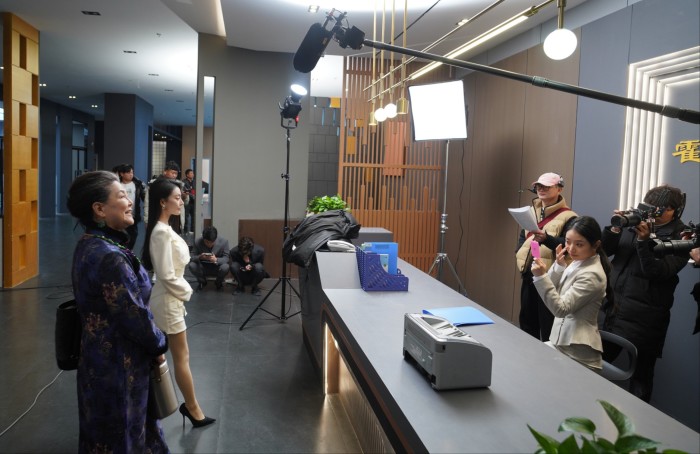
In just 8,000 sq m, about the size of a football pitch, Shudian Studio houses an international bank, a pharmacy, a police station, a hair salon, a luxury boutique, a courtroom, multiple hospital wards, offices, banquet rooms and even a private jet.
Every month in this complex of tightly packed film sets in southern China, producers rattle through about 10 “mini-drama” series — soap operas comprising episodes of two minutes or less — in one of the global entertainment industry’s fastest-growing sectors.
Chinese studios and start-ups popularised the format during the Covid-19 pandemic, garnering hundreds of millions of fans as short-form video apps such as Douyin, China’s version of TikTok, took off. The market is forecast to reach Rmb68.6bn ($9.6bn) this year, which would exceed China’s traditional box office, according to Shenzhen-based consultancy DataEye.
Many start-ups are hoping the model’s low costs, short production times and juicy plot lines will help them succeed where Quibi, a splashy US short-drama venture that featured big-name Hollywood actors, failed.
“It’s basically high dopamine, low friction,” said Ashley Dudarenok, founder of Hong Kong-based consultancy ChoZan, referring to the appeal of the productions to viewers.
Many platforms that helped popularise the format now invest in and produce their own series, which often entail revenge plots, domineering characters and melodramatic twists. Apps typically offer a few episodes for free and charge small fees to continue watching. A series can run anywhere from 20 to 100 episodes.
Chinese companies have already claimed success in exporting the format, with industry leaders such as ReelShort, backed by Beijing-based publisher COL Group, helping to make the US the second-biggest market for mini-dramas. Other large overseas markets include Japan and Indonesia, according to data from analytics provider Sensor Tower.
<div data-o-component="o-expander" class="o-expander o-expander__info-box" data-o-expander-shrink-to="hidden" data-trackable="clip-info-box" data-o-expander-collapsed-toggle-text="Show video info” data-o-expander-expanded-toggle-text=”Hide video info“>
Not an inch of space is wasted at Shudian Studio in the manufacturing hub of Dongguan. Multiple flats decorated to indicate their fictional residents’ varying levels of affluence are interconnected by a hallway resembling a hospital corridor. Visiting crews can even make use of a real-life school in the building next door.
The studio’s design helps minimise production times, with most crews finishing shoots between three and seven days, said Shudian deputy general manager and co-founder Luo Yifu. “For short dramas, time and cost are paramount.”
Luo, who invested in Shudian in July 2024 after China’s years-long property slump hit his architectural career, said business was good. “[We] invested several million yuan . . . and have just recouped our investment.”
In a sign of the format’s growing popularity, China’s National Radio and Television Administration this year said it would require mini-dramas to be vetted by either authorities or the platforms on which they were hosted.
The government has repeatedly warned against content with themes it views as “vulgar”, such as social revenge, family intrigue and romantic entanglements with powerful tycoons — common tropes in the productions.
Luo said that, in practice, the level of censorship depended on a work’s budget. He added that cheaper dramas were only reviewed by platforms, but those with budgets of Rmb1mn or more were scrutinised by provincial or national regulators. Mini-drama budgets were typically about Rmb300,000 a series.
Xin Guopeng, a scriptwriter, said the approval process was generally less onerous than for traditional films and television shows. “As long as you steer clear of topics such as religions and politics, [regulators] are happy to see you grow rapidly,” he said.
But the National Radio and Television Administration last month signalled tighter censorship of mini-dramas, pledging to “course-correct” a range of issues including “shocking” plots, “alpha CEO” characters and clickbait titles.
Start-ups also face an increasingly saturated market and a number have begun offering content for free but with advertising, a model pioneered by Red Fruit, an app backed by TikTok owner ByteDance.
Coco Li, a producer for the platform Reelbuzz, said the relatively low investment required, alongside a slowdown in China’s traditional film and television industry, meant new entrants had “poured” into mini-dramas.
“The domestic market is extremely overly competitive. All sorts of production costs have increased and we need to come up with really innovative subject matter,” she said during a break from managing an Indonesian crew at Shudian. “But overseas, they’re still in the phase of development that we were in domestically two years ago.”
Salsa Bila, a communications student and vlogger from Jakarta who was flown to Dongguan to feature for the first time in two Indonesian-language series, agreed.
“The pay is good,” she said in between scenes playing a secretary and the antagonist in a college drama. “I will do more.”