Good morning. Today, we look at efforts by the EU to defuse escalating trade tensions with Beijing over rare earths and chips, and our tech correspondent explains why campaigners are worried about the appointment of a former tech lobbyist to Ireland’s privacy watchdog.
Between two fires
EU officials are rushing to find a solution to the escalating trade spat with China over rare earths and chips, as the bloc finds itself stuck in the middle of a larger confrontation between Beijing and Washington.
Context: China this month imposed sweeping export restrictions on rare earths in response to US measures. Many European businesses rely on those critical minerals to manufacture technologies such as electric vehicles or fighter jets.
In a further escalatory step, the Netherlands seized control of chipmaker Nexperia from its Chinese owner, prompting China to also impose export curbs on Nexperia semiconductors finished off in China. These moves have raised alarm among European carmakers and other businesses which rely on Nexperia chips.
EU officials are now rushing to calm tensions. According to European Commission spokesperson Olof Gill, a delegation of “high-level technical experts” from China is expected in Brussels on Thursday. Preparatory discussions were already taking place yesterday, Gill said.
European Commission president Ursula von der Leyen at the weekend also announced a new plan to boost rare earths production in Europe and diversify imports, though details are still unclear.
Von der Leyen also hinted at the possibility of using the bloc’s powerful anti-coercion instrument if needed, an option also floated by French President Emmanuel Macron during a European summit last week, according to several EU officials.
German foreign minister Johann Wadephul yesterday travelled to Brussels to co-ordinate with the commission, after he cancelled a planned visit to China amid rising tensions.
“Protectionism is spreading,” Wadephul told reporters after the meetings. “Global tariffs and trade conflicts, as well as seemingly arbitrary export restrictions and export licensing procedures, threaten global free trade and thus, of course, the foundation of our prosperity.”
He said it was “crucial for German and European companies that we quickly find sustainable solutions, especially for the smooth supply of rare earths and computer chips.”
Wadephul however signalled optimism about finding agreement with China. “We are committed to ensuring that fair trade with China remains possible in all areas, including rare earths and chips,” Wadephul said.
US officials now expect China to delay the rare earths export controls, following trade talks over the weekend in Malaysia.
“We are still ready for this fair exchange and this fair trade, and believe that we will also have partners again in Beijing,” Wadephul said, adding that he would speak to his Chinese counterpart Wang Yi “soon” and arrange another visit.
Chart du jour: Closing in
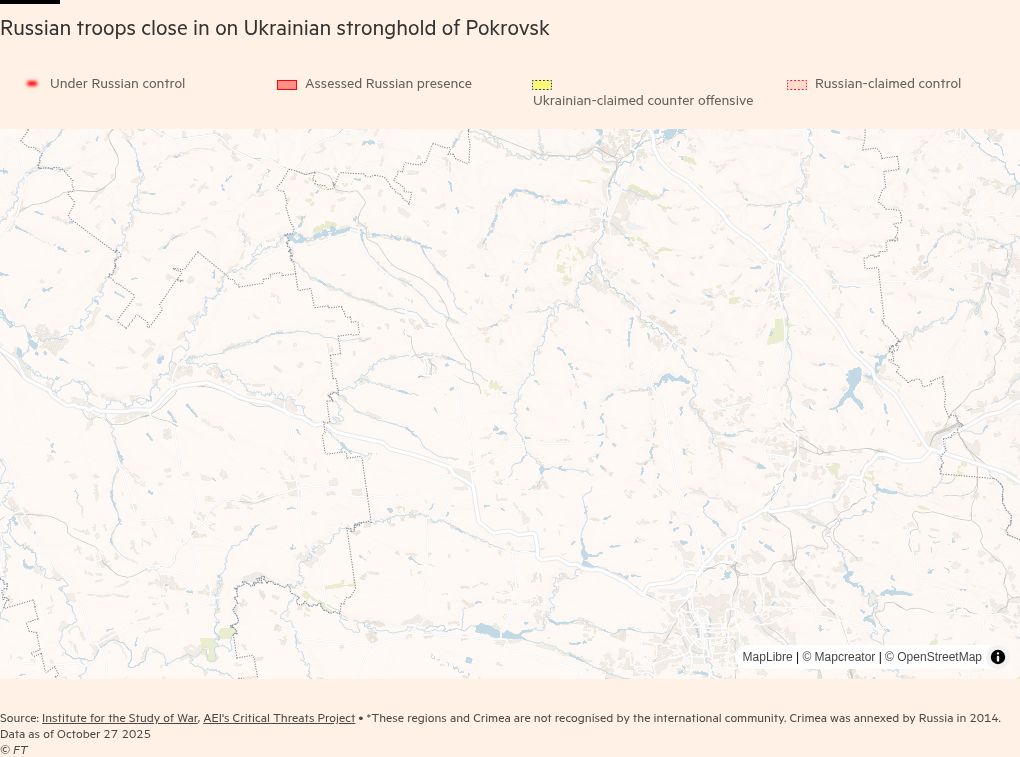
Russia has intensified its offensive in eastern Ukraine as US-led peace efforts falter, with some of Moscow’s forces entering the stronghold of Pokrovsk.
Watching the watchmen
Brussels has been asked to investigate the appointment of a former tech lobbyist at Ireland’s powerful Data Protection Commission, writes Barbara Moens.
Context: The Irish privacy regulator is one of the most important ones in Europe as a lot of tech companies, including Google, Meta and TikTok, have their headquarters in Dublin. Last month, the regulator named former Meta lobbyist Niamh Sweeney as one of its three data protection commissioners.
The appointment has led to outcry from civil society organisations. “We now literally have a US big tech lobbyist policing US big tech for Europe,” said privacy activist Max Schrems.
The Irish Council for Civil Liberties (ICCL) has now filed a formal complaint with the European Commission, seen by the Financial Times, accusing Ireland of breaching EU law.
The complaint focuses on the process of the appointment, which ICCL claims lacked the necessary safeguards against conflicts of interest and political inference.
It also points to reporting about the role of a lawyer who worked for Big Tech companies and was a member of the state panel which appointed Sweeney, who herself previously led lobbying efforts for Facebook and WhatsApp in Ireland and Europe.
“We expect the European Commission to act against Ireland to ensure that it upholds European law”, said Johnny Ryan, a senior fellow at ICCL.
The Irish Data Protection Commission did not respond to a request for comment.
What to watch today
Nato secretary-general Mark Rutte meets Belgian Prime Minister Bart De Wever in Brussels.
European Commission president Ursula von der Leyen attends a meeting of Nordic leaders and Nordic council of ministers in Stockholm.
Now read these
Are you enjoying Europe Express? Sign up here to have it delivered straight to your inbox every workday at 7am CET and on Saturdays at noon CET. Do tell us what you think, we love to hear from you: europe.express@ft.com. Keep up with the latest European stories @FT Europe