Unlock the Editor’s Digest for free
Roula Khalaf, Editor of the FT, selects her favourite stories in this weekly newsletter.
Who will be the Chinese answer to Tesla? In 2020, it looked like that was Nio. That year, the luxury electric vehicle maker’s shares rose more than 2,000 per cent, reflecting its potential as a homegrown brand that could match Elon Musk’s company’s engineering and design, attracting a rising class of local affluent consumers.
Today, Nio’s ascent is proving harder to sustain, and the premium EV segment has turned out to be far narrower than investors once hoped. The prize — chiefly scale, and with it the hope of expanding profitability — has already been captured by rivals playing a very different game.
Nio delivered around 222,000 vehicles last year, up roughly 40 per cent from the previous year. It still runs a net loss, running into the red by the equivalent of $720mn in the second quarter of this year. Local peer BYD, China’s market leader by number of vehicles, shipped more than 3mn last year and is profitable: its gross margin is nearly 20 per cent.
In the quest to cover its fixed costs, Nio is planning to pivot towards a sub-brand that provides mass-market vehicles, following BYD’s tracks. But the risk is that broadening its customer base will erode the premium image that, until now, justified its pricing power.
Nio’s dilemma is a reflection of the broader shift in China’s electric vehicle market. As hype wears off, the winners will be those that can manage cost and scale efficiency rather than simply tell a good story. China’s new energy vehicle sales growth is slowing, with annual growth down to 7.5 per cent in August from 12 per cent the previous month. Only 15 out of 129 electric and plug-in hybrid brands in China are expected to be financially viable by 2030, according to AlixPartners.
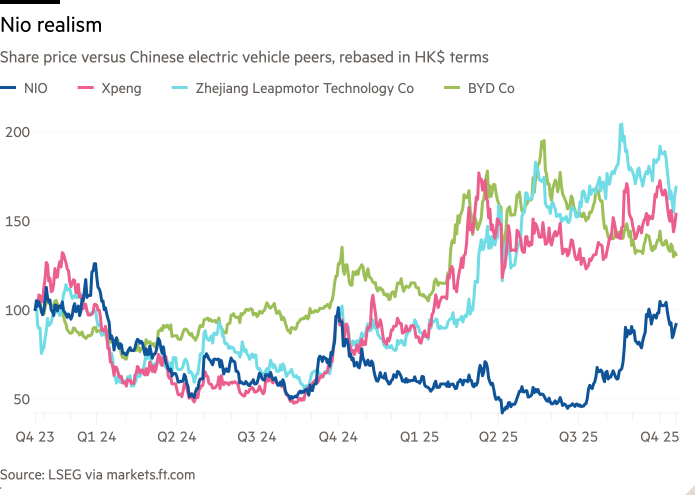
Shares of Nio are down about 90 per cent from its 2021 peak. Singapore’s sovereign wealth fund GIC has filed a rare lawsuit against Nio, alleging it unlawfully recognised leased battery revenue from a battery asset and leasing joint venture. Nio has denied the allegations, calling the case baseless, but the lawsuit has nonetheless rattled investors. When a company is making losses, institutional confidence matters.
As the industry’s once easy flow of capital slows, the importance of being able to attract new investment will only increase. China’s EV race won’t be won by sleekness and glamour, but something more prosaic: durability.