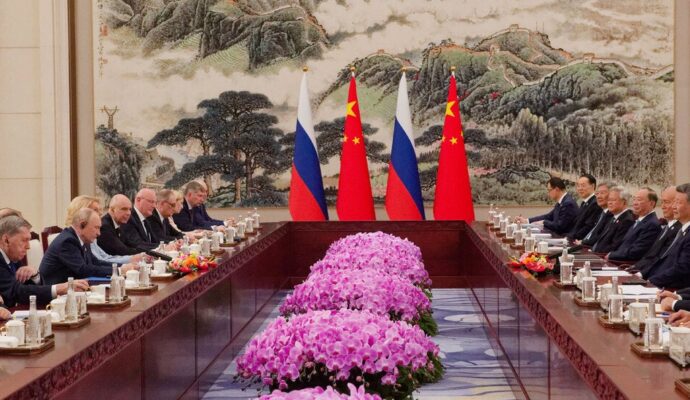
When U.S. President Donald Trump, Chinese President Xi Jinping and Russian President Vladimir Putin hold their first trilateral summit on Thursday in Shenzhen, China, on the sidelines of the APEC summit, a concrete agreement on nuclear arms control would be an unlikely result, analysts told Radio Free Asia.
The meeting comes as Washington seeks to bring Beijing into nuclear discussions with Moscow, while China maintains that its smaller arsenal makes participation in such negotiations unreasonable. North Korea, meanwhile, is closely monitoring the meeting for any implications it might have for its own nuclear weapons program.
Though a deal is not likely, the summit could open channels for further consultations on nuclear risks, Cheng Xiaonong, a U.S.-based Chinese scholar, told RFA Mandarin.
“My understanding is that Trump is essentially trying to use Putin to teach Xi Jinping a lesson,” he said. “Of course, Putin will want to negotiate something in return.”
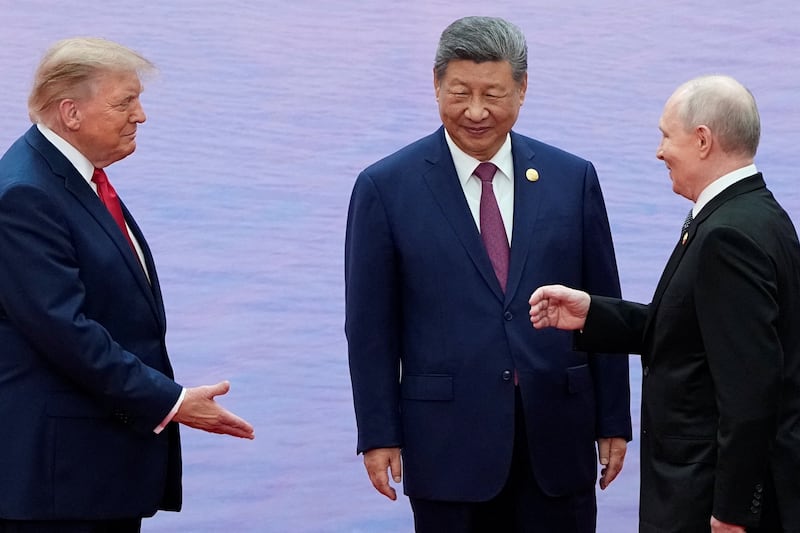
Trump is scheduled to meet Xi bilaterally before joining Putin for trilateral talks. Discussions are expected to include nuclear disarmament or the wars in Ukraine and Iran, although China has not released a detailed agenda.
North Korea, which maintains close ties with both Beijing and Moscow, has not publicly commented on the summit, but analysts say Pyongyang may hope its allies will use the meeting to advance its longstanding demands for recognition as a nuclear-armed state and relief from international sanctions.
Competing nuclear interests
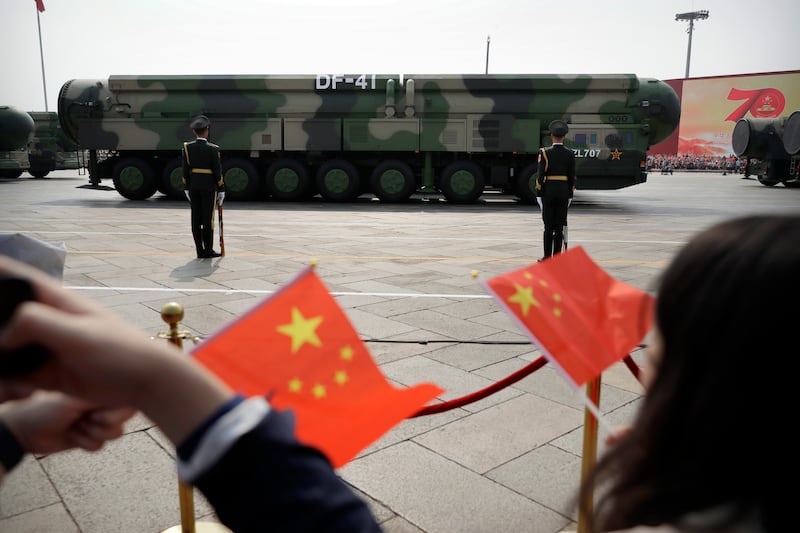
The United States and Russia have decades of experience negotiating nuclear arms control agreements, but China has resisted joining similar negotiations, arguing that its nuclear arsenal remains substantially smaller.
Cheng said that China’s continued nuclear expansion and reliance on strategic deterrence would make a trilateral agreement difficult.
He said Washington would seek a commitment from Xi to restrain China’s nuclear arsenal, while Beijing and Moscow would pursue their own objectives in negotiations with Trump.
“All three have their own calculations, and they can’t work together,” Cheng said. “Under those circumstances, a joint statement would be meaningless.”
Xi will likely use the summit to demonstrate China’s status as a major power and strengthen his domestic political authority, Song Guocheng, a Taiwanese international relations scholar, told RFA Mandarin.
He also considered a concrete nuclear arms control agreement unlikely but said the leaders could still make progress on reducing nuclear risks.
The leaders “could establish what we call a nuclear weapons communication mechanism, with emergency procedures or arrangements between them,” Song said. “That could at least help prevent nuclear miscalculations.”
China’s Foreign Ministry said Monday that the leaders would exchange views on maintaining world peace and promoting strategic stability among major powers.
Beijing has previously said requiring China to participate in trilateral nuclear disarmament negotiations at this stage would be neither reasonable nor realistic.
North Korea seeks recognition, fears concessions
For North Korea, analysts say the summit could provide an opportunity to seek diplomatic support for its nuclear ambitions, although Pyongyang is not participating in the talks.
North Korea likely hopes that China and Russia will convey Pyongyang’s demands to Trump, Kim Tae-woo, a former president of the Seoul-based Korea Institute for National Unification, told RFA Korean.
“North Korea essentially has two demands and expectations when it comes to nuclear weapons,” Kim said. “The first is recognition of its status as a nuclear-armed state. The second is that any nuclear talks with the United States must be conducted as arms reduction negotiations between nuclear powers on an equal footing.”
Analysts said an explicit endorsement of North Korea’s nuclear status was unlikely, but the absence of calls for denuclearization could still be welcomed by Pyongyang.
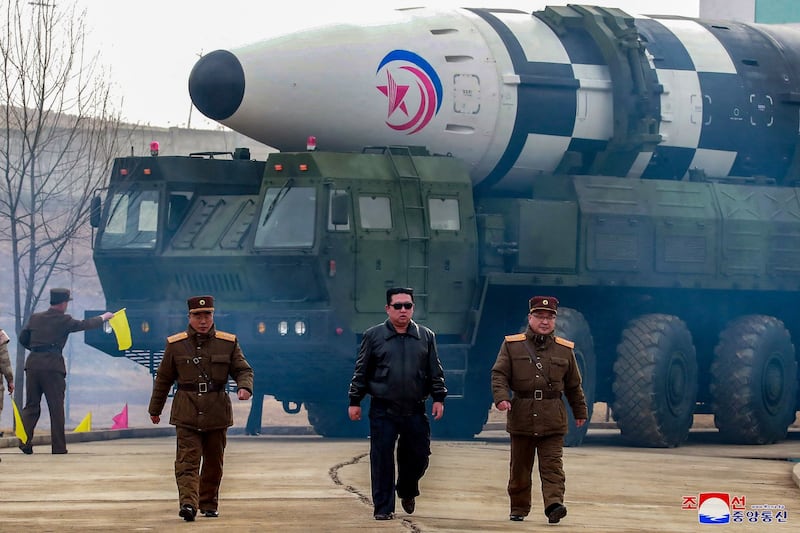
“North Korea will hope that there are no statements about stability on the Korean Peninsula or North Korea’s denuclearization,” Shin Beom-chul, South Korea’s former vice minister of national defense, told RFA Korean. “They will be satisfied as long as denuclearization is not discussed.”
North Korea may also hope Beijing and Moscow will press Washington to ease sanctions, analysts said.
In December 2017, the U.N. Security Council – which includes Russia and China – adopted Resolution 2397, which imposed tighter restrictions on North Korea’s petroleum supplies, exports and overseas workers.
The summit could present risks for Pyongyang if China or Russia uses their relationships with North Korea as leverage.
Recent high-level diplomatic exchanges between North Korea and its neighbors might be showing Pyongyang’s concerns about being sidelined, Ko Young-hwan, a former president of South Korea’s National Institute for Unification Education, told RFA Korean.
“The war in Ukraine won’t go on forever,” Ko said. “North Korea is probably worried that China and Russia might do something with the United States behind its back.”
South Korea’s presidential office has said Seoul’s position and interests must be fully reflected in discussions among the three powers.
Prospects for further talks
Beyond nuclear arms control, analysts differ on whether the summit could lead to a more permanent diplomatic framework among Washington, Beijing and Moscow.
A scholar of U.S.-China relations identified only as Mr. Xing told RFA Mandarin that the meeting could signal the emergence of a “new Yalta system,” referring to the 1945 conference at which Allied leaders discussed the postwar international order.
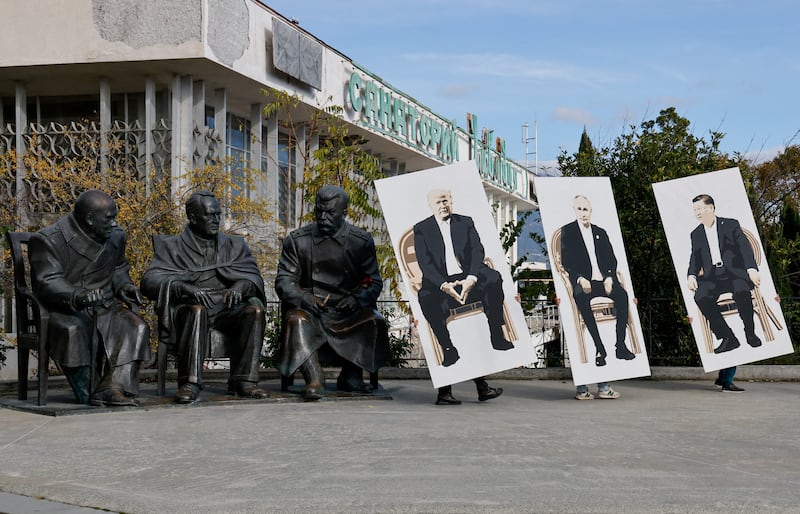
Xing predicted the summit would remain largely symbolic, with China unlikely to support a formal consultation mechanism.
The U.S.-based Arms Control Association said ahead of the meeting that a single summit was unlikely to produce a major breakthrough, but the leaders could instruct negotiating teams to begin sustained discussions on nuclear arms limits and risk reduction.
The Kremlin said the parties were discussing a possible joint communiqué. If they cannot agree on a text, the three leaders will issue separate assessments of the talks.
Edited by Taejun Kang and Eugene Whong.