Read a version of this story in Mandarin
As Nvidia CEO Jensen Huang Thursday announced his resignation amidst a scandal over an alleged extramarital affair that may have been a Chinese spy plot targeting him, a Radio Free Asia investigation revealed that sanctioned entities in China were able to get ahold of the company’s AI chips despite U.S. restrictions.
The U.S. government will continue to investigate Jensen Huang’s involvement with Alice Huang, also known as Huang Le, a former executive at Singapore cloud data center company Megaspeed, who is suspected of collecting intelligence for Beijing and assisting Chinese clients in obtaining restricted chips.
This “AI industry earthquake” triggered by news of Huang’s departure has attracted intense outside attention. After the U.S. restricted direct exports of certain Nvidia products to China starting in 2022, can sanctioned Chinese institutions still obtain Nvidia computing equipment through overseas cloud services or domestic suppliers?
RFA’s investigation of Chinese government procurement data revealed that Nvidia’s RTX 5090 graphics cards and DGX Spark products appeared in a winning bid announcement for an AI equipment procurement project this year by China’s Shandong Computing Center, also known as the National Supercomputing Center Jinan.
However, according to U.S. government regulations, even if the aforementioned products can enter China, they cannot be purchased or used by the Jinan Center because it appears on a list of export control entities.
On June 17, 2026, the China Government Procurement Network (web archive) published a procurement result announcement. The procured item was the “Edge Intelligent Computing Team AI Workstation and Graphics Card Procurement Project.” The winning bidder was Qiyuan Jiasu (Tianjin) Technology Co., Ltd., with a winning bid price of RMB 148,500 (US$22,000). The product list in the procurement document contained two items: “RTX5090” and “DGXSPark”, while the brand column indicated “Yixin,” a brand operated by Qiyuan Jiasu.
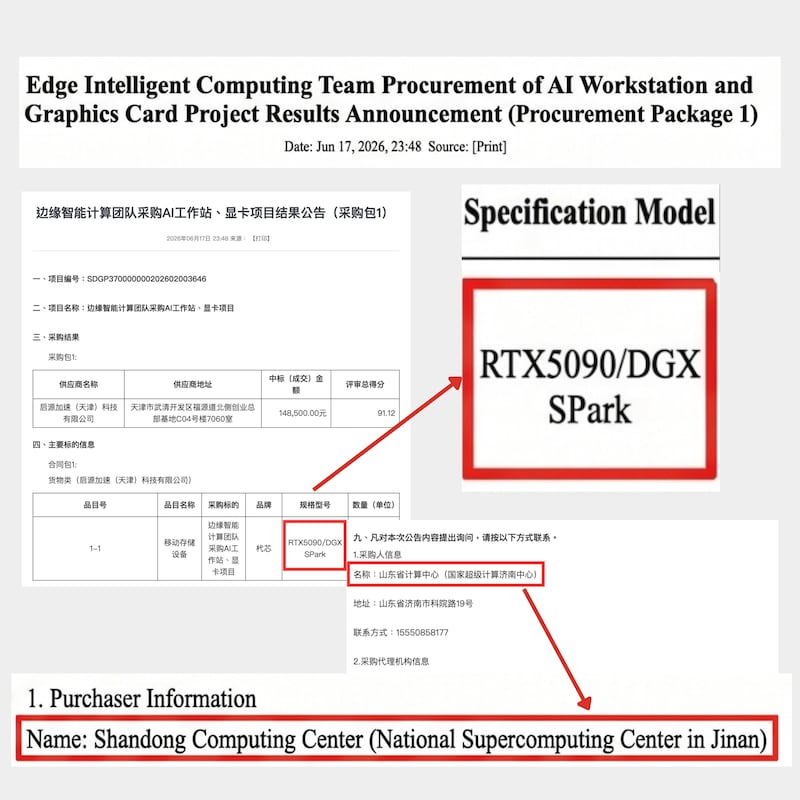
Information from China Government Procurement Network shows that the Shandong Computing Center, which is subject to US chip sanctions, was still soliciting bids for Nvidia high-end products as of June 2026. (Screenshot from China Government Procurement Network; RFA graphic)
“RTX 5090” is a graphics card from Nvidia that uses the Blackwell architecture and is equipped with 32GB GDDR7 memory; DGX Spark is a desktop AI computing system launched by Nvidia equipped with the GB10 Grace Blackwell Superchip.
The procurement quantity for this tender only indicated “one batch” without explicitly specifying how many RTX 5090 graphics cards or how many DGX Spark units were included in “one batch.”
Different restrictions on selling two products into China
RFA further checked Nvidia product categories and U.S. export control regulations, finding that rules for selling the two products into China’s general market are not the same.
The RTX 5090 graphics card has a standard version and a “special edition” tailored specifically for the Chinese market. The former falls under advanced computing products controlled by the U.S. which cannot be shipped to China without an applicable license. The special versions of the card have model numbers RTX 5090 D and RTX 5090 D v2. However, the Jinan Center’s procurement announcement only listed “RTX 5090,” making it impossible to confirm whether the purchase was for the original version or the China special edition.
The DGX Spark, a desktop AI computer equipped with the GB10 Grace Blackwell Superchip, is listed on Nvidia’s official Chinese website with purchasing channels in China. Therefore, the DGX Spark can indeed be sold in China’s general market.
However, availability in China’s general market does not allow for unrestricted sale to entities like the National Supercomputing Center Jinan.
Purchasing party identified by U.S. in 2021
The Shandong Computing Center was established in 1976 and is affiliated with Qilu University of Technology; the National Supercomputing Center Jinan was established in 2011, and both currently belong to the same institutional framework.
The U.S. Department of Commerce’s entity list explicitly listed “Shandong Computing Center” as an alias for “National Supercomputing Center Jinan.” The center was placed on the list in April 2021, prior to the broad export restrictions on advanced computing chips to China that the U.S. began implementing in 2022.
The U.S. Department of Commerce stated at the time that seven Chinese supercomputing and chip institutions, including Jinan, Shenzhen, Wuxi, and Zhengzhou, had procured U.S.-origin items to support Chinese military units, military modernization, and weapons of mass destruction programs. The U.S. determined that these activities were contrary to U.S. national security and foreign policy interests.
After being added to the entity list, exporting, re-exporting, or transferring items subject to the U.S. Export Administration Regulations, or EAR, within China to the Jinan Center in principle requires a license from the U.S. Department of Commerce, and without a license, it is subject to a presumption of denial. These restrictions target specific transaction counterparties and are not limited to prohibiting high-end AI chips purchased by general Chinese customers.
Tseng Chih-hua, an overseas researcher at Taiwan’s Research Institute for Democracy, Society and Emerging Technology, told RFA that items regulated under the U.S. Export Administration Regulations theoretically require review by the Bureau of Industry and Security, or BIS under the U.S. Department of Commerce whenever shipped to an entity on the entity list, even for items with looser control standards.
Tseng added that U.S. export controls travel with the item itself, so even if these two products were shipped to legitimate Chinese or third-country distributors, a license is still required to transfer them to a controlled entity like the Shandong Computing Center.
“The broader issue is that current controls still rely heavily on corporate self-compliance,” he said. “Whether it’s Nvidia tracking customers and end-users, or Chinese and other potential third-country distributors failing to comply with U.S. export rules upon transfer,” both present challenges.
Bloomberg News reported that in inventory verification reports submitted by Nvidia to the U.S. government, it was revealed that approximately 50,000 AI chips sold to Megaspeed were underreported. The uncounted chips were valued at billions of dollars, raising concerns that chips leaked illicitly into China via Southeast Asia.
Ties between the winning supplier and sanctioned distributor
The winning bidder in the deal in RFA’s investigation, Qiyuan Jiasu (Tianjin) Technology Co., Ltd., shares multiple noteworthy similarities with “Situngstar,” a Chinese company that was once a major Nvidia partner and was later sanctioned by the U.S.
Radio Free Asia reviewed public data for both companies and found that they both describe themselves on their webpages as “a leading artificial intelligence infrastructure solution provider,” using identical text.
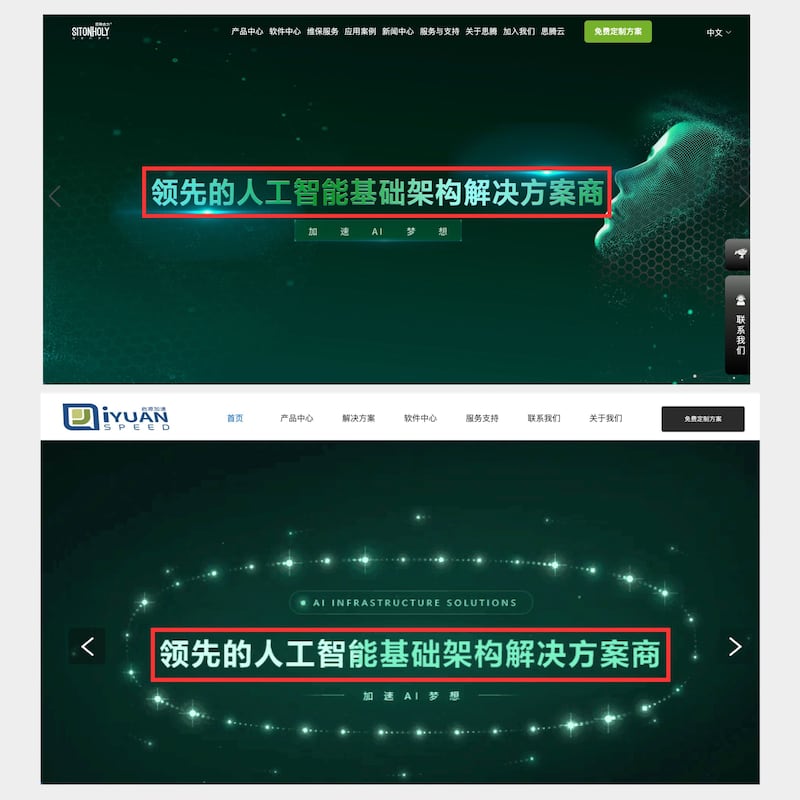
Both companies also set their production bases in Wuqing, Tianjin, and marketing offices in Shangdi, Beijing. The partner clients listed on both companies’ websites are also completely identical, including Tsinghua University, Peking University, Beijing Institute of Technology, as well as the CAS Institute of Computing Technology, Institute of Automation, Institute of Mechanics, Institute of Remote Sensing, and Institute of Information Engineering; even the phrasing and order listed by both companies are identical.
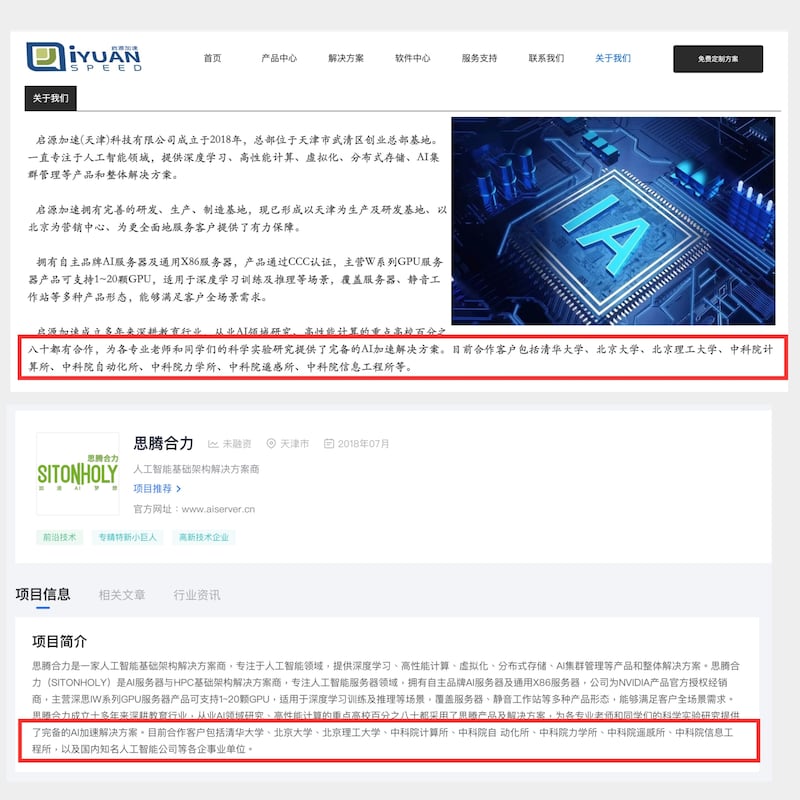
“Their business registration and website introductions are almost identical,” a commentator familiar with China’s AI industry told RFA in an interview, stating that this strongly raises suspicion that Qiyuan Jiasu might be a new entity taking over part of Situngstar’s business after Situngstar was sanctioned by the US. “This is one company operating under two banners; Qiyuan Jiasu may be a new shell used after Situngstar was placed on the Entity List.”
Public data shows that Situngstar had been an NPN authorized partner of Nvidia since 2015 and was described as an Nvidia Elite Partner, DGX Series official authorized value-added reseller, and Tesla Series core partner. Reports from the Tianjin Economic-Technological Development Area government in 2023 also confirmed its status as an Nvidia Elite Partner.
However, the U.S. Department of Commerce placed Situngstar on the Entity List sanctions on April 11, 2024, citing that the company acquired US-origin items to support Chinese military modernization.
Li Houchen, a Japan-based current affairs and economic columnist, remarked during an interview that if Qiyuan Jiasu indeed inherited Situngstar’s original operations, Nvidia would need to investigate the sales and ultimate flow of related products. However, current public information can only verify that the company profiles, client lists, and operational locations of the two companies overlap heavily, with no direct evidence yet proving both belong to the same ultimate beneficial ownership system.
Experts: Export controls have exploitable loopholes
Chen Yunchu, an economic security policy analyst at DSET who previously worked in sanctions and export control legal advisory, told RFA that under current U.S. regulations, third-party enterprises must not first purchase controlled products and then export or transfer them within China to the National Supercomputing Center Jinan. If carrying out such resales, third-party enterprises may likewise bear legal liability for violating export control regulations.
However, Chen Yunchu pointed out that practical enforcement faces staffing constraints. Currently, the U.S. Department of Commerce’s Bureau of Industry and Security has only one export control officer stationed in Beijing responsible for end-use and end-user verification; worldwide, there are only 15 such officers.
From a corporate compliance perspective, suppliers including Nvidia have an obligation to conduct “Know Your Customer” (KYC) procedures. Once suspicious “red flags” appear in a transaction, the enterprise should further verify the product’s end-use, end-user, and destination. If relevant doubts remain unresolved and the company proceeds with the transaction, it may be deemed that Nvidia “should have known” that illegal diversion of the product existed, thereby assuming corresponding liability.
Chen Yunchu noted that current rules do not mandate companies to continuously track chip locations, though such technology already exists. Public reports indicate Nvidia has offered an opt-in tracking software feature to Blackwell chip customers.
Currently, provisions related to the “Chips Security Act” have been incorporated into amendments proposed by the Senate for the National Defense Authorization Act for Fiscal Year 2027, or NDAA. The final text of the FY2027 NDAA must still be awaited to confirm whether the relevant clauses of the Chips Security Act will be retained and ultimately passed into law.
Chen Yunchu believes that even if the bill fails to pass, the next Congress controlled by Democrats may still reintroduce stricter export control measures.
Tseng told RFA that current supervision mainly consists of three levels: pre-shipment investigation of customers and end-users by Nvidia; post-shipment end-use checks by BIS export control officers; and self-directed spot checks by enterprises regarding product destination, or enhancing oversight via location verification tech under discussion in the Chips Security Act. Additionally, in specific cases, inter-country intelligence sharing and law enforcement cooperation can be used to trace product destinations.
China needs dual-use supercomputing technology
The Jinan Municipal Government’s 2019 publication “Opinions on Accelerating the Industrialization Development of Supercomputing” requires the National Supercomputing Center Jinan to lead the establishment of a collaborative innovation alliance, and to “establish and improve a mechanism for mutual access and sharing of military and civilian technology resources,” perform “joint key research on dual-use supercomputing technology,” and promote the industrialization of related technology.
The same policy document also listed medical health, artificial intelligence, new materials, agricultural disaster prevention, and smart manufacturing as supercomputing application fields. This demonstrates that the Jinan Center simultaneously undertakes civilian scientific research, industrial development, and military-civilian dual-use technology missions, though it cannot be assumed based on this that the equipment procured this time will be used directly for military projects.
Government procurement records show that the Jinan Center conducted this procurement through a Chinese domestic supplier. Public information shows that the winning company, Qiyuan Jiasu, deals in GPU servers, Nvidia graphics cards, and high-performance computing equipment, and has supplied servers to Chinese universities and research institutions in the past.
Radio Free Asia has sent an email to Nvidia asking whether it was aware of this procurement, whether the relevant products obtained applicable U.S. export licenses, and whether it will launch an investigation into this case. No response was received prior to press time.
Radio Free Asia also inquired with Qiyuan Jiasu and the Shandong Computing Center to learn whether this procurement project had received US authorization or involved smuggling issues; no response has been received yet.
Translation reviewed by Ruo Shui, edited by Charlie Dharapak and Eugene Whong for English.