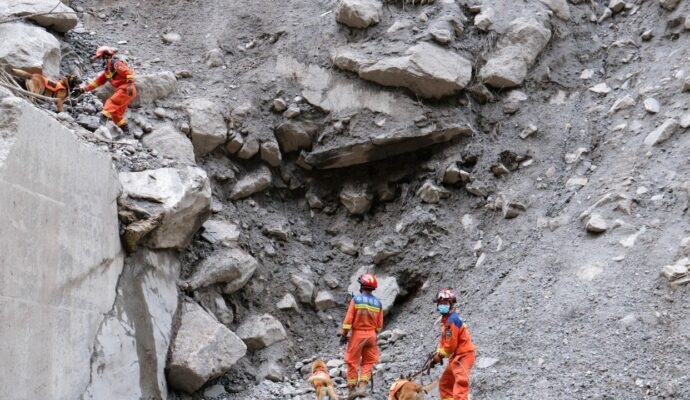
Rescue teams are working to reach more than 900 people thought to be trapped in the tunnels and underground areas of half a dozen hydropower projects in Nepal following the devastating flash floods, the country’s disaster management authority said on Monday.
The death toll from the unprecedented deluge of ice, rock, mud and debris that crashed through valleys of Nepal on Wednesday last week has now risen to 903 people, with 16 more dead reported on the Tibet side of the border. More than 4,000 are missing in Nepal, with another 500 in Tibet.
Hundreds of bodies, many unidentified, have been buried in shallow graves on the plains of the Himalayan region after being swept down the mountains by the torrent.
Nepali officials said on Monday the focus was on reaching the 933 people missing from hydropower projects in the flood-hit region.
Pictures and videos shared by rescue teams showed earth-moving equipment digging and shovelling mud to try to access the tunnels. “A large amount of debris has been deposited and that is posing us a big challenge to open the tunnels,” said Nepal army spokesperson Raja Ram Basnet.
Ashish Gurung, who normally works as a guide, was among the rescuers. “There is just mud everywhere,” he told the Guardian. “Inside the tunnel it was worse. It’s so difficult to move, the mud is so deep.”
On Sunday his team was trying to access Chilime Hydropower in Ruswana, in the worst-hit area.
Mountaineers improvised by grabbing planks of wood to check the depth of the mud, before using them as a makeshift bridge, along with a system of ropes to keep themselves safe, he said.
“Walking in it is very difficult; at one point it was up to our chests,” Gurung said. “We got close to the first station, about 130 metres in. Inside that far, you could [see further in]; it looked like it was just bodies.”
The hydro company had given his team a map and it looked like there was a chance people in the tunnels could have survived by staying inside the internal infrastructure.
“They have a safe area inside,” he said. “Some of them could potentially be alive. I am hoping they are alive.”
The Red Cross has estimated that more than 90,000 people are likely to have been affected by the disaster, which China and some experts linked to the effects of the climate crisis.
Nepal’s prime minister, Balendra Shah, said the flood was an “unprecedented and devastating natural disaster” and it remained challenging to compile a complete assessment of the damage.
“Despite the adverse weather, difficult terrain and continuing risks, we are moving forward with determination to save the lives of our citizens,” he said in a Facebook post late on Sunday. Almost 21,000 security personnel were involved in the rescue operations, besides civilian workers and volunteers, he added.
Nepal’s disaster agency said on Monday that 903 deaths had been counted there, with 4,247 people, including 592 foreigners, missing. As of Sunday, Chinese authorities reported 16 deaths and 546 missing, and Chinese state media said 261 of the missing were foreigners, including over a hundred Nepalis.
China’s state-run CCTV reported that Beijing had mobilised more than 2,100 rescue workers and allocated at least 220m yuan ($33m) to support relief efforts and had been airdropping equipment and supplies to frontline rescuers, while its soldiers used life-detection equipment to look for the missing.
Nepal has said it does not need foreign help in general search and rescue operations, but it has leaned on neighbours India and China for their expertise in tunnel rescues.
Rescue operations have been suspended several times since Friday because of bad weather and concerns that a lake formed across the Nepal-China border by the disaster could trigger fresh flooding after it began overflowing into Nepal’s rivers.
However, the weather was good on Monday and rescue work continued to pick up pace, said Narendra Pariyar, the district administrator of Rasuwa, one of the two hard-hit districts.
In the holy town of Devighat, on the banks of the Trishuli river that flooded, residents walked around the shells of what had once been homes, trying to salvage their belongings from the debris.
The flood was “caused by glacier instability under the long-term effects of global warming”, Chinese state broadcaster CCTV reported, saying it was a “new and prominent feature of cryosphere disasters” on the Tibetan plateau.
Two Nepali officials told Reuters that China had not shared much information on glacier risks and water levels following a meeting to strengthen cooperation earlier this year, and they feared that a lack of data sharing could hamper future disaster preparedness.
China’s foreign ministry did not respond to a request for comment on the meeting.
With Reuters and Agence France-Presse