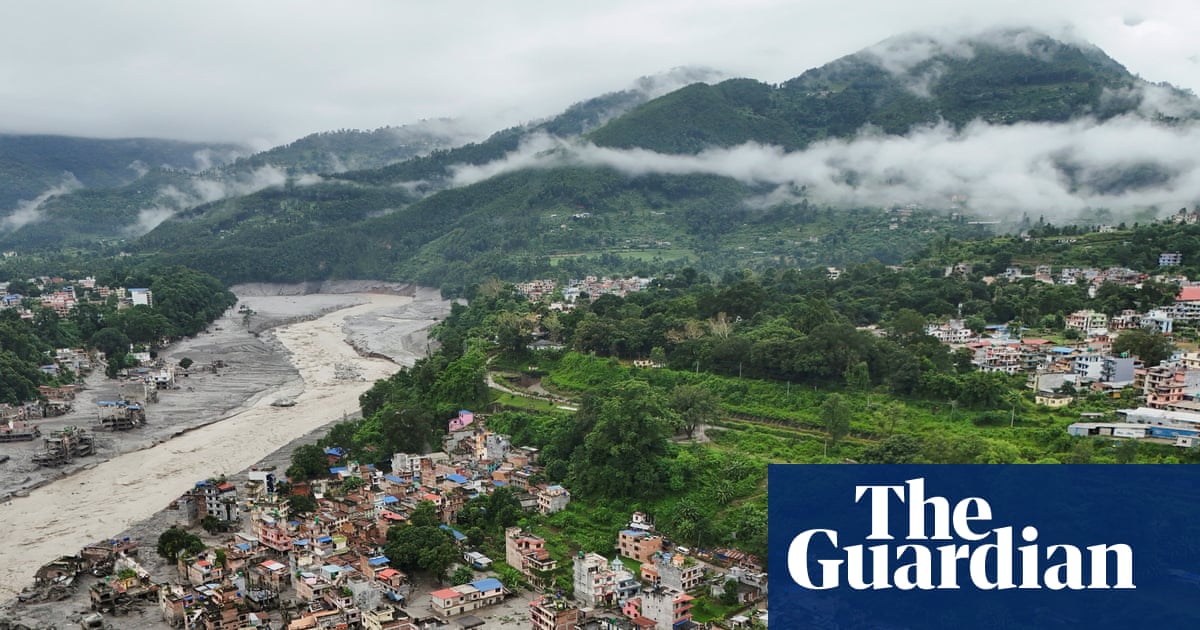
An earthquake was initially thought to be the cause; but by Thursday the US Geological Survey (USGS) said “a glacial collapse” was responsible for the disaster. “This event was initially reported as a magnitude 4.4 earthquake. Additional analysis of nearby seismic stations, long period seismic waves, and satellite imagery led to the determination that the seismic event was instead a glacial collapse and debris flow, and that no earthquake had occurred.” The USGS first reported the seismic jolt early on Wednesday about 66km (41 miles) north of Kathmandu, near the border.
Entire villages and markets were “wiped out”, the International Federation of Red Cross and Red Crescent Societies said. It was dispatching emergency supplies including blankets, first aid kits, stretchers and body bags. The United Nations secretary general, António Guterres, said UN teams and partners were mobilising supplies and personnel in Nepal to support affected communities.
Experts warned that a lingering blockage upstream on the Nepal-China border river could produce a second flood.
Nepal’s tourism ministry said the missing included scores of Indian nationals, Britons, Americans, Australians and Canadians as well as others from South Korea, the Netherlands, Malaysia, Portugal and South Africa. At least 28 Nepalese police were missing, a police spokesperson said.
Nepali police said in the immediate aftermath of the disaster on Wednesday that they had recovered more than 162 bodies. Tibet government officials mobilised hundreds of emergency workers and vehicles as well as sniffer dogs and speed boats to help the rescue efforts, China’s official Xinhua news agency said.
China’s president, Xi Jinping, said “the most urgent task is doing everything possible to search for and rescue the missing people”, according to Chinese state broadcaster CCTV. The Australian prime minister, Anthony Albanese, said his thoughts were with those concerned about their loved ones. He stressed that getting information about the status of those missing remained difficult.