Taiwan is concerned that the Iran war is depleting stocks of long-range cruise missiles that would be vital for the US to help defeat any Chinese invasion, making the country more vulnerable.
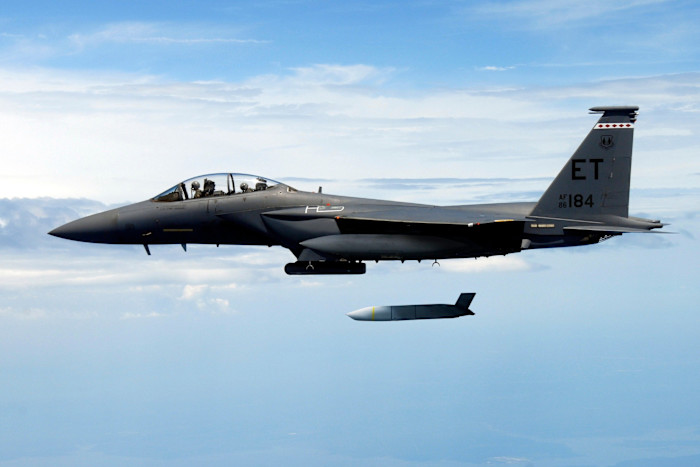
The US is estimated to have fired hundreds of so-called Joint Air-to-Surface Standoff Missiles (JASSMs) during weeks of conflict in the Middle East, as well as ship-launched Tomahawk missiles.
Defence experts said both would be crucial in any conflict over Taiwan because they can be fired from outside the range of an enemy’s air defences, diminishing the risk for an attacking aircraft or naval vessel.
“My concern is first and foremost that US forces are using up a lot of munitions which one assumes they would need so that an assault on Taiwan could be blunted,” a senior Taiwanese defence official told the FT. “This erodes deterrence.”
If the US was “spending too much time on other [battlefields], so much so that they pour too much capacity into those, in the end it will really create an imbalance”, said a Taiwanese national security official.
China claims Taiwan as part of its territory and threatens to attack it if Taipei refuses to submit under its control indefinitely.
While the US is ambiguous over whether it would intervene in a war over Taiwan, Washington considers any effort to determine Taiwan’s future by non-peaceful means as of grave concern. The US is committed by law to provide Taiwan with defensive weapons. It is also legally obliged to maintain its own capacity to resist coercion that would jeopardise Taiwan’s security.
The Center for Strategic and International Studies (CSIS) estimated last week that US forces fired 786 JASSMs and 319 Tomahawk missiles in the first six days of the Iran war — several years of production in both cases.
“All these munitions were acquired for the China fight, and they would be absolutely critical in that fight,” said Eric Heginbotham, an expert on Asian security issues at MIT, who co-organised a series of war games since 2023 about a potential US-China conflict over Taiwan.
“No one really calculated on using up large portions of the inventory on an unrelated war, or a war of choice, especially one of this scale.”
In a Taiwan war game CSIS and MIT jointly held in 2023, participants simulated expending the entire US arsenal of JASSMs in just a few weeks, to sink People’s Liberation Army ships in port to decimate its invasion fleet and to hit Chinese air bases.
While the Pentagon does not publicly specify for which conflicts it acquires certain weapons, military analysts widely agree on the importance of missiles including the JASSM.
“Potentially large quantities of long-range, penetrating cruise missiles would be critical in many US-China conflict scenarios,” said Tyler Hacker, a research fellow specialising in long-range strike at the Center for Strategic and Budgetary Assessments, a Washington defence think-tank.
“As of right now, JASSM is the US military’s primary conventional air-launched, long-range cruise missile.”
The US does not publicly disclose stockpile numbers or deployment locations for most missiles. The air force procured 5,569 JASSMs up to 2023 and an additional 1,140 and 450 were procured in 2024 and 2025 respectively, according to budget documents.
But it is unclear how many have been received as contractor Lockheed Martin has been delivering only a few hundred a year, with deliveries lagging about three years behind procurement.
It is also unknown how many have been used in tests or earlier conflicts, or have expired. Expert estimates for the total JASSM stockpile range from 3,500 to 6,500.
Stand-off munitions such as the JASSM or Tomahawk would be the most important tool for US forces to try to exhaust China’s missile arsenal in the opening phase of a conflict. China’s integrated air defence system would put any jet that attacked its coastal bases at risk of being shot down. China also has a large arsenal of anti-ship missiles that aim to sink approaching enemy vessels.
Analysts call the JASSM missile a “very enticing weapon” because of its highly accurate terminal guidance.
“When you calculate what munitions to use, there is a strong tendency to optimise on reducing risk to your own forces in the present context,” Heginbotham said. “That means you will almost always use more of the Gucci long-range stuff without thinking too much about the next war.”
Mark Cancian, author of last week’s CSIS report on weapons use and cost in the Iran war, said the number of JASSMs and Tomahawks being fired was likely to have fallen considerably after the US had established air superiority.
But analysts said other munitions in use against Iran such as the Joint Standoff Weapon, a glide bomb, could also create critical shortfalls for a potential Taiwan conflict.
Admiral Samuel Paparo, the top US military commander in the Indo-Pacific region, warned more than a year ago that expending munitions elsewhere imposed costs on the US’s readiness in the Indo-Pacific.
The region “is the most stressing theatre for the quantity and quality of munitions, because [China] is the most capable potential adversary in the world”, he said in November 2024.
This article has been amended since publication as an earlier version of this article incorrectly described the plane as an F-16 in the picture caption