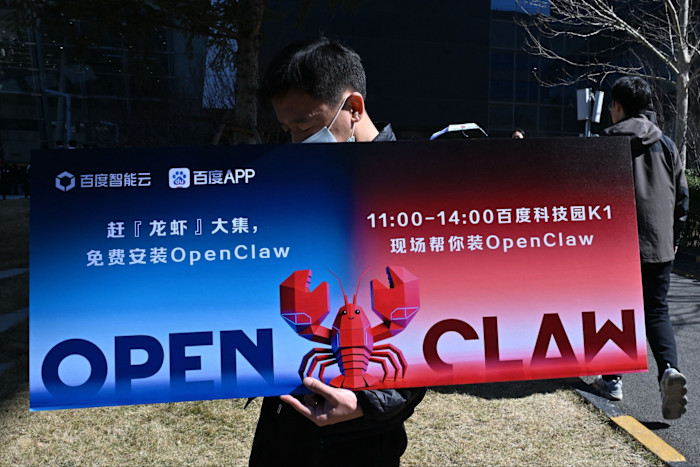
On a recent evening in Beijing, more than 100 technology enthusiasts packed into a rooftop bar to learn how to use OpenClaw, a new AI tool that has taken China by storm.
The open-source platform is used to create assistants that can do everything from browsing the web and sending messages to executing commands on a computer. Developed by a European engineer, OpenClaw has become so popular in China that “raising a lobster” — a nod to its crustacean logo and the time needed to install and train the AI agents — has become a buzzword.
“For the past two weeks I’ve stopped working, I’ve just been testing it,” said Li Fusheng, a 47-year-old entrepreneur who hoped OpenClaw would revolutionise his industrial software business.
“It will deceive you, forget things, dodge questions and do the opposite of what you wanted, but it also has flashes of brilliance . . . It’s torturing me.”

OpenClaw went viral this year among western tech enthusiasts, who started creating AI agents to manage their emails, calendars and other aspects of their digital life.
Its capabilities prompted OpenAI to hire its designer, Austrian engineer Peter Steinberger, last month, and Nvidia chief Jensen Huang compared it to the groundbreaking open-source operating system Linux at the company’s GTC conference on Monday.
But the tool has found a far wider audience in China among a swath of general users hoping to increase their productivity and open to tinkering with the latest novel technology.
OpenClaw adoption had become a “frenzy”, said Bao Linghao, senior analyst at Trivium China, with promotion by local governments and social media hype helping to supercharge its use.
“This kind of phenomenon tends to feed on itself,” he said.
While OpenClaw itself is free and open-source, the AI agents are powered by large language models owned by tech companies. They can burn through thousands of LLM tokens — the basic unit of AI usage — while they work.
The software is also difficult to install, spawning a cottage industry of OpenClaw consultants on Alibaba’s online marketplace Xianyu. Tencent, China’s most valuable tech company, launched a nationwide “lobster” tour this month to help people install it in 17 cities.
The enthusiasm is spurring hopes among investors that Chinese consumers, who are often reluctant to pay for software, may finally start spending on AI services. China’s big tech groups, which typically offer the cheapest LLM tokens, have raced to offer simplified versions of OpenClaw for the mass market.
ByteDance has released ArkClaw, Tencent has QClaw, while Alibaba has put out CoPaw and start-up Moonshot AI has unveiled Kimi Claw. Each version tends to funnel users towards the company’s own models and cloud services.
The craze lifted shares in Hong Kong-listed LLM provider MiniMax as much as 50 per cent last week and led to wild swings in the stock prices of other tech and AI groups. Alibaba’s Hong Kong-listed shares are down 7 per cent in the past month, while Tencent shares are up 7 per cent.
“OpenClaw by itself is not consumer-grade tech, so it makes sense for tech companies to make apps with a smoother onboarding experience and safety guardrails in place,” said Robin Zhu, a China tech analyst at Bernstein who estimated the AI agent market could make as much as $100bn in annual revenue by 2030.
Data from OpenRouter, which captures a small chunk of LLM usage, indicates Chinese LLM providers are benefiting from rapid growth amid the OpenClaw frenzy.
Local governments are hoping the AI agents can stimulate economic growth. A high-tech zone in Hefei, eastern China, is offering up to Rmb13mn ($1.8mn) in computing power vouchers and subsidised office space for “single-person companies” built on OpenClaw.
A district in Hangzhou, home to Alibaba, has pledged up to Rmb20mn a year to help companies pay for computing power, while Wuxi has offered large grants for OpenClaw projects.
The central government, meanwhile, has urged caution. China’s cyber security regulators have issued warnings about data breach risks tied to OpenClaw, noting that the software’s requirement for extensive system permissions presents risks.
Chinese users have reported mixed results with their OpenClaw tinkering.
Guo, a 38-year-old human resources head at a media company, said he trained a network of OpenClaw agents to collect resumes, build profiles for open positions and match and evaluate candidates. The agents also help him generate interview questions and conduct preliminary interviews.
While he had spent about Rmb5,700 on hardware and LLM tokens, the workload would have required two full-time employees, he said.
“There is still a step where humans are involved to get a feel for the candidate,” said Guo, “but that could change if the culture of an organisation can also be quantified and fed into AI.”
Finance professional Chris Yang, 34, said he had installed OpenClaw on three computers and was using agents to create presentations and conduct research.
His most valuable use case was having an agent read and summarise social media comments for him. “There is a lot of value in the comments,” he said.
But for many Chinese who have jumped on the hype, OpenClaw has not lived up to their expectations. The software requires technical knowledge to configure properly and the costs add up quickly.
Mason Mei, a 31-year-old employee at a state-owned financial institution, said he tasked his OpenClaw agents with summarising several corporate reports, costing him about Rmb40 in LLM tokens.
He said he was disappointed with the results and felt “completely exposed” after the software began “accessing my personal files and reading my private WeChat messages”. He promptly deleted it.
OpenClaw consultants have since expanded their services to removal, with one 21-year-old consultant saying he was already fielding more requests for deletion than installation.
“Some people fantasised about what OpenClaw might do,” he said, “but in reality it doesn’t work very well, and they worry it could create security risks or take up storage.”