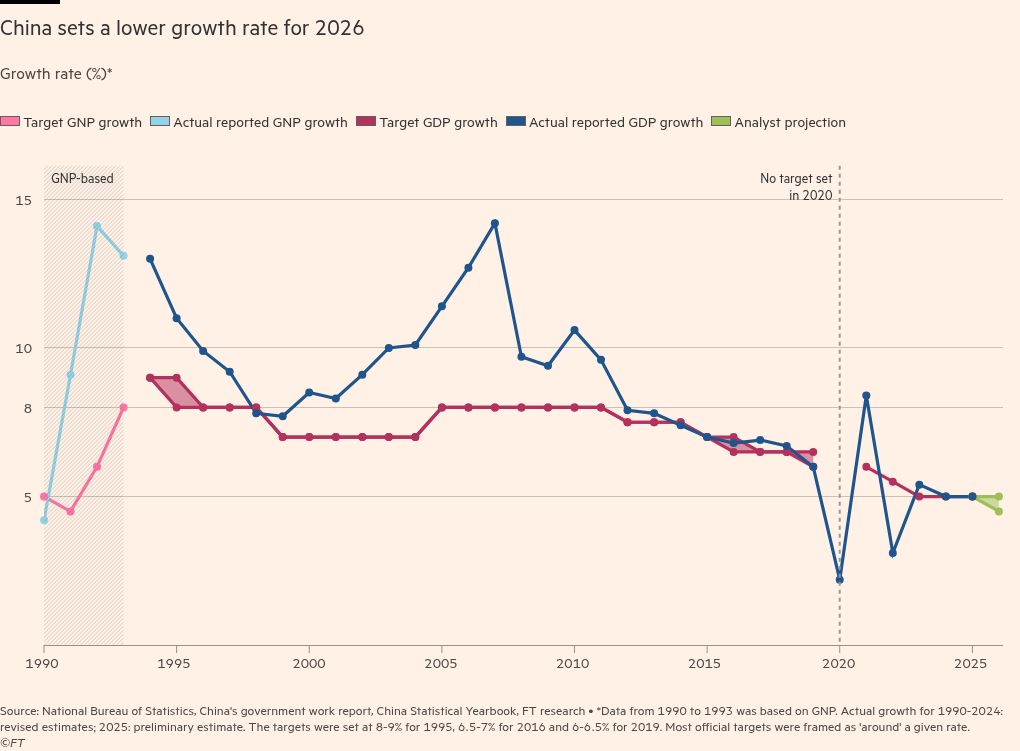
China has set a growth target for GDP this year of between 4.5 and 5 per cent, the lowest range in decades, and maintained a higher fiscal deficit as leaders warned of growing “difficulties and challenges” in the economy.
Announcing national economic targets for 2026, China’s Premier Li Qiang also said defence spending would rise 7 per cent this year, slightly lower than 7.2 per cent a year ago but still significantly outpacing overall fiscal expenditure as he warned against Taiwan “independence”.
The figures were released at the opening of the annual session of China’s rubber-stamp parliament in Beijing.
The GDP target, contained in the government’s “work report”, which lays out its goals for the year, represents a modest step down from last year’s goal of “around 5 per cent” and the actual growth of 5 per cent during 2025.
“Geopolitical risks are rising. Global economic momentum remains sluggish, while multilateralism and free trade are under severe threat,” said Li, reading the report in the Great Hall of the People before President Xi Jinping and thousands of delegates from across China.
On the home front, he acknowledged that the property market, which is in a deep downturn, was still “in a period of adjustment”, “the imbalance between strong supply and weak demand is acute” and it was “more challenging for people to secure employment and earn more”.
But he said over the past year, the economy had “proved remarkably resilient”, with China able to diversify its exports and increase spending on research and development.
China is aiming for global technological supremacy in its next five-year plan, which will also be officially released at the parliamentary meeting.
But the country faces severe challenges from a domestic slowdown in its own economy and deteriorating global conditions arising from US President Donald Trump’s trade war and attack on Iran.
“The wider [GDP growth] band provides greater policy flexibility to navigate domestic and external uncertainties,” said Yuhan Zhang, principal economist of the China Center at the Conference Board.
Standard Chartered economist Shuang Ding said the report suggested that the growth target remained the most important performance metric for cadres across China when setting their economic priorities.
The lowering of the range signalled the government would implement less expansionary fiscal policies this year as Beijing targeted its longer-term development goal of reaching “mid-level” developed-economy income by 2035 over short-term growth.
“They may continue to lower the target” in future years, he added, suggesting the 2035 GDP target eventually implied annual growth of 4.2 per cent.
The work report set a fiscal deficit target of 4 per cent for the coming year — the second year running in which Beijing has put it above its preferred level of 3 per cent.
It targeted consumer prices index growth of 2 per cent. This would be a challenge, analysts said, given prolonged deflationary pressures, with CPI nearly flat, producer prices declining and the deflator, the widest measure of prices in the economy, also negative.
But they are also increasingly concerned about weak household sentiment, announcing schemes to try to boost consumer spending.
The work report sharpened its language regarding Taiwan compared with last year. Li vowed to “resolutely crack down on ‘Taiwan independence’ separatist forces, oppose external interference, promote the peaceful development of cross-strait relations and advance the great cause of national reunification”.
Last year, the report contained a reference to opposing “Taiwan independence separatism” and “external interference”.
“Indeed, ‘resolutely cracking down’ is different from that, it indicates that fighting ‘Taiwan independence forces’ has been made a focus of this year’s government work,” said an analyst who has advised Taiwanese politicians on cross-Strait policy.
Beijing formally criminalised speech and behaviour promoting Taiwan independence in 2024 and has since targeted some prominent Taiwanese politicians overseas.
Experts also noted that the work report did not toughen language towards the US ahead of a planned visit by President Donald Trump to Beijing.
“They are separating ‘Taiwan independence forces’ and external forces. The ‘opposition’ to Trump and other countries supporting Taiwan is not described as ‘resolute’,” said the Taiwanese expert. “The attitude towards Trump is clearly more moderate,” said the Taiwanese expert.
Among the delegates attending the NPC, Fan Shenghua, a representative of the wealthy industrialised coastal province of Zhejiang, said the growth target “will definitely be met”.
Fan, who worked in the high-end tea industry, said: “The premium and high-quality products are mainly consumed domestically; we can’t rely on foreign markets for that.”
He added: “We need to strengthen domestic demand. As long as we make our products well and push quality to the highest standard, there will be no problem.”