Unlock the Editor’s Digest for free
Roula Khalaf, Editor of the FT, selects her favourite stories in this weekly newsletter.
Chinese consumers are snapping up Apple’s new iPhones, with a flashy “Hermès orange” premium model going viral and helping reverse a lengthy sales decline in one of the Silicon Valley company’s largest markets.
Chief executive Tim Cook recently touted Apple’s record-breaking iPhone sales in China in the fourth quarter, when revenue jumped 38 per cent year-on-year to $26bn, contributing nearly a fifth of total sales.
Analysts said a design refresh for the iPhone 17 range has reinforced Apple’s status-symbol position in China by making the latest handsets more immediately recognisable as new and high-end.
In particular, a new vivid orange-coloured device has attracted thousands of online posts and videos from fans showing off their new phones since its launch last autumn.
The phone has been dubbed “Hermès orange” for its resemblance to the French luxury brand’s signature hue, though Apple officially calls the tone ‘cosmic orange’.
“It sounds simple, but it’s the external obvious changes to design, which includes the introduction of a shout-out orange colour, that pulled out early upgraders,” said IDC senior research director Nabila Popal.
“I was instantly drawn to the colour — it felt very special, who doesn’t like Hermès orange?” said a model and influencer who goes by the stage name Xiao Mei, in a video posing with her new accessory. “The more I look at it, the more I love it.”
The turnaround in China reverses a roughly three-year sales slump that left investors questioning the tech company’s future in the highly competitive smartphone market where it vies for attention against domestic rivals such as Huawei, Vivo and Xiaomi.
It is a boost to the iPhone-maker which is emerging from a year of tariff risks and AI setbacks that hammered its stock. Strong iPhone demand globally has helped lift Apple’s shares 7 per cent over the past week.
It has also suffered as tensions between Beijing and Washington triggered a top-down drive for Chinese public-sector employees to phase out iPhone usage, and Huawei rolled out a high-end smartphone running on a locally made processor.
Analysts worried that Beijing’s failure to approve Apple’s suite of AI features for local iPhones would hurt sales. But Chinese consumers have instead been wowed by the redesigned casing and finish.
“It’s eye-catching,” said David Qiu, who swapped an old iPhone for the new orange shade. “It’s the newest colour.”
Apple’s base iPhone 17 model has also benefited from government subsidy policies for cheaper phones in China. Consumers receive subsidies of up to Rmb500 ($72) on smartphones priced below Rmb6,000 as part of Beijing’s drive to stimulate the economy.
Bank of America analyst Wamsi Mohan noted that Apple is meanwhile benefiting from comparisons to a lacklustre 2024. The US group’s China sales had contracted for eight of the previous nine quarters, and had not seen consistent growth since 2022.
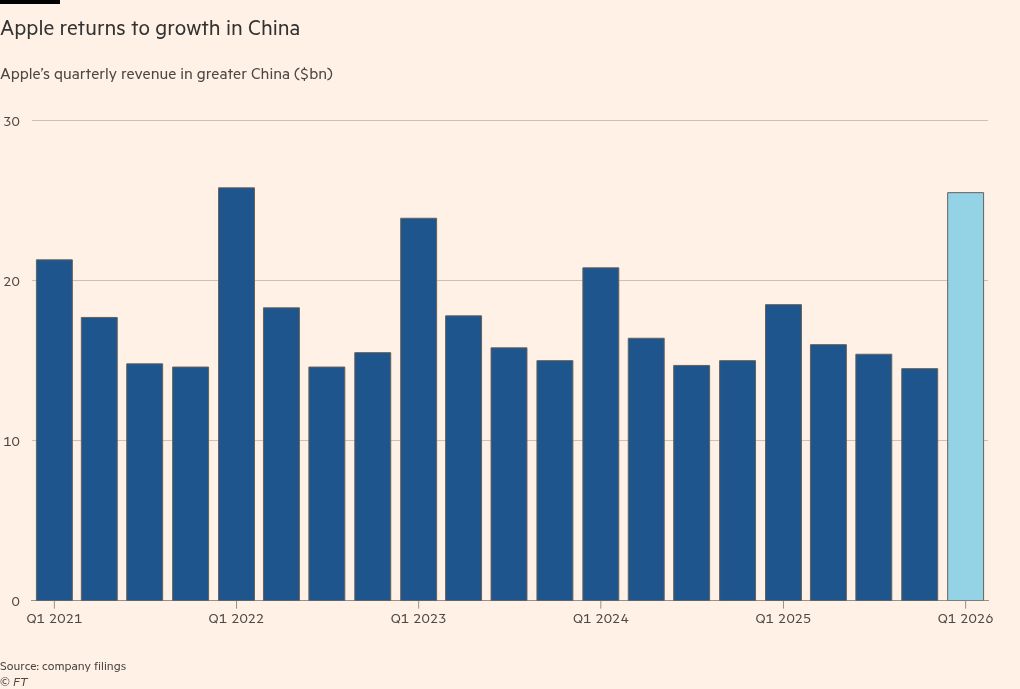
Significant upgrades to the iPhone 17’s cameras, chip, display and battery helped drive an upgrade “supercycle” that comes exactly four years after the company’s last major growth spurt in China in 2021, according to IDC’s Popal.
She added that Apple had also benefited from stumbles on the part of Huawei, which saw its sales decline about 10 per cent in the last quarter amid user complaints about its Harmony operating system.
Buyers of the orange iPhone played up the colour’s association with success, riffing on wordplay in which “orange” sounds like “success” in Mandarin.
“May all your wishes turn orange; may orange come at once,” many purchasers of the new iPhone posted online.
An Liang, a social media influencer who has built a following by flaunting his wealth, said in a recent video: “Picking orange means everyone knows this is the new iPhone 17,” adding: “I’m just a badass.”
Nian Liu contributed reporting from Shanghai