China’s military has accused its top general of undermining the command authority of Xi Jinping, suggesting that ensuring the powers of the Chinese leader is behind a probe of Zhang Youxia announced on Saturday, rather than just charges of corruption.
Zhang, vice chair of the Central Military Commission, and Liu Zhenli, another CMC member and the People’s Liberation Army’s chief of staff, had “severely trampled on and damaged the chairman responsibility system”, the military’s official newspaper PLA Daily said in an editorial published on Sunday.
Under the Chinese constitution, the leader of the state and Chinese Communist Party (CCP) chairs the CMC and has supreme decision-making power over the military. This “chairman responsibility system” is designed to secure the party’s absolute control over the armed forces.
The PLA mouthpiece’s editorial said the two generals had “seriously abetted political and corruption problems that affect the [Communist] party’s absolute leadership over the military and endanger the foundation of the party’s rule”.
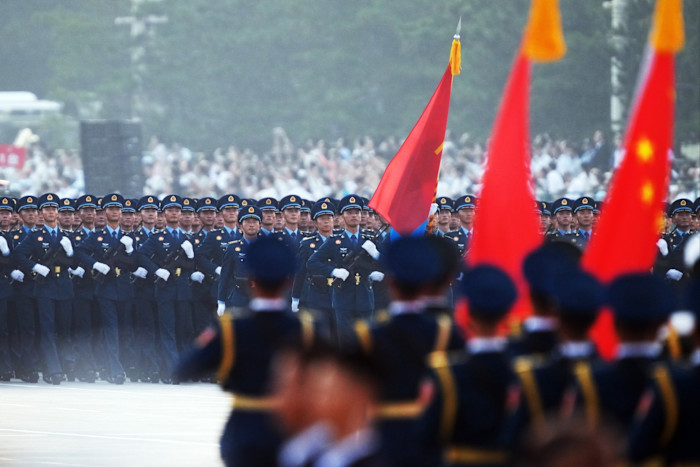
The comments highlight the crucial importance of the PLA for Xi in his expected quest for a fourth term, which the party would have to confirm at its next congress, due in 2027.
Since the party seized power through civil war and most of its founders fought in those battles, it regards control over the armed forces as indispensable.
“The military is the only organisation in China that has a history of defying party leaders,” said Dennis Wilder, an expert on the Chinese military and former head of China analysis at the CIA, citing criticism of Mao Zedong’s policies by then defence minister Peng Dehuai in 1959 and a 1971 alleged coup attempt against Mao by top general Lin Biao.
Wilder said that after Zhang had won a fight with He Weidong, the second vice CMC chair and member of a rival faction who was purged last year, “Xi probably feared that […] Zhang was all powerful in the military. Presuming that Xi wants a fourth term in office, he would have to fear that Zhang could lead an effort within the Party to oust him”.
According to a defence ministry statement issued on Saturday, Zhang and Liu are being investigated for “serious discipline violations and violations of the law”, Communist Party code for corruption that is also commonly used in political purges.
The announcement shocked many observers. Zhang had been seen as a close confidant of Xi, whose seniority and combat experience made him crucial to the Chinese leader’s implementation of reforms to turn the PLA into a world-class force on par with the US military.
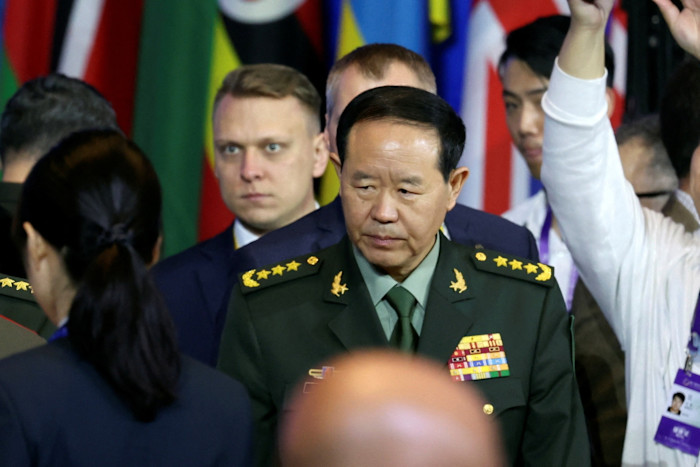
The probe of Zhang and Liu has hollowed out the CMC, leaving Zhang Shengmin, a political commissar in charge of investigating corruption, as the only active member besides Xi.
Lyle Morris, an expert on the PLA at the Asia Society Policy Institute, said references to violations of the chairman responsibility system suggested that Zhang Youxia had too much power independent of Xi himself.
“The PLA and Xi have emphasised the [chairman responsibility system] in recent years as the central tenet of PLA discipline. So, highlighting such a violation suggests that Zhang was out of step with Xi’s chain of command,” Morris added.
James Char, an assistant professor at Singapore’s S Rajaratnam School of International Studies who has been tracking Xi’s PLA purges for a decade, said: “I very much doubt that Zhang Youxia or anyone else in the regime would have had the temerity to engage in open confrontation against Xi Jinping.”
But he added Zhang’s fall could be related to factional politics and “mountaintop-ism”, a habit of regional leaders to build their own power bases, which has plagued the party since its guerrilla days.
The “Shaanxi Gang” headed by Zhang and the “Fujian Clique” to which He and other now-purged members belonged were rivals within the CMC.
“It does not make sense that Xi only remove the leader of one group but not the other. What he has now done helps ensure no particular faction grows too powerful,” said Char.
“Zhang should have seen this day coming,” he added, pointing to a previous wave of probes into corruption in the PLA’s arms development and procurement system, which Zhang had headed until 2017.
Ja Ian Chong, associate professor of political science at National University of Singapore, said that while Zhang’s arrest sparked speculation about plots against Xi, there was no corroborating evidence that he was under any imminent threat.
It was clear that “Xi continues to have significant reach and remains unopposed or at least impossible to oppose within the system,” Chong said. “This extends to princelings formerly seen as untouchable and people reputed to be close with him.”
One way to try to understand how disruptive the Zhang arrest might be to the Chinese system would be to see whether it caused delays to important meetings and the official agenda in the coming weeks, Chong said.
Morris said the fact that Xi undertook such a dramatic move suggested that he had the full support of the party and was confident he had consolidated power over the military.
“It’s not a sign of weakness, but of strength, for Xi,” said Morris. “There will presumably be backlash from Zhang’s power base against Xi. In some eras of Chinese history, this would lead to coup concerns. But Xi felt confident in his grip on power to withstand such backlash.”