Much analysis of Xi Jinping paints the Chinese president as a great disrupter, someone who has tossed out the rules of the game to maintain power at home and challenge the west head-on abroad.
This makes sense in some respects. After all, in 2018 Xi brushed aside the emerging norm in China that communist party leaders should stick to two five-year terms, in effect leaving him in office in perpetuity.
On foreign policy, he has confronted the US like no other Chinese leader and entrenched Beijing’s interests in global bodies such as the United Nations, while building institutions with rival values alongside them. China’s size and its rapid economic growth over more than four decades would alone have made the country a globally disruptive force, no matter who was in charge in Beijing.
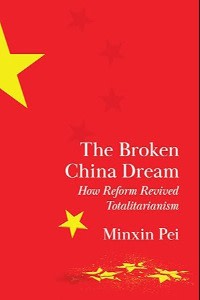
But as the political scientist Minxin Pei convincingly argues in his new book, The Broken China Dream, it is more accurate to see Xi as part of a communist continuum rather than radical change. More to the point, the focus on change in China distracted attention from what stayed the same — the ruling party’s absolute determination to remain in power, and the fact that it never relinquished the tools to do so.
“In retrospect, the relative ease with which Xi could turn back the clock and restore a form of totalitarian rule few had thought would be possible was not a random outcome of Chinese history in the post-Mao era,” writes Pei.
If this analysis is right, the chances of democratic political reform in China remain just as dim in the future as they were in the past. Indeed, the Chinese leadership’s confidence in their system has only hardened over time.
Pei’s book covers China from the launch of the reform era in the late 1970s, when the leadership headed by Deng Xiaoping embraced market forces to snap the country’s economy and society out of its Maoist torpor, until the present day.
Deng is often seen solely as an economic reformer. But he also introduced rules for political reform, to prevent the emergence of another Mao Zedong, China’s revolutionary leader who unleashed multiple, deadly political campaigns and drove the economy into the ground.
It is remarkable to read Deng’s 1980 speech on political reform today. In it he attacks all the tenets of Mao’s rule that Xi has replicated — the concentration of power in a single leader, life-long tenure at the top and the nurturing of personality cults.
Authoritarian states, including China, have traditionally struggled with peaceful transfers of power. In the late 1980s, Deng himself had two leaders removed, Hu Yaobang and Zhao Ziyang. (Deng’s rules didn’t apply to himself.)
But after his system took hold in the early 1990s, China enjoyed remarkable political stability, transitioning from Jiang Zemin to Hu Jintao and then to Xi Jinping in 2012, all while the economy boomed.
Some of Deng’s directives have endured, notably the system of retirement ages, which means that no one aside from the head of the party can stay in office for long beyond prescribed limits. But the most important rules, on term limits and an over-concentration of powers at the very top, were easily swept aside by Xi. Much as the gnarly Captain Barbossa explained the “Pirate’s Code” in Pirates of the Caribbean, Deng’s diktats turned out to be “what you’d call guidelines rather than actual rules”.
Deng’s political reforms relied entirely on the force of his political personality. But as a good communist, he refused to put in place any institutions independent of the party to enforce them.
So while Deng bequeathed the rules to the Chinese system, he also left them vulnerable to removal. Once another powerful leader like Xi arrived, they were easily swept aside.
Xi has used multiple tools to enforce his singular power — an anti-corruption campaign to take down rivals, increased surveillance, ideological enforcement and an ever-present enemy in the US, always useful to mobilise the system.
All the levers were there. Xi only had to pull them.
Deng and Xi are held up by many analysts, inside and outside of China, as very different leaders. On closer examination, “the discontinuities are superficial and the continuities between the two are fundamental”, argues Pei. “Both are hardcore Leninists who regard preservation of the party’s monopoly of power as the overriding objective of their rule.”
If there is a difference, it might be that Xi has a more socialist view of the economy. But that might also be because he runs a country that is much more unequal than it was in Deng’s day.
Pei describes the journey from the Deng to the Xi era as one from neo-authoritarianism to “neo-Stalinism”, a kind of digital totalitarianism with Chinese characteristics. I wonder, though, whether neo-Stalinism really captures China today.
Take the private sector. Yes, Xi has cracked down on entrepreneurs, especially digital giants such as Alibaba. His aim, as ever, was to erase any emerging centres of power not subservient to his agenda.
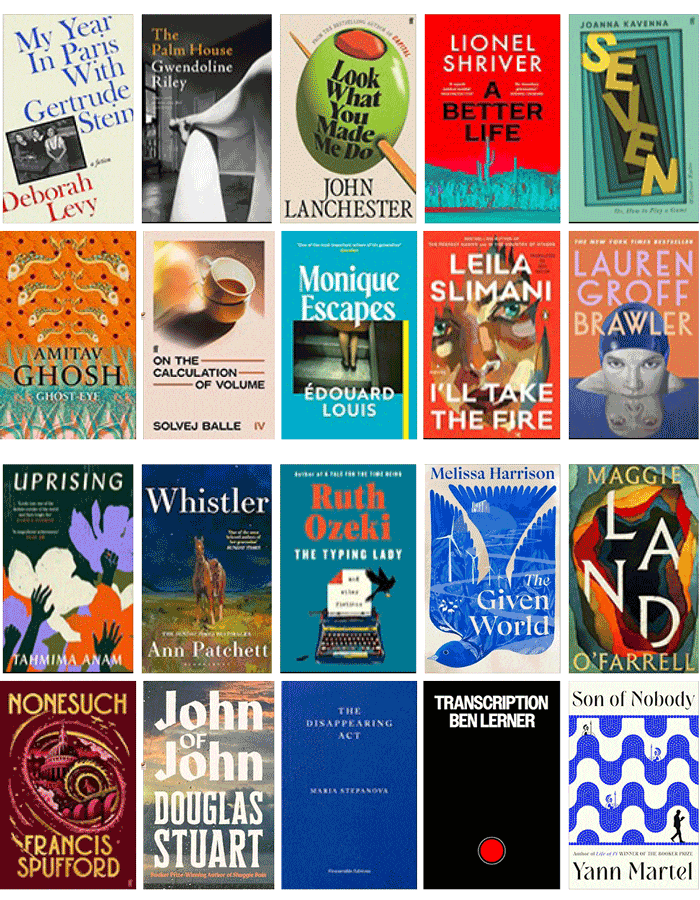
New reading for 2026
Books from Amitav Ghosh, Maggie O’Farrell, John Lanchester and others — here are some of the top titles of the year ahead
But Xi has hardly squelched the private economy in the process, as many argue and Pei implies. Look at the economic frontiers that China dominates — in electric vehicles, batteries, solar power and the like — and in which it is competitive, such as AI. China’s global champions, like BYD (cars) and CATL (batteries), are all private. DeepSeek, China’s AI pioneer, also rose largely on its own.
Chinese private companies have benefited from subsidies and protection. They can be closed at any time by the state, as they don’t enjoy any real legal protection. But they are also highly innovative, globally competitive and enormously useful to Xi’s agenda. Stalinism never enjoyed anything like it.
Pei is right to see Xi as a leader in the traditions of Chinese communism. But whether Xi “is failing more than he is succeeding” in building China into a global superpower is far from clear, and, in any case, can only be judged in relative terms, in comparison to Donald Trump’s America. On that score, Xi is doing exceedingly well.
The Broken China Dream: How Reform Revived Totalitarianism by Minxin Pei Princeton £35/$29.95, 344 pages
Richard McGregor is a senior fellow for east Asia at the Lowy Institute in Sydney and author of ‘The Party: The Secret World of China’s Communist Rulers’
Join our online book group on Facebook at FT Books Café and follow FT Weekend on Instagram, Bluesky and X