Unlock the Editor’s Digest for free
Roula Khalaf, Editor of the FT, selects her favourite stories in this weekly newsletter.
The EU has proposed giving WTO members more freedom to raise tariffs, in the bloc’s boldest move yet to deal with a creaking multilateral trade order.
Proposals to abandon the “most favoured nation” (MFN) principle, under which WTO members must treat one another equally, marks a dramatic shift in Brussels’ approach, as it has long defended the idea.
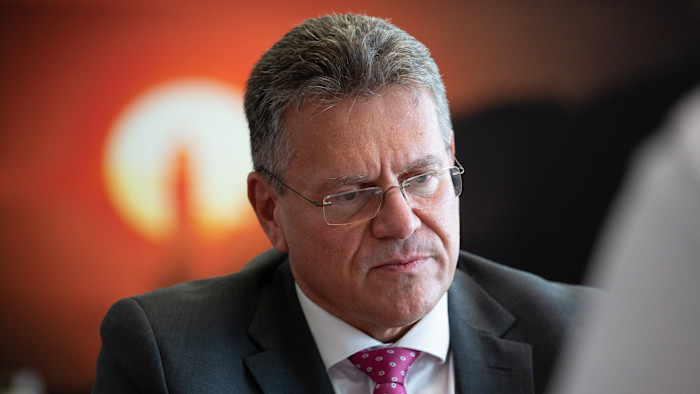
“We need a frank discussion on the link between MFN status and reciprocity, taking into account members’ actual levels of market openness, their commitment to fair competition and transparency, and their evolving weight in global trade,” Maroš Šefčovič, the EU’s trade commissioner, wrote in a piece for the FT.
His intervention came ahead of a meeting of trade ministers at the World Economic Forum in Davos on Thursday to discuss how to reform the WTO, which will hold its annual ministerial meeting in Cameroon in March.
Šefčovič’s criticism of the principle in an era of increasing unilateralism in world trade, led by US President Donald Trump, follows a declaration by the US last month that the “era had passed” for MFN.
EU officials said that Šefčovič was merely trying to “start a conversation” about how the MFN system could survive in an era where so many big players in world trade, including China, India and the US, were not providing equal access to their markets.
Šefčovič said WTO members should be able to change tariff levels more easily to deal with “threats to our economies”.
“Access to lower tariffs cannot be unconditional: it must be earned through stronger, credible commitments to the core principles of free and fair trade,” he wrote.
However a senior Pacific-region trade envoy said Šefčovič’s words amounted to a “kick in the guts” for the MFN principle. “Regardless of how it is dressed up, this is the end of MFN for the EU,” they said.
“The clever drafting doesn’t conceal the fact that the EU has changed its mind about MFN. The suggested adaptations do not save the concept — on the contrary they make it meaningless.”
While Šefčovič did not name China specifically, he criticised state intervention and subsidies, tools used by Beijing to corner almost a third of the world’s manufacturing output.
“To ensure fairness, we need to address asymmetries among members in market openness and commitment to fair competition,” he said.
Šefčovič questioned whether MFN has “genuinely fostered openness and a level playing field” or is a “straitjacket that . . . enables free riding”.
“If the WTO is to meet today’s challenges, its rules must be fair and deliver balanced, legitimate outcomes. Today, they do neither.”
His criticism echoes that of the US, which claims China blocks imports with government procurement policies that favour locally made products while using subsidies to rapidly grow exports. Its trade surplus with the world has just topped €1tn.
“Over the past three decades, several WTO members have dramatically expanded their share of global trade while keeping their markets largely closed,” Šefčovič said.
“At the same time, state support for industries and other non-market policies have multiplied, distorting competition on a global scale. The result has been structural trade imbalances and chronic overcapacities, with damaging effects on both developed and developing economies.”
While Trump has raised bilateral tariffs and placed export controls on sensitive goods, Brussels has continued to use WTO processes to deal with Beijing.
It has taken dozens of trade defence actions, increasing tariffs on China or cutting quotas, in accordance with the body’s rule but imports of Chinese goods have continued to grow while EU exports have fallen.
China joined the WTO in 2000 and now accounts for about 16 per cent of world merchandise trade. But it retains “developing country” status, which allows it to avoid some open trade commitments. It has voluntarily declined to exercise the status for non-agricultural trade but not relinquished it.
In the wake of Trump’s tariff war, China has sought to paint itself as a defender of the multilateral order and a pillar of world trade, denying that its subsidies create overcapacity even as its surpluses have surged and domestic demand sagged.
“[China’s] commitment to upholding the multilateral trading system will provide foreign companies with stable expectations for operations in China,” Ling Ji, vice-minister of commerce, said at a function for foreign investors in Beijing this week, according to China’s official media.
Šefčovič said that developing countries should be treated “with a more targeted, needs-based approach”. The EU already provides tariff-free access for most products from the poorest countries.
Additional reporting by Joe Leahy in Beijing